CrossingAnthropology
Amerindian perspectivism + enactivism
Amazonian ethnography and biology each tie a being's world to its body, and they disagree about what different bodies share.
- IdeaAmerindian perspectivismMany Amazonian peoples hold that animals and spirits see themselves as human, so beings share one culture and differ in the worlds their bodies reveal.Anthropology
- School or branchEnactivismA school holding that mind is the activity of a living body making sense of its surroundings, with no inner model of a ready-made world.Cognitive science & linguistics
What each entry sees
Amerindian perspectivism
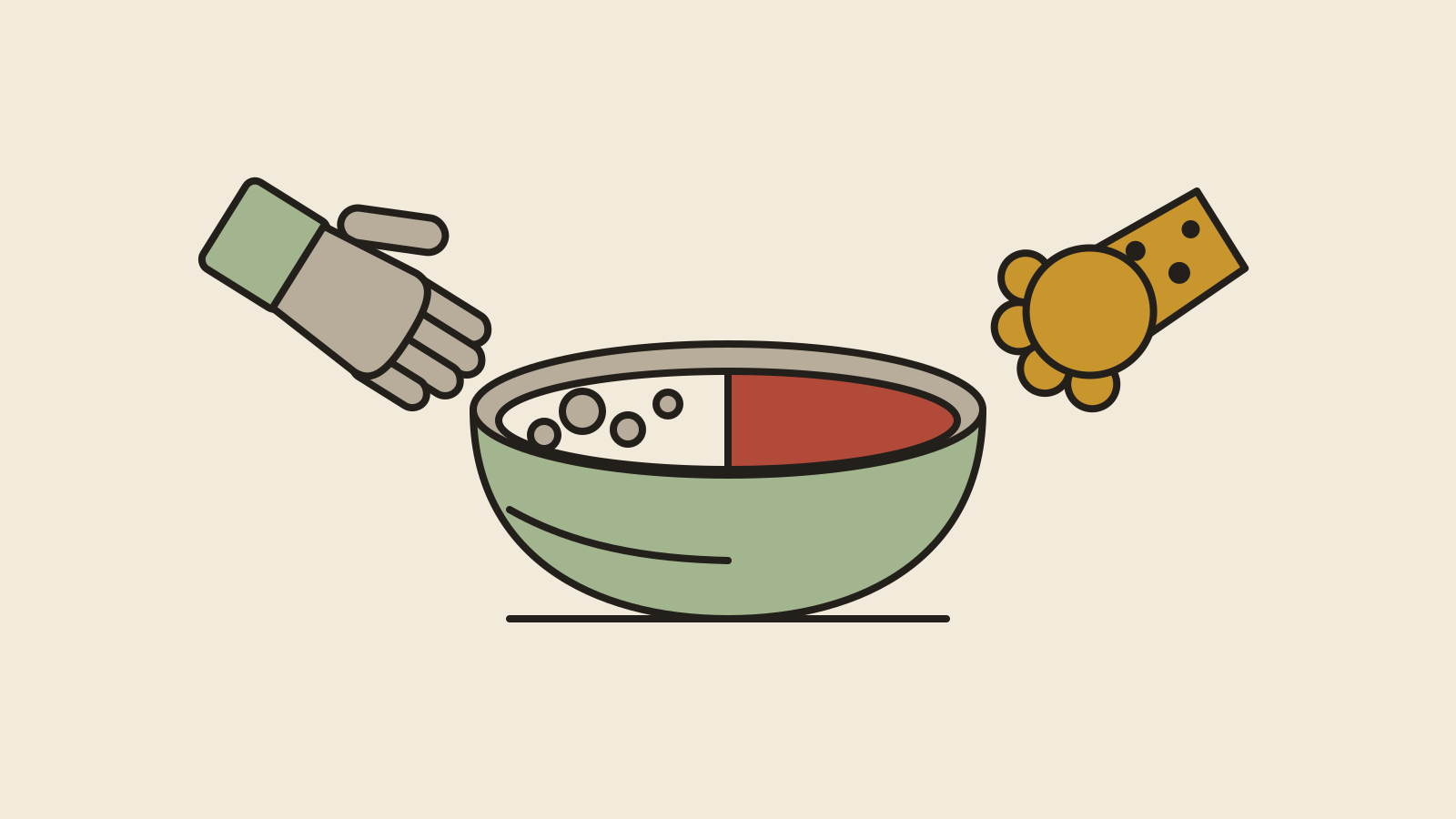
Amerindian perspectivism is Eduardo Viveiros de Castro's account of how many Amazonian peoples understand other beings. Jaguars, peccaries and spirits each see themselves as persons living a human life, with houses and manioc beer. What counts as beer depends on the body doing the seeing, so to a jaguar blood is beer. All beings share one culture and differ in the natures their bodies reveal. The theory is an anthropologist's synthesis, and specialists remain divided over how well it reads the record.
Amerindian perspectivism
Many Amazonian peoples hold that animals and spirits see themselves as human, so beings share one culture and differ in the worlds their bodies reveal.
Eduardo Viveiros de Castro
Brazilian anthropologist of Amazonia whose theory of perspectivism treats Indigenous thought as philosophy and helped launch the ontological turn.
Enactivism
Enactivism holds that mind is the activity of a living body making sense of its surroundings. A creature builds no inner model of a ready-made world and instead brings forth a world of things that matter to it through its history of acting and perceiving. You cross a crowded hawker centre with a full tray by looking and sidestepping, without mapping every stool first. The school began in 1991 with Francisco Varela and two colleagues. Its central claims remain contested.
Enactivism
A school holding that mind is the activity of a living body making sense of its surroundings, with no inner model of a ready-made world.
Francisco Varela
Chilean biologist who defined life as self-production and argued that mind is the activity of a living body, not a model in the brain.
Diagram
Amerindian perspectivism + enactivism
Read as text
Overlap of Amerindian perspectivism (Idea, Anthropology) and Enactivism (School or branch, Cognitive science & linguistics). Only Amerindian perspectivism: Animism and Claude Lévi-Strauss. Only Enactivism: Autopoiesis and Computational theory of mind. Shared: The question it opens.
What the crossing shows
Both reject one picture: a single finished world out there, with many minds forming opinions of it. Both put the body where that picture puts the mind. A jaguar's appetites give it beer where a human finds blood. An organism's needs make some surroundings food and some danger.
The differences are as plain. Perspectivism reports what people say about jaguars and spirits, and it stands or falls as a reading of ethnography. Enactivism is a claim about organisms, argued from biology and experiment. In the Amazonian accounts every kind of being has the same soul and the same social life, and only bodies differ. Enactivists posit no culture shared across species and hold instead that a basic form of cognition reaches down to the simplest living things. A shaman can also take up another kind's view and come back to report it, and enactive theory has no place for that.
The question it opens
Is perspectivism an enactive theory of mind stated as cosmology? The fit is loose, because spirits have no living body and no enactivist claims that a bacterium sees itself as human. A stricter test would ask whether everyday hunting talk, and not only myth and shamans' reports, treats what an animal perceives as fixed by what its body can do. Critics of perspectivism say that everyday talk is where its evidence is thinnest.
Further reading
- Thompson, E. (2007). Mind in life: Biology, phenomenology, and the sciences of mind. Harvard University Press.
- Turner, T. S. (2009). The crisis of late structuralism. Perspectivism and animism: Rethinking culture, nature, spirit, and bodiliness. Tipití: Journal of the Society for the Anthropology of Lowland South America, 7(1), 3–42. https://doi.org/10.70845/2572-3626.1098
- Varela, F. J., Thompson, E., & Rosch, E. (1991). The embodied mind: Cognitive science and human experience. MIT Press. https://doi.org/10.7551/mitpress/6730.001.0001
- Viveiros de Castro, E. (1998). Cosmological deixis and Amerindian perspectivism. The Journal of the Royal Anthropological Institute, 4(3), 469–488. https://doi.org/10.2307/3034157
Cite this entry
Scholia. (2026). Amerindian perspectivism + enactivism. In Scholia: Notes in the margin of the human sciences. Retrieved November 28, 2026, from https://scholia.zennia.sg/crossings/amerindian-perspectivism-plus-enactivism