IdeaSociologyAlso in Philosophy, Psychology, Economics
Alienation
Marx's claim that capitalism separates workers from what they make, from the work itself, from one another and from their own human capacities.
The idea
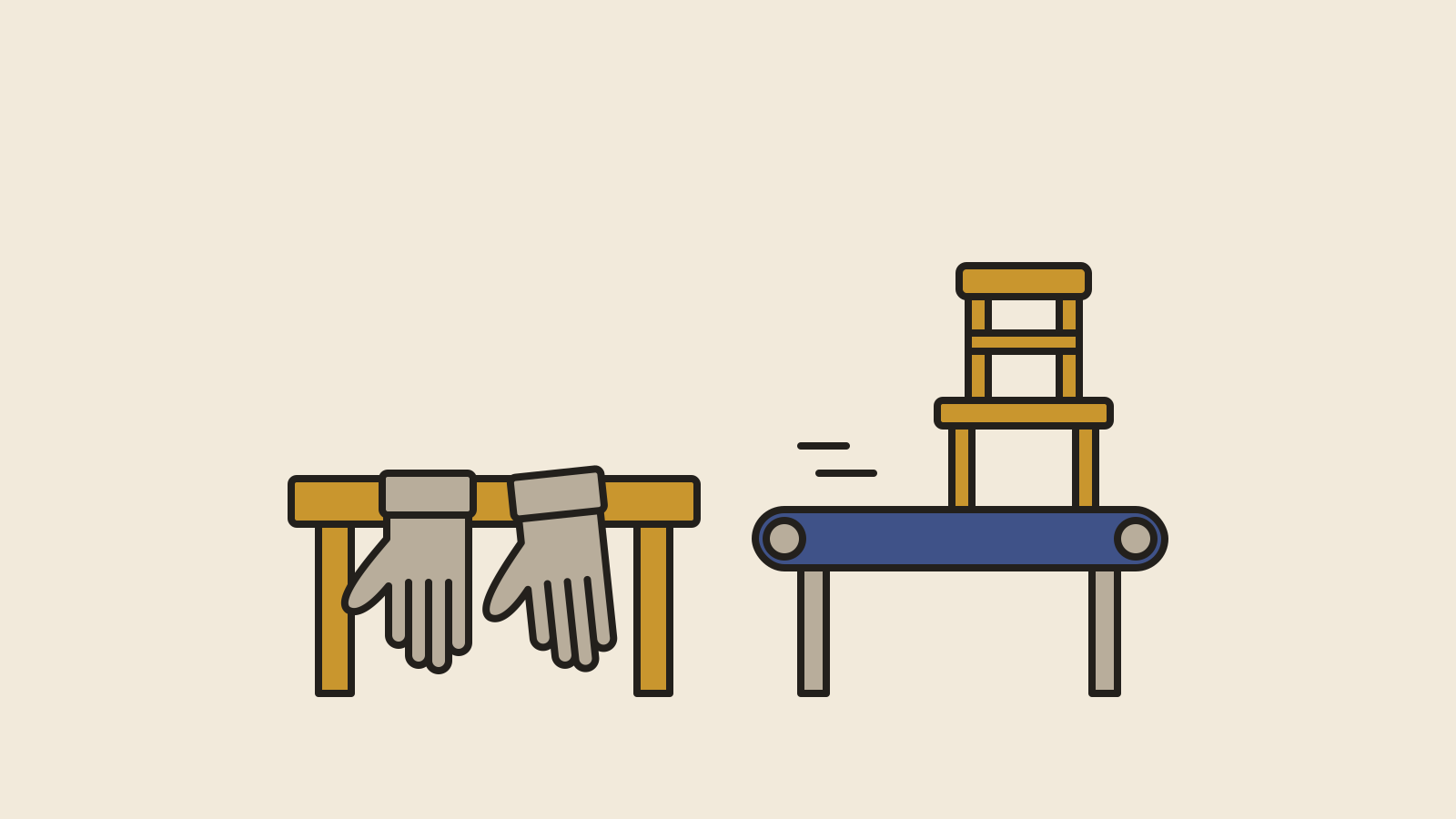
Marx's claim is that work under capitalism separates people from things that ought to be theirs. For him, making things freely and for one another is what humans are for. When a person sells their capacity to work, an employer decides what gets made, how and for whom. The product leaves the maker's hands as someone else's property, and the working day becomes a cost to be endured for the sake of the evening.
Picture a warehouse picker whose handheld scanner sets each route and times each item. The work is done competently and none of it is the worker's own: the pace, the method and the goods all belong to someone else. Marx would call this person alienated however they feel on a given day. The term describes a relation between people and their labour. Feeling flat or detached is one possible result of that relation.
Diagram
Marx described four separations that follow from alienated labour
Read as text
A tree with alienated labour at the root and four branches. The worker is separated from the product, which belongs to the employer. The worker is separated from the activity of working, which others direct. The worker is separated from human nature, which Marx called species-being. The worker is separated from other people.
Key features
- Workers are separated from the product, which belongs to the employer and returns to face them as capital.
- They are separated from the activity, which is directed by others and done only to earn a living.
- They are separated from their human nature, which Marx called species-being: the capacity for free, conscious and creative work.
- They are separated from other people, who appear as rivals or as means to an end.
- The cause is the organisation of production, so a better attitude or a pay rise cannot remove it.
Not to be confused with
| Look-alike | The difference | Differs on |
|---|---|---|
| Anomie | Durkheim's anomie comes from too little regulation: rules lag behind change and desires lose their limits. Alienation comes from the way work is owned and directed, and can be worst where rules are tightest. | Differs onMechanism |
| Emotional labour | Arlie Hochschild's term covers jobs that require workers to produce feelings to order, as cabin crew do. She presented it as one case of alienation, in which the thing taken from the worker is a smile. | Differs onScope |
| Exploitation | In Marx, exploitation is a claim about quantity: workers produce more value than they are paid. Alienation is a claim about the quality of work and life. A well-paid worker can be alienated. | Differs onClaim |
| Commodity fetishism | Marx's later idea that goods seem to have value in themselves, which hides the labour behind them. It concerns how a market economy appears. Alienation concerns what work does to the worker. | Differs onScope |
- Differs onMechanism
Durkheim's anomie comes from too little regulation: rules lag behind change and desires lose their limits. Alienation comes from the way work is owned and directed, and can be worst where rules are tightest.
- Differs onScope
Arlie Hochschild's term covers jobs that require workers to produce feelings to order, as cabin crew do. She presented it as one case of alienation, in which the thing taken from the worker is a smile.
- Differs onClaim
Exploitation
In Marx, exploitation is a claim about quantity: workers produce more value than they are paid. Alienation is a claim about the quality of work and life. A well-paid worker can be alienated.
- Differs onScope
Commodity fetishism
Marx's later idea that goods seem to have value in themselves, which hides the labour behind them. It concerns how a market economy appears. Alienation concerns what work does to the worker.
Origins and development
Marx took the word from Hegel, for whom spirit becomes estranged from its own creations, and from Ludwig Feuerbach, who said humans project their own powers onto God. In notebooks written in Paris in 1844 he moved the idea to the workshop. The notebooks were published only in 1932, and they reshaped how Marx was read. In 1959 Melvin Seeman turned alienation into five measurable feelings, and in 1964 Robert Blauner compared it across industries.
Why it matters
The idea lies behind most talk of meaningless jobs, burnout and disengagement at work. It shaped experiments in job redesign and industrial democracy in the 1970s, and it has returned in debates about gig platforms and management by algorithm. It also supplies a test that differs from pay: who decides what is made, and how.
Critiques and limits
Louis Althusser argued that alienation belongs to a young, humanist Marx who later dropped it for a science of economic structures. Others doubt the premise. The idea needs an account of the human nature from which workers are estranged, and anti-humanist critics such as Michel Foucault denied that any such essence exists. Blauner's surveys complicated matters, since alienation varied with technology inside capitalism. The claim is interpretive: it rests on argument and reading of cases, which no single study could settle.
Connections
Belongs to
MarxismPolitical theory & science
Alienation is the humanist strand of Marxism, the part concerned with what capitalism does to people.
Originated by
Marx set out the four forms of alienated labour in notebooks written in Paris in 1844.
Influenced by
G. W. F. HegelPhilosophy
Hegel described spirit becoming estranged from its own creations, and Marx moved that story into the workshop.
Critiques
Classical economicsEconomics
Marx charged the political economists with treating private property and wage labour as natural facts needing no explanation.
Division of labourEconomics
Marx granted that dividing tasks multiplies output and argued that it does so by narrowing each worker to a fragment of a person.
Contrasts with
Differs on mechanism. Anomie comes from too little regulation, alienation from the way work is owned and directed.
Differs on scope. Hochschild's emotional labour is one case of alienation, in which the worker's managed feelings are the product.
Applied in
Blauner and later researchers compared alienation across industries and technologies to guide job design.
Influenced
Hochschild's flight attendants, estranged from their own smiles, carry Marx's alienation from the factory hand to managed feeling.
Cross with
Two distant entries to read beside this one, each with the question the pairing opens.
Original affluent societyAnthropology
Sahlins's foragers worked few hours and wanted little: does alienation begin with wage labour, or earlier, with wants that outrun needs? Set them side by side
Intrinsic and extrinsic motivationPsychology
Is alienated labour what psychologists would measure as work done only for extrinsic reward, or does Marx's claim add something no motivation scale captures? Set them side by side
Further reading
- Blauner, R. (1964). Alienation and freedom: The factory worker and his industry. University of Chicago Press.
- Leopold, D. (2022). Alienation. Stanford Encyclopedia of Philosophy. https://plato.stanford.edu/entries/alienation/
- Marx, K. (1964). Economic and philosophic manuscripts of 1844. International Publishers. (Original work published 1932)
- Ollman, B. (1971). Alienation: Marx's conception of man in capitalist society. Cambridge University Press.
Cite this entry
Scholia. (2026). Alienation. In Scholia: Notes in the margin of the human sciences. Retrieved November 28, 2026, from https://scholia.zennia.sg/ideas/alienation-marx