IdeaAnthropologyAlso in Political theory & science
Band, tribe, chiefdom, state
Elman Service's four-part classification of societies by political organisation, from small egalitarian bands to centralised states.
The idea
In 1962 the American anthropologist Elman Service proposed that human societies come in four political types. A band is a few dozen foragers, related by kinship, with no leader who can give orders. A tribe is larger, usually farmers or herders, held together by clans or age groups but still without a ruler. A chiefdom has a permanent office of chief, ranked families and a centre that collects goods and hands them out. A state has a government with officials, taxes and a monopoly on legitimate force.
The types differ in how decisions get made. A group of friends choosing a restaurant works like a band: people talk until nobody objects. A large company with departments, managers and rule books works more like a state. Service also read the four as a sequence that societies had moved through over time. That second claim is the disputed one.
Diagram
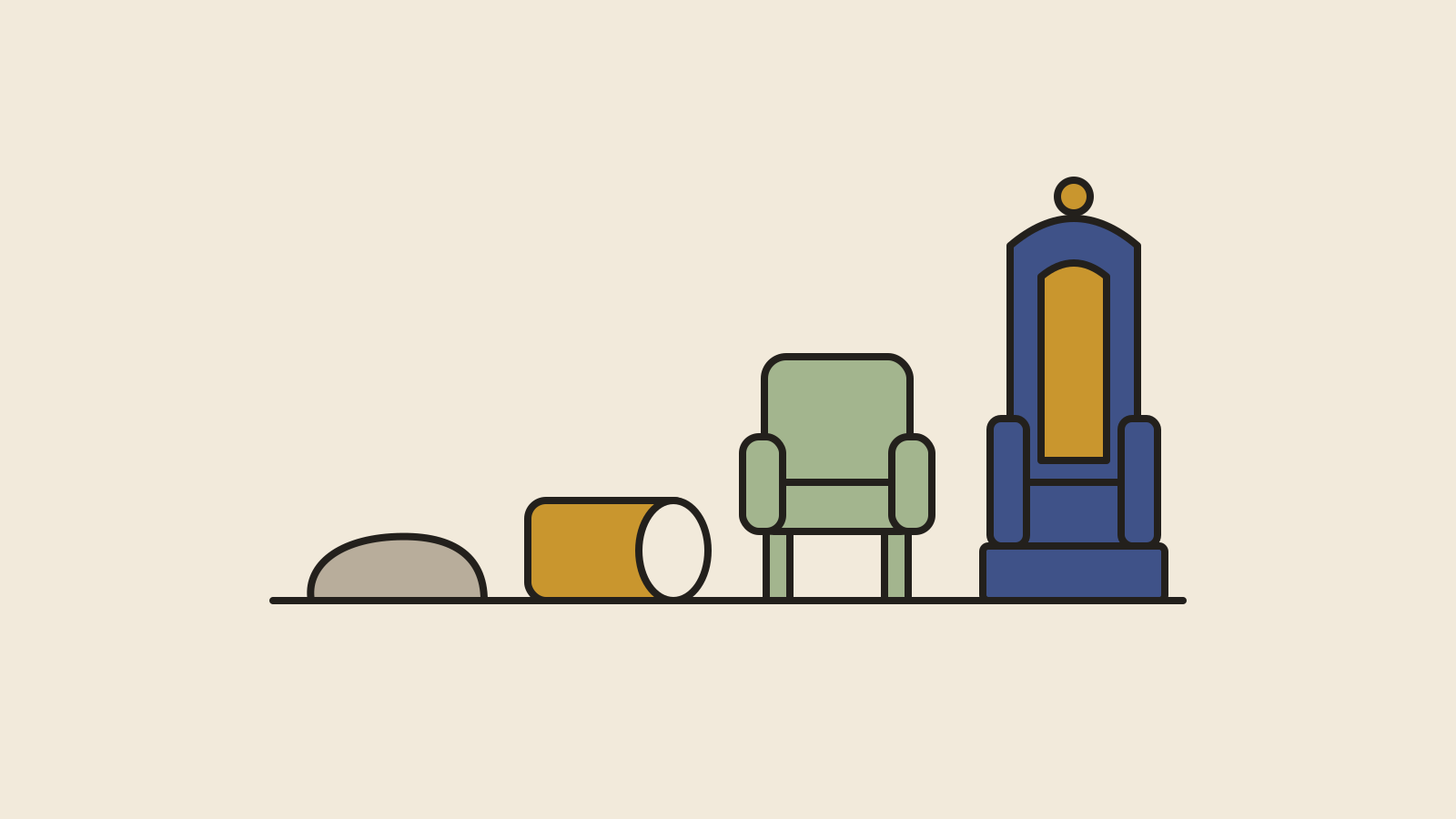
Service's four types run from small and equal to large and centralised
Read as text
A line running from small and egalitarian on the left to large and centralised on the right, with four positions marked. Band sits at the far left, then tribe, then chiefdom, with state at the far right. The line shows how the four types are classified. It does not show that every society moves along it in order.
Key features
- Bands and tribes are egalitarian. Influence comes from age, skill or persuasion, and nobody can command.
- Tribal leaders are often "big men" who earn a following by generosity and lose it when the giving stops.
- Chiefdoms make rank hereditary, and the chief redistributes food and goods collected from followers.
- States add social classes, full-time officials and the power to tax, conscript and punish.
- Each step brings a larger population, denser settlement and more inequality.
Not to be confused with
| Look-alike | The difference | Differs on |
|---|---|---|
| Cultural evolutionism | Nineteenth-century evolutionists such as Lewis Henry Morgan ranked peoples from savagery to civilisation and took the ranking as moral progress. Service classified by political organisation and claimed growing complexity, with no judgement that later is better. | Differs onClaim |
| The state | The state is the last of the four types and the only one most political theory discusses. The typology's point is that three other ways of organising power came first and lasted far longer. | Differs onScope |
| Fried's stages | Morton Fried's rival scheme of 1967 sorts societies as egalitarian, ranked, stratified or state. His test is unequal access to prestige and resources. Service's test is how a society is held together. | Differs onStandard of judgement |
| Stateless society | A catch-all for any society without a state. Service's scheme divides that category into three distinct kinds. | Differs onScope |
- Differs onClaim
Nineteenth-century evolutionists such as Lewis Henry Morgan ranked peoples from savagery to civilisation and took the ranking as moral progress. Service classified by political organisation and claimed growing complexity, with no judgement that later is better.
- Differs onScope
The state is the last of the four types and the only one most political theory discusses. The typology's point is that three other ways of organising power came first and lasted far longer.
- Differs onStandard of judgement
Fried's stages
Morton Fried's rival scheme of 1967 sorts societies as egalitarian, ranked, stratified or state. His test is unequal access to prestige and resources. Service's test is how a society is held together.
- Differs onScope
Stateless society
A catch-all for any society without a state. Service's scheme divides that category into three distinct kinds.
Origins and development
Service set out the scheme in Primitive Social Organization (1962). He belonged to a group of American neo-evolutionists who drew on Leslie White and Julian Steward and revived the study of long-run social change after decades of neglect. The chiefdom took its name from Kalervo Oberg and its defining feature, redistribution, from Karl Polanyi. Archaeologists adopted the four types quickly, since they offered a way to label sites by their size and monuments. Service himself later dropped the scheme, doubting "tribe" most of all.
Karl Polanyi
Hungarian economic historian who argued that markets were always embedded in society until the nineteenth century tried, at great cost, to set them free.
Why it matters
The four words appear in almost every introductory textbook and in popular histories by writers such as Jared Diamond. They shape how museum labels, documentaries and news reports describe societies past and present. The scheme also frames one of the largest questions in social science: why people who governed themselves for most of human history came to live under rulers.
Critiques and limits
Morton Fried argued that tribes are no natural stage, and that many formed in reaction to states and empires pressing on them. Archaeologists including Norman Yoffee object that the scheme forces varied societies into boxes and implies one ladder that all must climb. David Graeber and David Wengrow point to peoples who shifted between forms by season. The types survive as rough description. As a sequence of stages the scheme is contested, and many specialists have abandoned it.
Connections
Belongs to
Political and legal anthropology
It is the branch's best-known classification of political systems.
Extends
Service revived the evolutionists' idea of stages but ranked societies by political organisation, with no scale of moral progress.
Influenced by
Karl PolanyiSociology
Service defined the chiefdom by redistribution, one of Polanyi's three forms of economic integration.
Contrasts with
Differs on claim. The Victorian schemes ranked peoples by moral and technical progress, while Service classified by political organisation alone.
The statePolitical theory & science
Differs on scope. The state is one of the four types, and the typology covers the three other forms that came before it.
Influenced
The statePolitical theory & science
Anthropology's sequence of political forms shows the state as a late and unusual arrangement that needs explaining.
Cross with
Two distant entries to read beside this one, each with the question the pairing opens.
Stages of cognitive developmentPsychology
What evidence shows that a sequence of stages, Service's or Piaget's, is a path of development and not just a sorting? Set them side by side
State of naturePolitical theory & science
How closely do the egalitarian bands known to ethnography match the state of nature that Hobbes and Rousseau imagined? Set them side by side
Further reading
- Fried, M. H. (1967). The evolution of political society: An essay in political anthropology. Random House.
- Lewellen, T. C. (2003). Political anthropology: An introduction (3rd ed.). Praeger. https://doi.org/10.5040/9798216980988
- Service, E. R. (1962). Primitive social organization: An evolutionary perspective. Random House.
- Yoffee, N. (2005). Myths of the archaic state: Evolution of the earliest cities, states, and civilizations. Cambridge University Press. https://doi.org/10.1017/cbo9780511489662
Cite this entry
Scholia. (2026). Band, tribe, chiefdom, state. In Scholia: Notes in the margin of the human sciences. Retrieved November 28, 2026, from https://scholia.zennia.sg/ideas/band-tribe-chiefdom-state