IdeaPhilosophyAlso in Psychology
Conatus
Spinoza's claim that every thing strives to keep existing, and that this striving is what the thing most basically is.
The idea
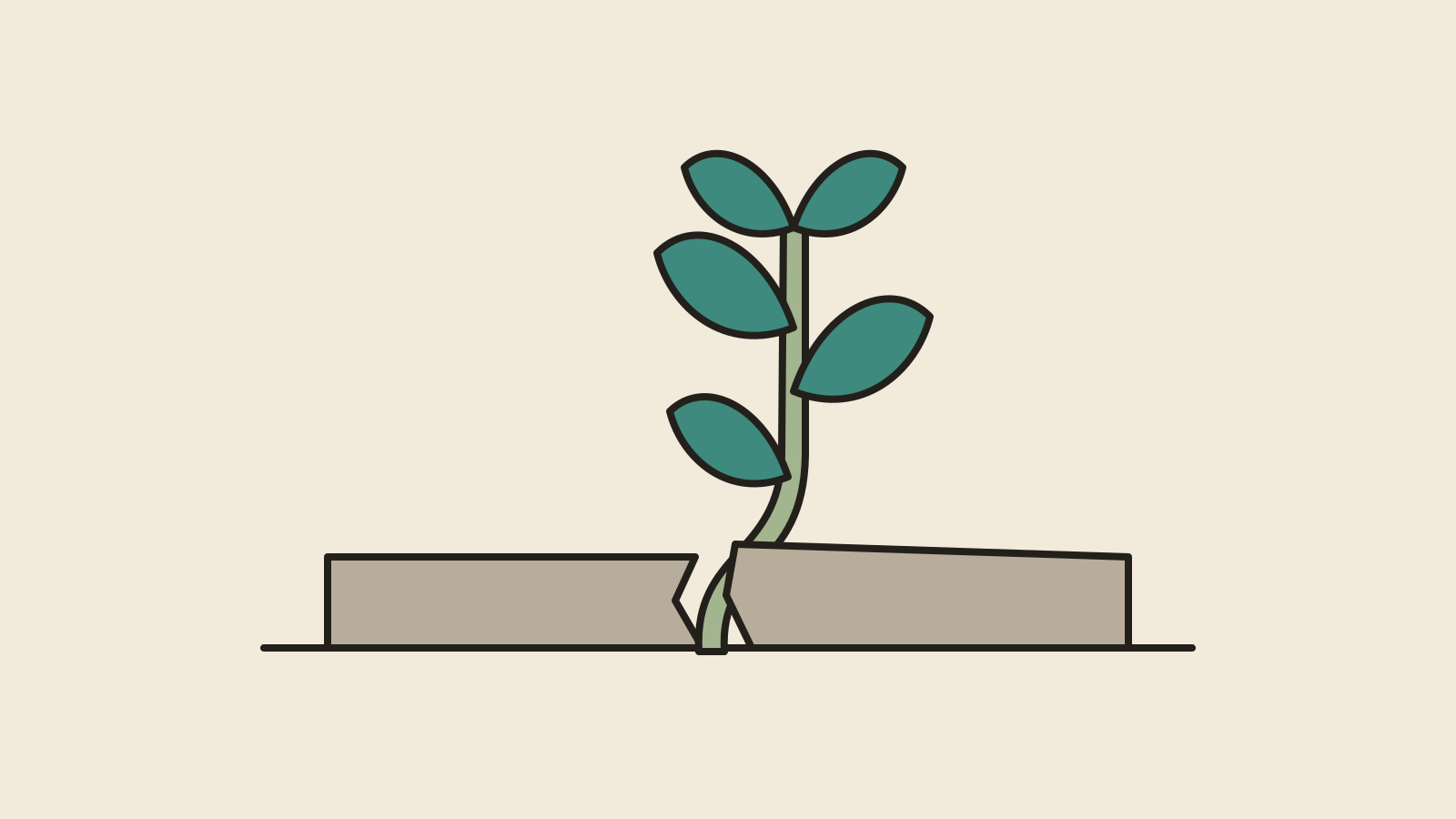
Conatus is Spinoza's name for the striving by which each thing tries to keep existing. The Latin word means effort or endeavour. In the Ethics he claims that every single thing, so far as it can, strives to persevere in its being, and that this striving is the thing's very essence. A stone resists being split, a plant turns to the light and a person seeks food, safety and company. Each is the same push at a different level.
Watch a toddler learning to walk. She falls, cries, gets up and tries again, and she beams when she crosses the room. For Spinoza the trying is her conatus. Her delight is that striving succeeding, a felt rise in her power to act, and her tears are the same striving thwarted. He built his account of the emotions on this base. He also reversed a common view of value: we call things good, he said, because we strive for them.
Diagram
Joy and sadness are the same striving helped or hindered
Read as text
Two panels set side by side on one dimension, the change in a thing's power to act. On the left is joy: the striving to persist is helped and the power to act rises. On the right is sadness: the striving is hindered and the power to act falls. Both are states of the one conatus, and with desire they are the emotions from which Spinoza builds all the others.
Key features
- Every finite thing has it, living or not, since nothing contains anything that works to destroy itself.
- It is the thing's essence, so a thing does not have a striving in addition to being what it is.
- In humans it appears as appetite, and as desire when we are aware of it.
- Joy is the passage to a greater power of acting and sadness the passage to a lesser, and every other emotion is built from these two and desire.
- It is the foundation of virtue, because acting well means preserving one's being under the guidance of reason.
Not to be confused with
| Look-alike | The difference | Differs on |
|---|---|---|
| Will to power | Nietzsche held that living things want to grow, overcome and discharge their strength, and that self-preservation is only a frequent side effect. Spinoza made persistence itself the basic striving. | Differs onClaim |
| The will (Schopenhauer) | Schopenhauer's will is one blind force behind all appearances, the source of suffering and best quietened. Conatus belongs to each thing separately, and its success is joy. | Differs onClaim |
| Teleology | Teleology explains a thing by the end it aims at. Spinoza denied that nature has ends. Conatus is a push from what a thing already is, with no goal pulling from ahead. | Differs onMechanism |
| Survival instinct | An instinct belongs to animals and concerns staying alive. Conatus belongs to everything and covers a thing's whole power of acting, so a person may strive to understand as well as to survive. | Differs onScope |
- Differs onClaim
Nietzsche held that living things want to grow, overcome and discharge their strength, and that self-preservation is only a frequent side effect. Spinoza made persistence itself the basic striving.
- Differs onClaim
Schopenhauer's will is one blind force behind all appearances, the source of suffering and best quietened. Conatus belongs to each thing separately, and its success is joy.
- Differs onMechanism
Teleology explains a thing by the end it aims at. Spinoza denied that nature has ends. Conatus is a push from what a thing already is, with no goal pulling from ahead.
- Differs onScope
Survival instinct
An instinct belongs to animals and concerns staying alive. Conatus belongs to everything and covers a thing's whole power of acting, so a person may strive to understand as well as to survive.
Origins and development
The word was already in use. Stoic writers held that an animal's first impulse is to preserve itself. Descartes used conatus in physics for a body's tendency to keep moving, and Hobbes called the small beginnings of motion in us endeavour. Spinoza made it a principle of metaphysics in Part III of the Ethics, published after his death in 1677. Schopenhauer and Nietzsche reworked the notion of a basic striving, and Freud's drives belong to the same family. The neuroscientist Antonio Damasio argues that conatus anticipates homeostasis, the self-regulation that keeps a body within the limits of life.
René Descartes
A French philosopher and mathematician who doubted everything he could, then rebuilt knowledge on the one certainty that he was thinking.
Thomas Hobbes
An English philosopher who argued that people without government would live in fear, and would rationally agree to obey a sovereign.
Why it matters
Conatus offers a way to think about emotion without moralising. Feelings become readings of how one's power to act is faring, an idea that sits well with modern research on motivation and emotion. It also underlies Spinoza's ethics and politics. People who understand their own striving can direct it, and a state is strong, on his view, when it works with its citizens' desire to persist and do well.
Motivation and emotion
The branch of psychology that asks what moves people to act and what feelings are, how they arise and what they do.
Critiques and limits
Jonathan Bennett argued in 1984 that Spinoza's proof fails, because from the premise that nothing destroys itself it does not follow that everything actively works to preserve itself. Suicide and self-sacrifice are hard cases, and Spinoza had to say that outside causes overpower the person. Bennett also charged him with bringing back the goal-directed explanation he had banned, and Don Garrett replies that Spinoza banned only divine purposes, not the ends of finite things. The thesis is conceptual: a metaphysical claim tested by argument, which no experiment decides.
Connections
Belongs to
It is a claim about what every finite thing most basically is: an active power of persisting.
Originated by
Spinoza turned an older word for effort into the essence of every thing, in Part III of the Ethics.
Influenced by
The Stoics taught that every animal's first impulse is to preserve itself, a doctrine Spinoza widened to all things.
Thomas HobbesPolitical theory & science
A generation earlier Hobbes had made endeavour and the fear of death the springs of human action.
Contrasts with
Differs on claim. Conatus is a striving to persist, where Nietzsche's will to power seeks growth and treats self-preservation as a side effect.
Differs on claim. Conatus belongs to each thing and its success is joy, where Schopenhauer's will is one blind force that brings suffering.
Differs on mechanism. Teleology explains by an end aimed at, where conatus is a push from what a thing already is.
Applied in
Motivation and emotionPsychology
Spinoza's account of joy and sadness as changes in the power to act is an early theory of emotion, revived by Damasio.
Further reading
- Bennett, J. (1984). A study of Spinoza's Ethics. Hackett.
- Damasio, A. (2003). Looking for Spinoza: Joy, sorrow, and the feeling brain. Harcourt.
- Della Rocca, M. (2008). Spinoza. Routledge. https://doi.org/10.4324/9780203894583
- Spinoza, B. (1996). Ethics. Penguin. (Original work published 1677)
Cite this entry
Scholia. (2026). Conatus. In Scholia: Notes in the margin of the human sciences. Retrieved November 28, 2026, from https://scholia.zennia.sg/ideas/conatus