IdeaAnthropologyAlso in Sociology
Differential mode of association (chaxu geju)
Fei Xiaotong's model of Chinese society as rings of personal ties spreading from each person, with obligations that weaken as the rings widen.
The idea
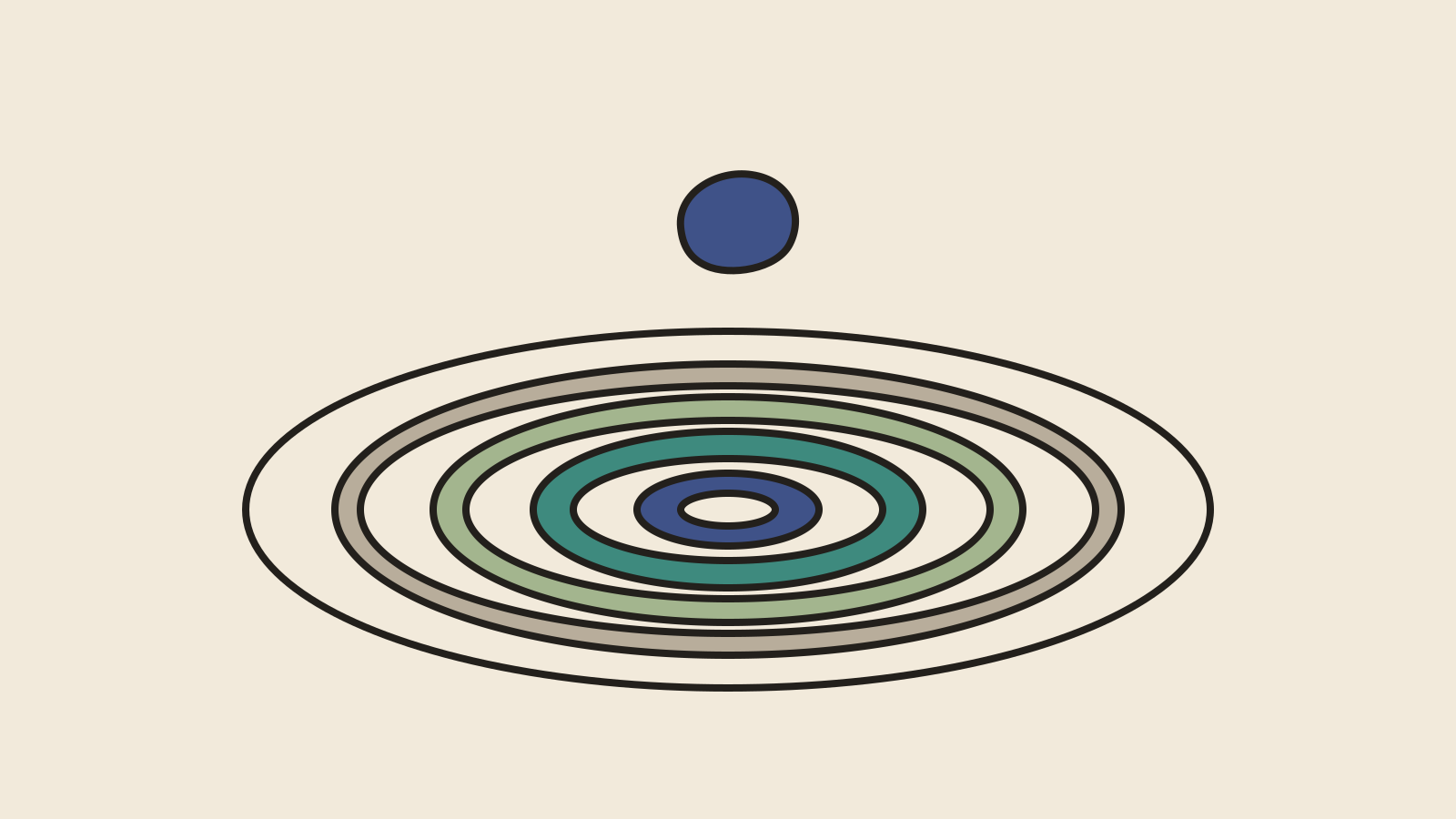
Fei Xiaotong argued that Chinese society is built from webs of personal ties, each centred on a single person. His image was a stone thrown into a pond, with rings spreading out from the point where it lands. Each person stands at the centre of such rings. Parents and children are closest, wider kin come next, then neighbours and friends, with strangers at the edge. What one person owes another depends on which ring that other stands in.
He set this against a Western pattern, which he compared to rice straw tied in bundles. There each person belongs to bounded groups, such as a congregation, a club or a nation, and members of a group have equal standing under common rules. A request for help shows the difference. In the ripple pattern the first question is who is asking and how close they are. In the bundle pattern it is whether they qualify.
Diagram
Each person stands at the centre of rings of weakening obligation
Read as text
Five circles nested inside one another. The innermost is the self. Round it come parents and children, then wider kin, then neighbours and friends. Strangers are in the outermost ring. What a person owes to others is strongest at the centre and weakens with each ring outward. The rings belong to one person only: someone else stands at the centre of a different set.
Key features
- Every network is centred on one person, so no two people have the same one, brothers included.
- Obligation is graded, strongest at the centre and thinner with each ring outward.
- Morality attaches to particular relationships, such as parent and child or friend and friend, and few rules apply to everyone alike.
- The line between "us" and "them" is elastic, so the same circle can stretch to a whole lineage or shrink to one household as interest requires.
- Fei called the result egocentrism and kept it apart from individualism, which assumes equal members of a group.
Not to be confused with
| Look-alike | The difference | Differs on |
|---|---|---|
| Guanxi | Guanxi is the everyday practice of building and using personal connections. The differential mode of association is Fei's model of the social structure that makes such connections count for so much. | Differs onScope |
| Individualism and collectivism | That scale places China at the collectivist end, where the group comes first. Fei denied that Chinese society is centred on groups. Loyalty runs to particular people in one's own web, and sacrifice for an abstract collective is weak. | Differs onClaim |
| Gemeinschaft and Gesellschaft | Tönnies sorted social bonds by the kind of group they form, close community or impersonal association. Fei's unit is the single person's web of graded ties, which forms no bounded group. | Differs onUnit of analysis |
- Differs onScope
Guanxi
Guanxi is the everyday practice of building and using personal connections. The differential mode of association is Fei's model of the social structure that makes such connections count for so much.
- Differs onClaim
Individualism and collectivism
That scale places China at the collectivist end, where the group comes first. Fei denied that Chinese society is centred on groups. Loyalty runs to particular people in one's own web, and sacrifice for an abstract collective is weak.
- Differs onUnit of analysis
Tönnies sorted social bonds by the kind of group they form, close community or impersonal association. Fei's unit is the single person's web of graded ties, which forms no bounded group.
Origins and development
Fei wrote the idea up in 1947, in one of a set of short essays drawn from his lectures on rural society and collected as Xiangtu Zhongguo. The Chinese name is chaxu geju. It leans on the Confucian idea of lun, the ordered differences between kinds of relationship. The book was hard to obtain in mainland China from the 1950s until the 1980s. Its English translation, From the Soil, came in 1992, and the term is now standard in Chinese sociology.
Why it matters
The model is the usual starting point for explaining guanxi, the part that favours and introductions play in Chinese business and politics, and the weak hold of impersonal rules where personal ties are strong. Fei used it to explain neglect of shared goods: a canal that everyone used was nobody's own to keep clean. Surveys still find trust in China falling away ring by ring.
Critiques and limits
Yan Yunxiang argues that readers have flattened the idea into rings of closeness and dropped its second half, which is rank. The ties also order people as senior and junior. Jack Barbalet holds that the model borrows more from Confucian teaching than Fei admitted, and that its picture of the West is drawn for contrast. Fei himself called the essays tentative. The model is interpretive, a reading of Chinese society from his fieldwork and from classical texts, which he never tested systematically.
Connections
Belongs to
Yenching school (Chinese community studies)
It is the best-known theoretical result of the school's programme of building concepts from Chinese fieldwork.
Originated by
Fei named the pattern in essays of 1947, drawing on a decade of village fieldwork.
Influenced by
ConfucianismPhilosophy
Fei traced the graded ties to the Confucian ordering of relationships, each pair with duties of its own.
Contrasts with
Individualism and collectivismPsychology
Differs on claim. The scale files China under group-first collectivism, and Fei held that loyalty runs to particular persons and not to groups.
Gemeinschaft and GesellschaftSociology
Differs on unit of analysis. Tönnies sorts bonds by the kind of group they form, Fei by each person's own web of graded ties.
Parallels
Independent and interdependent self-construalPsychology
Fei in 1947 and Markus and Kitayama in 1991 each described a self made of its relationships, set against a bounded Western individual.
Applied in
Indigenous psychologyPsychology
Chinese psychologists built their models of face, favour and relationship on Fei's graded circles.
Cross with
Two distant entries to read beside this one, each with the question the pairing opens.
Categorical imperativePhilosophy
Can a morality in which duties weaken with social distance answer Kant's demand that a rule hold for everyone alike? Set them side by side
Transaction costsEconomics
Do rings of personal ties make dealing cheaper inside the circle at the price of making it dearer with strangers? Set them side by side
Further reading
- Arkush, R. D. (1981). Fei Xiaotong and sociology in revolutionary China. Council on East Asian Studies, Harvard University. https://doi.org/10.2307/j.ctt1tfjcs4
- Fei, X. (1992). From the soil: The foundations of Chinese society. University of California Press. https://doi.org/10.1525/9780520912489 (Original work published 1948)
- Yan, Y. (1996). The flow of gifts: Reciprocity and social networks in a Chinese village. Stanford University Press.
- Yan, Y. (2006). Chaxu geju yu Zhongguo wenhua de dengji guan [The differential mode of association and the notion of hierarchy in Chinese culture]. Shehuixue Yanjiu, 21(4), 186–200. https://shxyj.ajcass.com/Magazine/show/?id=72550
Cite this entry
Scholia. (2026). Differential mode of association (chaxu geju). In Scholia: Notes in the margin of the human sciences. Retrieved November 28, 2026, from https://scholia.zennia.sg/ideas/differential-mode-of-association