IdeaPhilosophyAlso in Cognitive science & linguistics
Gödel's incompleteness theorems
Any consistent set of rules strong enough for basic arithmetic leaves some true statements unprovable, and cannot prove its own consistency.
The idea
Mathematicians prove things by starting from a few basic rules called axioms and applying steps of logic. A set of axioms with fixed rules of proof is a formal system. Around 1900 many hoped that one such system could settle every question about the whole numbers. Kurt Gödel showed in 1931 that this cannot be done.
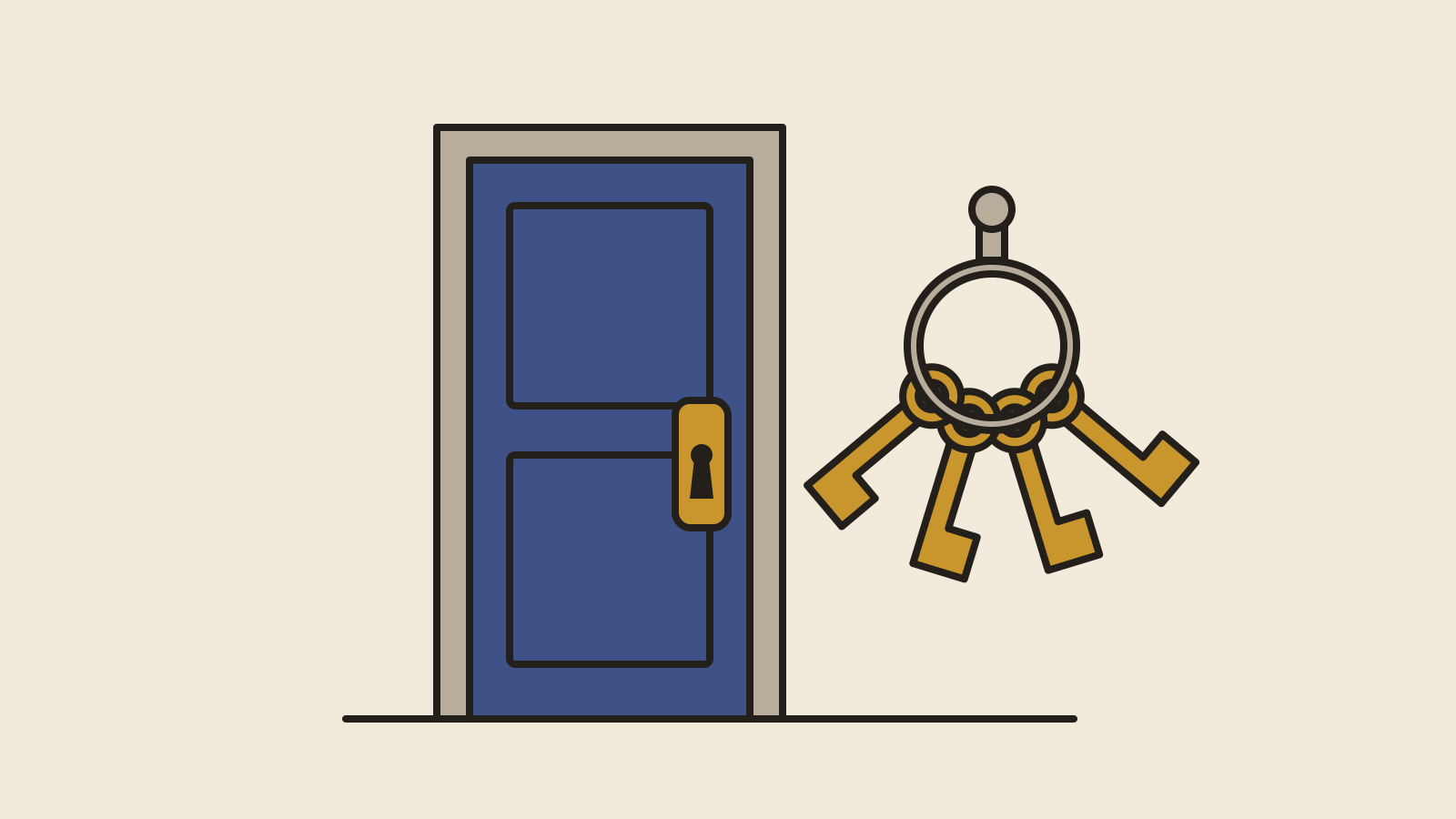
Picture a club rulebook written so that any dispute can be settled by checking the rules alone. Gödel's first theorem says that, for arithmetic, every such rulebook has a gap. If the system never proves a contradiction, some true statements about numbers can be neither proved nor disproved in it. Adding the missing statement as a new rule does not help, because the bigger system has a new gap of its own. The second theorem adds that no such system can prove its own consistency. A rulebook cannot certify itself.
Diagram
A consistent arithmetic system contains a true sentence it cannot prove
Read as text
A flow of six steps. Start with a consistent formal system strong enough for basic arithmetic. Code its statements and proofs as numbers, so that arithmetic can talk about provability in the system. Use this coding to build a sentence that refers to itself. The sentence says, in effect, that it cannot be proved in the system. If the system is consistent, the sentence cannot be proved, since a proof of it would let the system prove a contradiction. So what the sentence says is the case, and it is a true sentence the system cannot prove.
Key features
- The theorems apply only to systems that are consistent, rich enough to express ordinary arithmetic and set out by rules a machine could check.
- Gödel turned statements and proofs into numbers, so arithmetic could describe its own proofs.
- The key sentence says, in effect, "I cannot be proved in this system", and if the system is consistent it is both unprovable and true.
- The limit belongs to each system and not to mathematics as a whole: a stronger system can prove what a weaker one cannot, and then has its own blind spot.
Not to be confused with
| Look-alike | The difference | Differs on |
|---|---|---|
| Liar paradox | The liar sentence speaks of its own truth and produces a contradiction. Gödel built a sentence that speaks of its own provability, and the result is a proved theorem with no contradiction in it. | Differs onClaim |
| Turing machine | Gödel showed that some truths escape proof in a given system. Turing's 1936 machine was built to show a neighbouring result: no mechanical procedure can decide, for every statement, whether it is provable. | Differs onClaim |
| Gödel's completeness theorem | His earlier result of 1929 shows that ordinary first-order logic can prove every statement that is true in all its interpretations. Completeness is about logic itself. Incompleteness is about theories of arithmetic. | Differs onClaim |
- Differs onClaim
The liar sentence speaks of its own truth and produces a contradiction. Gödel built a sentence that speaks of its own provability, and the result is a proved theorem with no contradiction in it.
- Differs onClaim
Gödel showed that some truths escape proof in a given system. Turing's 1936 machine was built to show a neighbouring result: no mechanical procedure can decide, for every statement, whether it is provable.
- Differs onClaim
Gödel's completeness theorem
His earlier result of 1929 shows that ordinary first-order logic can prove every statement that is true in all its interpretations. Completeness is about logic itself. Incompleteness is about theories of arithmetic.
Origins and development
David Hilbert hoped to rest all of mathematics on axioms and then prove, by simple finite means, that they could never lead to a contradiction. Gödel, a young logician in Vienna, announced his first result at a conference in Königsberg in 1930 and published both theorems the next year. John von Neumann reached the second theorem on his own within weeks. Barkley Rosser strengthened the first in 1936, and Turing's work on computation soon recast both in terms of machines.
Why it matters
The theorems ended the hope of a complete and self-certifying foundation for mathematics. They set a limit that every proof checker and every attempt to automate mathematics must work within. Readers meet them most often in popular arguments about minds and machines, and in claims that some truths lie beyond reason.
Critiques and limits
As mathematics the theorems are proved, and their correctness is not in dispute. The dispute is about what they show. John Lucas in 1961 and Roger Penrose from 1989 argued that a human mathematician can see the truth of a Gödel sentence that no machine could prove. Torkel Franzén replied that the argument needs us to know our own reasoning is consistent, which we cannot. He also catalogued looser uses in popular writing and cultural theory, where the theorems are said to show that nothing can be known for certain.
Connections
Belongs to
The theorems are results of mathematical logic about how far formal proof can reach.
Originated by
Gödel proved both theorems in Vienna in 1930, aged 24, and published them in 1931.
Influenced by
Gödel's paper takes the system of Russell and Whitehead's Principia Mathematica as its main example.
Contrasts with
Differs on claim. The liar speaks of its own truth and yields a contradiction, while Gödel's sentence speaks of its own provability and yields a theorem.
Turing machineCognitive science & linguistics
Differs on claim. Gödel showed some truths are unprovable in a system, and Turing's machine showed no procedure decides every statement.
Applied in
Computation and mindCognitive science & linguistics
John Lucas and Roger Penrose used the theorems to argue that minds are not computers, a claim most logicians reject.
Further reading
- Franzén, T. (2005). Gödel's theorem: An incomplete guide to its use and abuse. A K Peters.
- Gödel, K. (1931). Über formal unentscheidbare Sätze der Principia Mathematica und verwandter Systeme I. Monatshefte für Mathematik und Physik, 38(1), 173–198. https://doi.org/10.1007/BF01700692
- Nagel, E., & Newman, J. R. (1958). Gödel's proof. New York University Press.
Cite this entry
Scholia. (2026). Gödel's incompleteness theorems. In Scholia: Notes in the margin of the human sciences. Retrieved November 28, 2026, from https://scholia.zennia.sg/ideas/godels-incompleteness-theorems