IdeaSociologyAlso in Political theory & science
Graded inequality
Ambedkar's claim that caste lasts because it ranks every group above another, so the oppressed never unite against it.
The idea
Graded inequality is B. R. Ambedkar's claim about why caste lasts. In a simple inequality there are two camps, the few on top and the many below, and the many share a reason to resist. Caste ranks every group above some other. Almost everyone has an inferior to look down on, so almost everyone has something to lose if the ranking collapses.
Caste
A ranked social group that people are born into, marry within and cannot easily leave, best known from South Asia.
A school with a hazing custom works the same way. Each year group is bullied by the one above and bullies the one below. The youngest suffer most, yet the custom survives, because each class is waiting for its turn and no two classes combine against the tradition.
Ambedkar argued that this arrangement explains the stability of caste. Rights and honour are handed out in unequal portions down the scale, so each caste guards its small portion against those beneath it. In his words, "all the slaves are not equal in status".
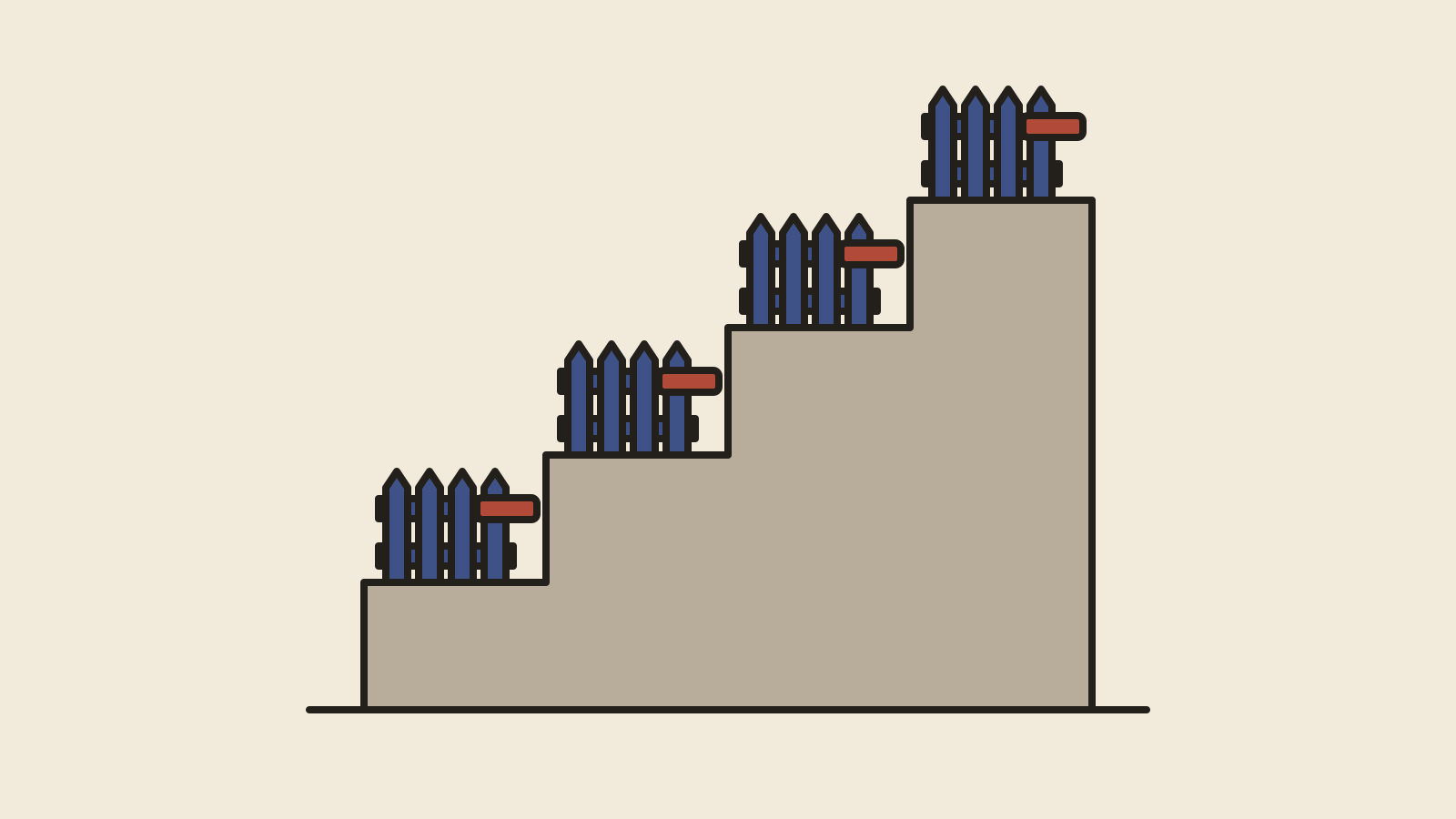
Diagram
Every rank but the lowest has another beneath it to look down on
Read as text
Five ranks stacked from top to bottom: Brahmins, Kshatriyas, Vaishyas, Shudras and, at the base, those placed outside the four orders, once called untouchable. An arrow labelled rights and reverence increase points up the stack. Each rank except the lowest stands above another, so each has a standing to protect, and Ambedkar argued that this is why the ranks do not unite against the order.
Key features
- Rank is a ladder of many rungs, with Brahmins at the top and the castes once called untouchable at the bottom.
- Reverence rises with each step up, and contempt deepens with each step down.
- Privileges are spread unequally, so that even low-ranked castes hold some advantage over others.
- The grading reaches inside the lowest groups, where Dalit castes have ranked and avoided one another.
- The result is that a common front against the system rarely forms.
Not to be confused with
| Look-alike | The difference | Differs on |
|---|---|---|
| Caste | Caste names the ranked birth groups themselves. Graded inequality is one disputed claim about them: that the many steps of rank are what keep the order safe from revolt. | Differs onScope |
| Social class | Class sets those who own against those who work for them, and Marx expected the workers to unite. Ambedkar replied that workers ranked against each other by birth have more than chains to lose. | Differs onMechanism |
| Sanskritization | Srinivas held that a low caste can climb by copying the customs of a higher one. Ambedkar's claim explains why such climbing leaves the ladder standing: the climbers want a better rung. | Differs onClaim |
| Dumont's hierarchy | Louis Dumont described caste as an order held together by a shared value, the ranking of pure over impure. Ambedkar saw rank held in place by contempt and unequal rights. | Differs onClaim |
- Differs onScope
Caste names the ranked birth groups themselves. Graded inequality is one disputed claim about them: that the many steps of rank are what keep the order safe from revolt.
- Differs onMechanism
Class sets those who own against those who work for them, and Marx expected the workers to unite. Ambedkar replied that workers ranked against each other by birth have more than chains to lose.
- Differs onClaim
Srinivas held that a low caste can climb by copying the customs of a higher one. Ambedkar's claim explains why such climbing leaves the ladder standing: the climbers want a better rung.
- Differs onClaim
Dumont's hierarchy
Louis Dumont described caste as an order held together by a shared value, the ranking of pure over impure. Ambedkar saw rank held in place by contempt and unequal rights.
Origins and development
Ambedkar set out the argument in Annihilation of Caste, a speech written in 1936 for a reform society in Lahore. The society withdrew its invitation on reading the text, and he printed it himself. There he described castes as a graded order of unequal rights. The phrase "graded inequality" runs through his later work, including Philosophy of Hinduism, which was published after his death. A paper of 1916 had already traced caste to marriage within the group, copied down the scale. Sociologists of caste and Dalit political movements have used the idea since.
B. R. Ambedkar
The jurist born into an untouchable caste who led the drafting of India's constitution and argued that caste itself had to be destroyed.
Why it matters
It answers a question that puzzles outsiders: why an order that harms most people has so rarely been challenged by them together. Indian politics shows the pattern. Many parties draw their core support from a single caste, and alliances among lower castes repeatedly break over relative rank. In 2024 India's Supreme Court allowed states to subdivide the quota for Scheduled Castes, so the weakest among them aren't crowded out. Any ladder of small privileges, in an office or an immigration system, can set those near the bottom against one another.
Critiques and limits
Gandhi replied in 1936 that the fourfold order of callings ranks no one when rightly understood. Ambedkar, he said, had judged Hinduism by its worst examples. Indian Marxists then expected caste to fade once class relations changed. Dipankar Gupta argues that no single ladder exists: castes dispute the ranking, and each tells an origin story that places itself high. On his account castes share a pride in rank but no agreed scale. The claim rests on interpretation and case evidence, and no study has tested the whole argument.
Connections
Belongs to
It is a theory of why one ranked order, caste, has resisted challenge from below.
Originated by
B. R. AmbedkarPolitical theory & science
Ambedkar set out the argument in Annihilation of Caste in 1936 and named it in later writings.
Critiques
MarxismPolitical theory & science
Ambedkar told Indian socialists that workers ranked against one another by caste would not unite as a class.
Contrasts with
Differs on scope. Caste names the ranked birth groups, and graded inequality is one claim about why their order survives.
Differs on mechanism. Class sets owners against workers who may unite, where graded rank gives each group a place to defend.
Differs on claim. Srinivas says a low caste can climb by imitation, and Ambedkar says such climbing leaves the ladder standing.
Parallels
Collins also holds that most people are both penalised and privileged, which blurs the line between oppressor and oppressed.
Applied in
Comparative politicsPolitical theory & science
Used to explain why lower-caste voting blocs split by sub-caste and why quotas come to be subdivided.
Cross with
Two distant entries to read beside this one, each with the question the pairing opens.
Collective action problemPolitical theory & science
Economists explain failed cooperation by private costs and free riders: does a ladder of small privileges add a separate reason why the many do not combine? Set them side by side
Further reading
- Ambedkar, B. R. (2014). Annihilation of caste: The annotated critical edition. Verso. (Original work published 1936)
- Dumont, L. (1980). Homo hierarchicus: The caste system and its implications (Complete rev. English ed.). University of Chicago Press. (Original work published 1966)
- Gupta, D. (2000). Interrogating caste: Understanding hierarchy and difference in Indian society. Penguin Books.
- Jaffrelot, C. (2005). Dr Ambedkar and untouchability: Analysing and fighting caste. Hurst.
Cite this entry
Scholia. (2026). Graded inequality. In Scholia: Notes in the margin of the human sciences. Retrieved November 28, 2026, from https://scholia.zennia.sg/ideas/graded-inequality