IdeaPhilosophyAlso in Cognitive science & linguistics, Anthropology
Indeterminacy of translation
Quine argued that rival translations of a language can fit all the evidence of speakers' behaviour, with no further fact deciding which is right.
The idea
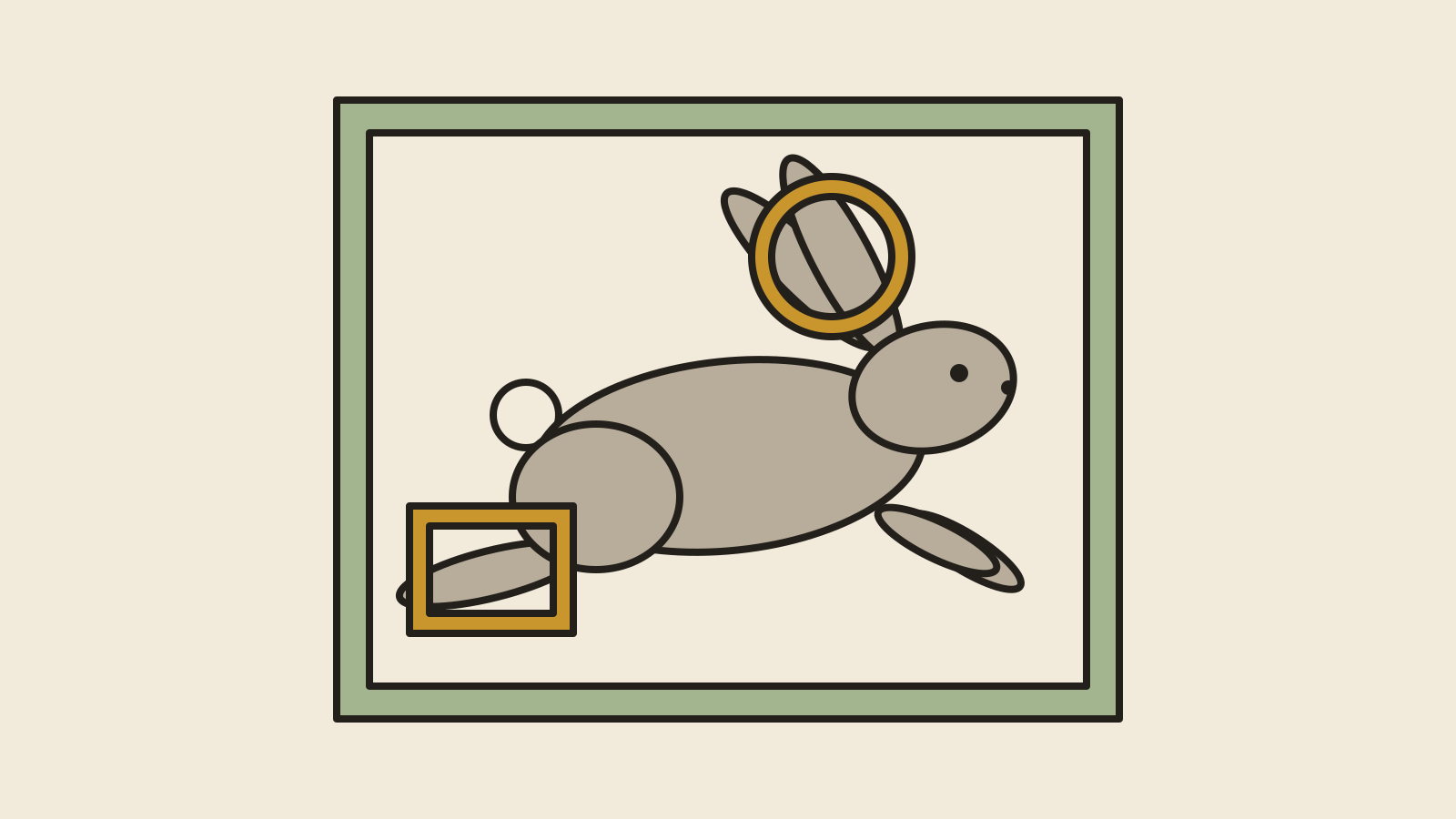
Picture yourself in a market abroad, with no dictionary and no shared language. A rabbit dashes past and a stallholder points and says "gavagai". You write down "rabbit". W. V. O. Quine asked what makes that right. Every time a rabbit appears, an undetached part of a rabbit appears too, and so does a brief stage in a rabbit's life. Whatever you ask, and whatever the speaker assents to, fits all three readings.
Quine's claim goes further than saying the translator lacks information. He held that two whole translation manuals could match every word to different meanings and both fit all possible evidence about speakers' behaviour. Then there would be no fact of the matter about which is correct. On his view the problem begins at home, because understanding a neighbour who speaks your own language involves the same guesswork.
Diagram
One body of evidence fits several rival translations equally well
Read as text
At the top sits all the evidence a linguist could gather about the word "gavagai": when speakers assent to it and dissent from it. Three translations branch from it, rabbit, undetached rabbit part and brief rabbit stage. Each fits the same evidence equally well, and on Quine's view no further fact decides between them.
Key features
- Radical translation is the test case: a linguist starts with no dictionary or bilingual helper, only behaviour and its surroundings.
- The evidence is what speakers assent to and dissent from when their senses are stimulated in particular ways.
- Rival manuals can each fit all that evidence while disagreeing over what particular sentences mean.
- Nothing beyond the evidence decides between them, so the problem is not ignorance of a hidden fact.
- Reference is inscrutable too: no evidence settles whether a word picks out rabbits, rabbit parts or rabbit stages.
Not to be confused with
| Look-alike | The difference | Differs on |
|---|---|---|
| Linguistic relativity | Relativity says the language you speak shapes how you think, and it is tested by comparing speakers. Indeterminacy says no fact fixes how any language, even your own, maps onto another. | Differs onClaim |
| Underdetermination | Underdetermination says the evidence fails to settle which scientific theory is true, though one of them may be. Quine held that translation is worse off, since there is no fact for the evidence to miss. | Differs onClaim |
| Private language argument | Both put meaning in public behaviour. Wittgenstein argued that meaning needs a public check on use. Quine went further: even all the public evidence leaves meaning unsettled. | Differs onClaim |
- Differs onClaim
Relativity says the language you speak shapes how you think, and it is tested by comparing speakers. Indeterminacy says no fact fixes how any language, even your own, maps onto another.
- Differs onClaim
Underdetermination says the evidence fails to settle which scientific theory is true, though one of them may be. Quine held that translation is worse off, since there is no fact for the evidence to miss.
- Differs onClaim
Both put meaning in public behaviour. Wittgenstein argued that meaning needs a public check on use. Quine went further: even all the public evidence leaves meaning unsettled.
Origins and development
Quine sketched the idea in a 1959 essay and set it out in the second chapter of Word and Object (1960). He drew on the behaviourist psychology of his day and his doubts about analytic truth. In "Ontological relativity" (1968) he extended it to reference. His student Donald Davidson turned radical translation into radical interpretation, adding that an interpreter must assume the speaker's beliefs are mostly true.
Analytic–synthetic distinction
The claim that some statements are true by meaning alone (analytic) while others depend on how the world is (synthetic).
Donald Davidson
The American philosopher who argued that to understand anyone we must find them mostly right, and built one theory of meaning, mind and action.
Why it matters
Field linguists, translators and anthropologists meet the problem whenever they render a word with no neat equivalent. The thesis also pushed philosophers to stop treating meanings as objects in the mind, which Quine mocked as a museum where words label exhibits.
Critiques and limits
Noam Chomsky argued in 1969 that indeterminacy is only the ordinary underdetermination every science faces, so it says nothing special about meaning. John Searle argued in 1987 that it is a reductio of behaviourism, since each speaker knows from the inside that "rabbit" means rabbit. Others note that real linguists rarely face rival manuals in practice. The dispute is conceptual and remains open.
Noam Chomsky
American linguist who argued that the capacity for grammar is inborn, and one of the best-known critics of United States foreign policy.
John Searle
An American philosopher who argued that a computer program cannot understand and that money and marriage exist because people agree they do.
Connections
Belongs to
It is a claim about what fixes meaning, and it denies that anything beyond speakers' behaviour does.
Originated by
Quine set out the thesis and the gavagai case in the second chapter of Word and Object in 1960.
Influenced by
Behaviourism (psychology)Psychology
Quine allowed the translator only observable evidence, what speakers assent to and dissent from in given circumstances.
Critiques
If no fact fixes translation, there are no determinate meanings or senses for words to carry from one language to another.
Contrasts with
Linguistic relativityCognitive science & linguistics
Differs on claim. Relativity says a language shapes its speakers' thought, while indeterminacy says no fact fixes how any language translates into another.
Differs on claim. Underdetermined theories still differ in which is true, while Quine held that rival translations leave no fact to be right about.
Differs on claim. Wittgenstein says meaning needs a public check, while Quine goes further and holds that even all public evidence leaves meaning unsettled.
Applied in
Ethnographic methodAnthropology
Ethnographers cite it when asking whether their rendering of another people's concepts can ever be checked against a fact.
Influenced
His radical interpretation reworked the radical translation behind Quine's thesis, tying sentences to shared objects in place of stimulation.
Further reading
- Hylton, P. (2007). Quine. Routledge. https://doi.org/10.4324/9780203962435
- Quine, W. V. (1960). Word and object. MIT Press.
- Quine, W. V. (1970). On the reasons for indeterminacy of translation. The Journal of Philosophy, 67(6), 178–183. https://doi.org/10.2307/2023887
Cite this entry
Scholia. (2026). Indeterminacy of translation. In Scholia: Notes in the margin of the human sciences. Retrieved November 28, 2026, from https://scholia.zennia.sg/ideas/indeterminacy-of-translation