IdeaPhilosophy
Leap of faith
Kierkegaard's claim that faith is reached by a decision, a leap, because no amount of evidence or argument can carry a person there.
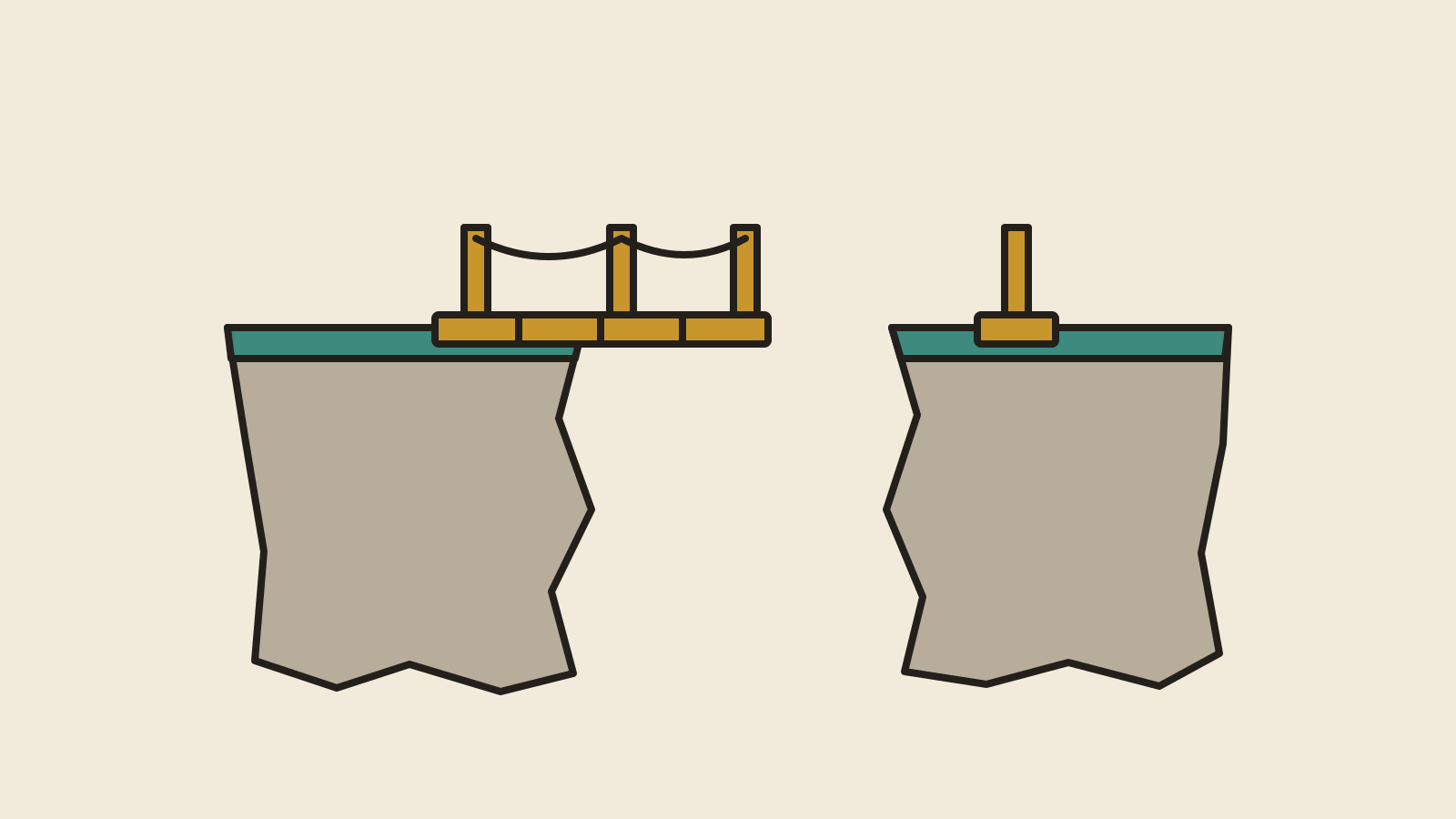
The idea
The leap of faith is the answer Søren Kierkegaard gave to a question about religious belief: can evidence and argument take a person all the way to faith? He said no. Historical evidence about Jesus, for example, can only ever make a claim more or less probable. Faith is a different kind of thing. It is a commitment of one's whole life, held with passion and at risk. Between the two lies a gap that reasoning can narrow and never close. Crossing it takes a decision, which he pictured as a leap.
Søren Kierkegaard
A Danish thinker who made the single individual's choices, anxiety and faith the centre of philosophy and is often called the father of existentialism.
Marriage is the everyday parallel. Two people can weigh each other's character for years, and the evidence may be excellent. It still cannot prove that the marriage will go well. At some point each either commits or does not, and collecting more evidence becomes a way of avoiding the choice. Kierkegaard held that the largest questions of life all have this shape.
Diagram
Evidence can approach faith, but only a decision arrives
Read as text
Two columns divided by the question of how belief is reached. On the left, weighing the evidence gives a result that is more or less probable, always open to revision and never finished. On the right, the leap is a decision, staked on one's life and held at risk. Kierkegaard's claim is that the left column can come close to the right one and never turns into it.
Key features
- Evidence yields only approximation: scholarship can always be revised, so it cannot ground a commitment meant to be unconditional.
- The move is a change of kind, from weighing a claim to staking a life on it, and no series of small steps adds up to it.
- The leap is a free act made by one person alone, and nobody can make it on another's behalf.
- Faith keeps its uncertainty: the believer, in his image, stays afloat over 70,000 fathoms of water.
- What is believed, that the eternal God became a man in time, is a paradox that offends the understanding.
Not to be confused with
| Look-alike | The difference | Differs on |
|---|---|---|
| Pascal's wager | Pascal offers a calculation: if God exists the believer gains everything, and if not loses little, so belief is the prudent bet. The leap rejects such reckoning. It is made without odds and gives up the security of a good bet. | Differs onStandard of judgement |
| The absurd | Kierkegaard called the content of faith absurd and leapt towards it. Camus used the word for the clash between the human demand for meaning and a silent world. He called the leap an evasion and advised living with the clash. | Differs onClaim |
| Blind faith | Blind faith refuses to look at reasons. The leap comes after the reasons have been examined and found to run out. | Differs onClaim |
| The will to believe | William James argued in 1896 that one may believe ahead of the evidence when a choice is live, forced and momentous, since belief may bring real goods. Kierkegaard offers no test by results. Faith may cost the believer everything. | Differs onStandard of judgement |
- Differs onStandard of judgement
Pascal offers a calculation: if God exists the believer gains everything, and if not loses little, so belief is the prudent bet. The leap rejects such reckoning. It is made without odds and gives up the security of a good bet.
- Differs onClaim
Kierkegaard called the content of faith absurd and leapt towards it. Camus used the word for the clash between the human demand for meaning and a silent world. He called the leap an evasion and advised living with the clash.
- Differs onClaim
Blind faith
Blind faith refuses to look at reasons. The leap comes after the reasons have been examined and found to run out.
- Differs onStandard of judgement
The will to believe
William James argued in 1896 that one may believe ahead of the evidence when a choice is live, forced and momentous, since belief may bring real goods. Kierkegaard offers no test by results. Faith may cost the believer everything.
Origins and development
The image comes from the German writer Gotthold Lessing, who wrote in 1777 of a broad and ugly ditch between historical reports and necessary truths that he could not get across. Kierkegaard took it up in Philosophical Fragments (1844) and at length in the Concluding Unscientific Postscript (1846), both under the pseudonym Johannes Climacus. He aimed it at the followers of Hegel, who held that thought moves smoothly from each stage to the next. He never wrote the phrase "leap of faith". He wrote of the leap. Twentieth-century existentialism made the longer phrase famous.
G. W. F. Hegel
A German philosopher who argued that reason, freedom and society develop through history by working out their own contradictions.
Existentialism
A movement in philosophy and literature holding that people have no given purpose and must make themselves through free choices they answer for.
Why it matters
The phrase is now everyday English for any commitment made ahead of the evidence: starting a business, emigrating, trusting a stranger. In arguments about religion it marks one standing position, that faith and proof are different things and that asking for proof misunderstands faith. It also names something familiar outside religion. Careers, marriages and political loyalties are rarely chosen on complete information, and waiting for certainty is itself a choice.
Critiques and limits
Albert Camus called the leap philosophical suicide: thought reaches its limit and then denies what it has just seen. Alasdair MacIntyre argued that a choice made without criteria is arbitrary, so nothing recommends leaping one way over another. C. Stephen Evans and M. Jamie Ferreira answer that this misreads Kierkegaard, for whom reflection and imagination prepare the leap. They add that he meant a leap to faith, where the popular phrase suggests faith does the leaping. The idea is a philosophical position, argued over and open to no experiment.
Albert Camus
The French-Algerian writer who held that a life without given meaning is still worth living and that no cause justifies murder.
Alasdair MacIntyre
The Scottish philosopher who argued that modern moral debate is built from fragments, and that the virtues make sense only inside practices and traditions.
Connections
Belongs to
Existentialists took from it the picture of a person who must choose a way of life without a guarantee.
It is the classic statement of the view that faith is a commitment evidence can prepare and never compel.
Originated by
He developed the leap in works of 1843 to 1846, most fully in the Concluding Unscientific Postscript.
Critiques
Against Hegel's smooth passage from each stage to the next, it holds that the decisive changes in a life are breaks.
Contrasts with
Differs on standard of judgement. Pascal reaches belief by reckoning gains and losses, where the leap is made without odds and gives up that security.
Differs on claim. Kierkegaard leapt towards a faith he called absurd, where Camus called that leap an evasion and stayed with the absurd.
Critiqued by
He called the leap philosophical suicide, an escape from the absurd bought by giving up reason.
Camus calls the leap philosophical suicide, since it ends the absurd by giving up the reason that noticed it.
Further reading
- Evans, C. S. (2009). Kierkegaard: An introduction. Cambridge University Press. https://doi.org/10.1017/CBO9780511809699
- Gardiner, P. (2002). Kierkegaard: A very short introduction. Oxford University Press. https://doi.org/10.1093/actrade/9780192802569.001.0001 (Original work published 1988)
- Kierkegaard, S. (1992). Concluding unscientific postscript to Philosophical fragments (Vol. 1). Princeton University Press. (Original work published 1846)
- Kierkegaard, S. (1985). Fear and trembling. Penguin. (Original work published 1843)
Cite this entry
Scholia. (2026). Leap of faith. In Scholia: Notes in the margin of the human sciences. Retrieved November 28, 2026, from https://scholia.zennia.sg/ideas/leap-of-faith