IdeaPhilosophyAlso in Cognitive science & linguistics
Liar paradox
The sentence "This sentence is false" is true if false and false if true, which exposes a fault in our everyday idea of truth.
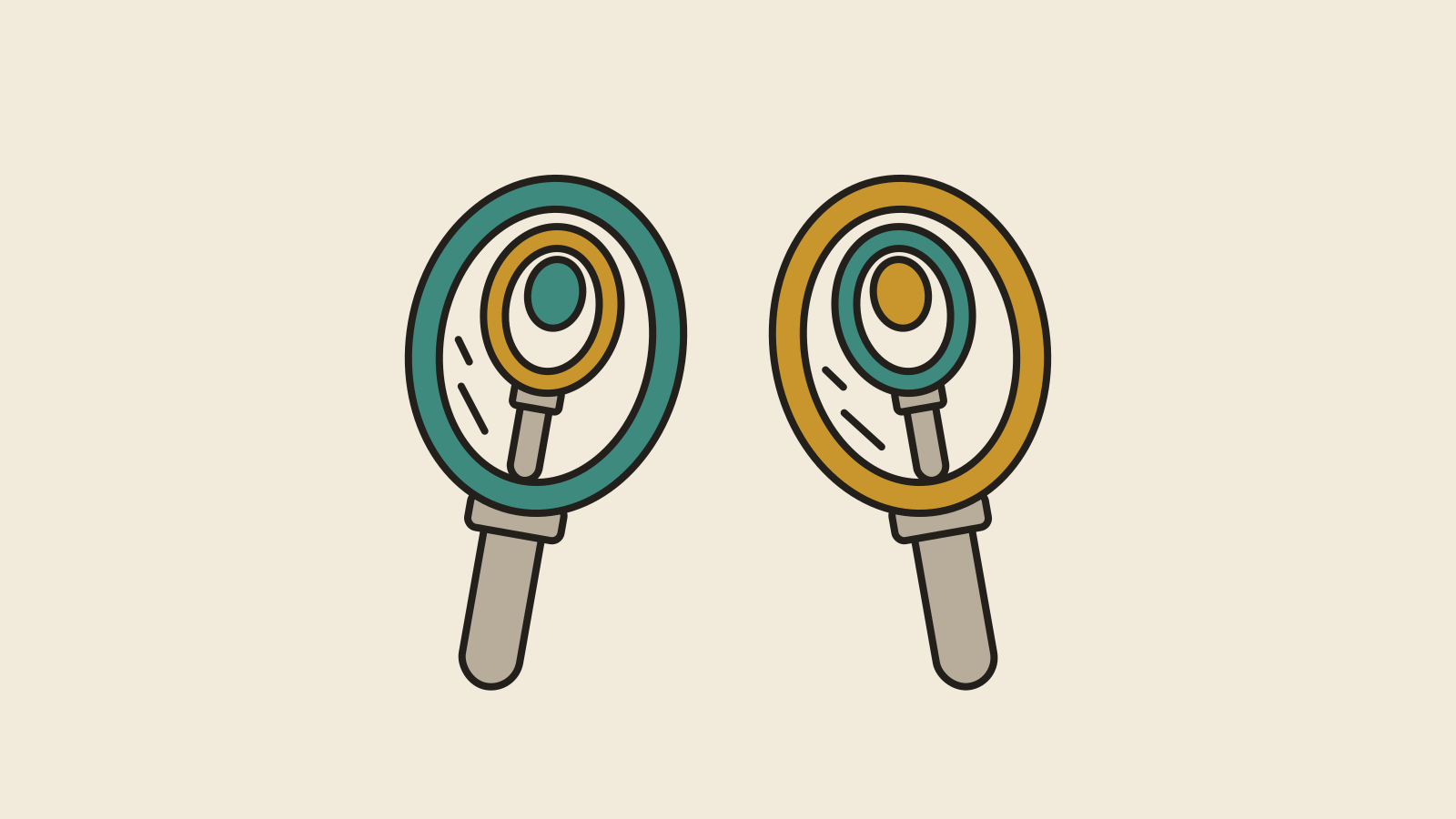
The idea
Consider the sentence "This sentence is false." If it is true, then what it says holds, so it is false. If it is false, then what it says fails, so it is true. Each answer flips into the other. The sentence seems to be either neither true nor false or both at once, and neither option sits well with ordinary logic.
The puzzle can turn up in daily life. Picture a fridge door with a single note on it, which reads "Every note on this fridge is false." Nothing about the note looks odd on its face, and a child could have written it. The trouble comes from two harmless-looking features working together: sentences can refer to themselves, and the word "true" obeys the rule that a sentence is true exactly when things are as it says. The paradox shows that a language with both features, plus ordinary logic, contradicts itself.
Diagram
Each answer to the liar sentence flips into its opposite
Read as text
A cycle with the sentence "This sentence is false" at its centre. Suppose the sentence is true. Then what it says holds, so it is false. Suppose instead it is false. Then what it says fails, so it is true. The reasoning returns to its start and never settles on one answer.
Key features
- The paradox needs only three ingredients: self-reference, the everyday rule for the word "true" and the standard laws of logic.
- Self-reference can be indirect, as in a pair of cards where each says the other is false.
- Calling the sentence meaningless or "neither true nor false" invites a stronger version: "This sentence is not true."
- Each proposed solution gives up something, whether a rule of logic, the full power of "true" or the reach of the language.
Not to be confused with
| Look-alike | The difference | Differs on |
|---|---|---|
| Sorites paradox | The liar gets its contradiction from a sentence that turns back on itself. The sorites gets one from a long chain of small steps applied to a vague word such as "heap". | Differs onMechanism |
| Gödel's incompleteness theorems | Gödel borrowed the liar's shape but swapped truth for provability. His sentence says it cannot be proved, and the outcome is a theorem about formal systems with no contradiction in it. | Differs onClaim |
| The Cretan saying of Epimenides | "All Cretans are liars", said by a Cretan, is no true paradox. It can consistently be false, provided some other Cretan sometimes tells the truth. | Differs onClaim |
| Russell's paradox | Russell's paradox concerns the set of all sets that are not members of themselves. It is a problem for theories of sets, while the liar is a problem for truth in language. | Differs onScope |
- Differs onMechanism
The liar gets its contradiction from a sentence that turns back on itself. The sorites gets one from a long chain of small steps applied to a vague word such as "heap".
- Differs onClaim
Gödel's incompleteness theorems
Gödel borrowed the liar's shape but swapped truth for provability. His sentence says it cannot be proved, and the outcome is a theorem about formal systems with no contradiction in it.
- Differs onClaim
The Cretan saying of Epimenides
"All Cretans are liars", said by a Cretan, is no true paradox. It can consistently be false, provided some other Cretan sometimes tells the truth.
- Differs onScope
Russell's paradox
Russell's paradox concerns the set of all sets that are not members of themselves. It is a problem for theories of sets, while the liar is a problem for truth in language.
Origins and development
Ancient writers credit Eubulides of Miletus, of the Megarian school, with the paradox in the fourth century BCE, and the Stoic Chrysippus wrote several books on it. Medieval logicians filed it among the "insolubles". In the 1930s Alfred Tarski argued that a language cannot consistently contain its own truth predicate, so truth must be defined in a richer language above it. Saul Kripke offered in 1975 a single language with truth-value gaps, in which the liar is neither true nor false.
Alfred Tarski
A Polish-American logician who gave the first exact definition of truth for formal languages and was a founder of model theory.
Why it matters
The liar shaped modern logic. It lies behind Tarski's theory of truth, and its structure reappears in Gödel's theorems and in Turing's proof that some problems cannot be computed. Anyone designing a formal language, from logic to programming, has to decide how its sentences may talk about themselves.
Critiques and limits
No solution commands agreement, and each has a cost. Tarski's levels of language fit badly with English, where one word "true" serves every level. Kripke's gaps fall to the stronger liar, since a sentence saying it is not true seems true if gappy. Graham Priest accepts the contradiction and holds that the liar is both true and false, at the price of changing logic itself. Its status is conceptual, since the paradox concerns logical consistency and not empirical evidence. Among logicians the question remains open.
Connections
Belongs to
Logicians treat the liar as a test that any exact account of truth in a language must pass.
It shows that a language able to talk about its own sentences cannot use "true" without restriction.
Critiques
It defeats any theory letting a language say, without limit, which of its own sentences are true.
Contrasts with
Gödel's incompleteness theorems
Differs on claim. The liar speaks of its own truth and yields a contradiction, while Gödel's sentence speaks of its own provability and yields a theorem.
Differs on mechanism. The liar's contradiction comes from a sentence turning back on itself, the sorites' from small steps applied to a vague word.
Differs on mechanism. The liar produces contradiction through a sentence that refers to itself, while Zeno's arguments arise from infinity and the continuum.
Parallels
The later Mohist canons observe that saying all sayings are wrong defeats itself, a self-referring trap found with no Greek contact.
Further reading
- Kripke, S. (1975). Outline of a theory of truth. The Journal of Philosophy, 72(19), 690–716. https://doi.org/10.2307/2024634
- Sainsbury, R. M. (2009). Paradoxes (3rd ed.). Cambridge University Press. https://doi.org/10.1017/CBO9780511812576 (Original work published 1988)
- Tarski, A. (1944). The semantic conception of truth and the foundations of semantics. Philosophy and Phenomenological Research, 4(3), 341–376. https://doi.org/10.2307/2102968
Cite this entry
Scholia. (2026). Liar paradox. In Scholia: Notes in the margin of the human sciences. Retrieved November 28, 2026, from https://scholia.zennia.sg/ideas/liar-paradox