IdeaPhilosophyAlso in Psychology, Sociology
Master and slave morality
Nietzsche's claim that morality has two sources, codes the powerful make to praise themselves and codes the powerless make to condemn them.
The idea
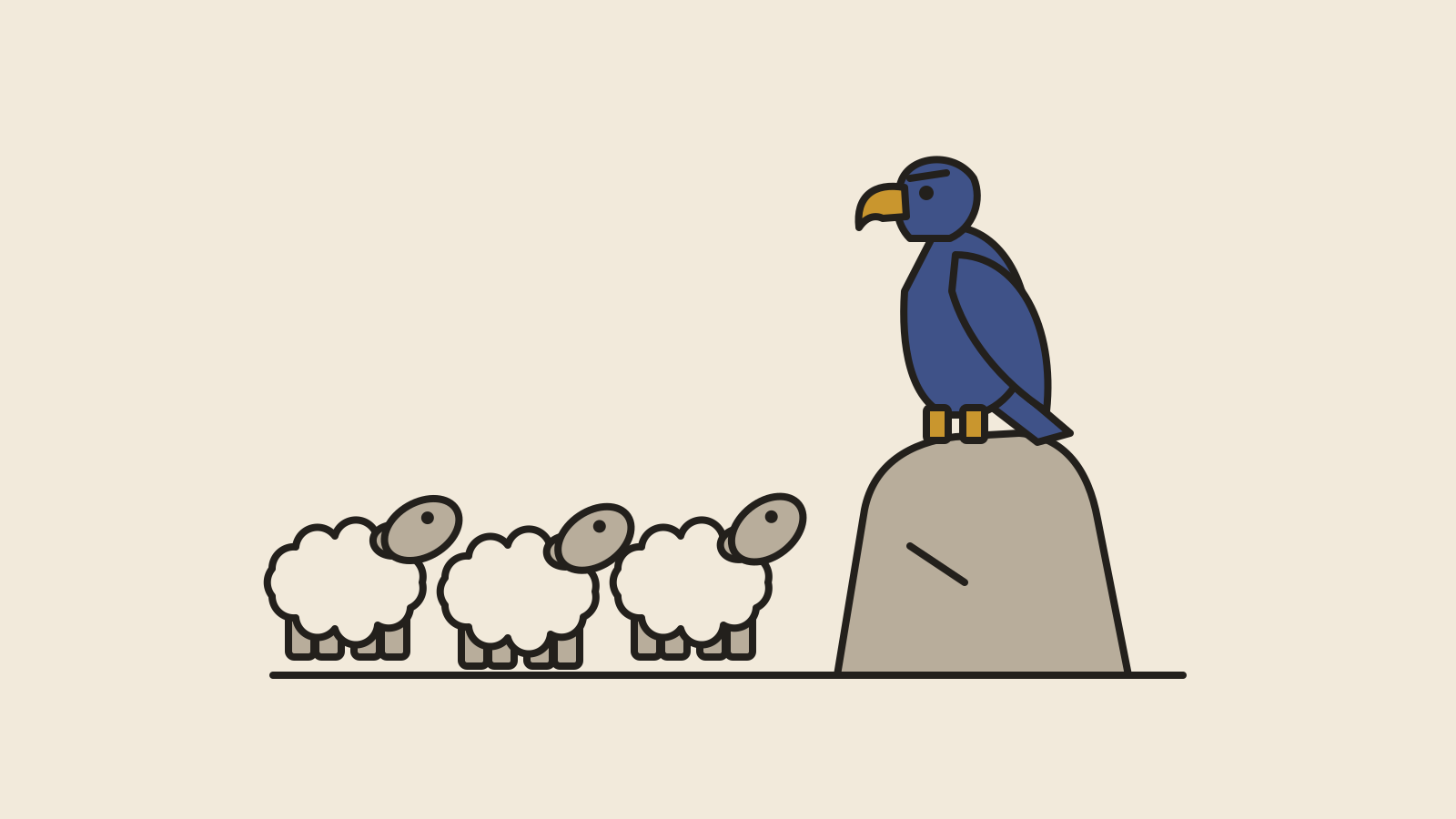
Nietzsche argued that there are two basic kinds of morality and that they come from opposite places. Master morality starts with the strong. They look at themselves, call what they see good (proud, capable, generous) and call whatever is unlike them bad, meaning common or low. Slave morality starts with the weak. They look first at those who dominate them and call them evil. Only then do they call themselves good, meaning harmless. Nietzsche pictures lambs who call the birds of prey evil and conclude that lambs must be good.
Friedrich Nietzsche
A German philosopher who declared the death of God, traced the hidden history of moral values and asked what could replace them.
Slave morality runs on what Nietzsche called ressentiment, the stored-up grudge of people who can't hit back. Take someone who can't afford the smart restaurant and decides that the people who eat there are greedy and that a simple supper shows better character. The wish has been renamed a vice and going without a virtue. Nietzsche held that humility, pity and meekness became virtues by the same route.
Diagram
The two moralities start from opposite points and praise opposite traits
Read as text
Two columns divided by where the values start. Master morality begins with self-praise, sets good against bad and prizes pride and strength. Slave morality begins with a grudge against the powerful, sets good against evil and prizes humility and pity.
Key features
- The two codes use different opposites: master morality sets good against bad, and slave morality sets good against evil.
- Master morality affirms first and condemns as an afterthought, while slave morality condemns first and builds its idea of good from the denial.
- The "slave revolt" was won without force, by persuading the strong to judge themselves by the values of the weak.
- Nietzsche placed its beginning among the priests of ancient Judea and saw Christianity as the heir that carried it across Europe.
- Both codes survive side by side, often within one person, and Nietzsche granted that the revolt made human beings deeper and cleverer.
Not to be confused with
| Look-alike | The difference | Differs on |
|---|---|---|
| Lordship and bondage | Hegel's master and slave are two selves in a struggle to be recognised, and the slave gains the fuller self-awareness through work. Nietzsche's pair are two moralities. His concern is where values come from, and he sees no progress in the slave's victory. | Differs onClaim |
| Moral relativism | The relativist says each code is valid on its own terms and none ranks above another. Nietzsche ranks them. He asks which kind of life a morality serves and judges slave morality hostile to human excellence. | Differs onClaim |
| A defence of slavery or of rule by force | The names describe where each code began, among rulers or among the ruled. Nietzsche admired aristocratic cultures and distrusted democracy, but the account is a history of values and no political programme. He scorned the nationalists and antisemites of his own day. | Differs onDescriptive or normative |
- Differs onClaim
Hegel's master and slave are two selves in a struggle to be recognised, and the slave gains the fuller self-awareness through work. Nietzsche's pair are two moralities. His concern is where values come from, and he sees no progress in the slave's victory.
- Differs onClaim
The relativist says each code is valid on its own terms and none ranks above another. Nietzsche ranks them. He asks which kind of life a morality serves and judges slave morality hostile to human excellence.
- Differs onDescriptive or normative
A defence of slavery or of rule by force
The names describe where each code began, among rulers or among the ruled. Nietzsche admired aristocratic cultures and distrusted democracy, but the account is a history of values and no political programme. He scorned the nationalists and antisemites of his own day.
Origins and development
Nietzsche introduced the pair in section 260 of Beyond Good and Evil (1886) and gave the full story in the first essay of On the Genealogy of Morality (1887). He was answering English writers who traced morality to usefulness, and he drew on his training in ancient languages. The German word for bad, he noted, once meant simply plain. In 1912 Max Scheler turned ressentiment into a general theory of how blocked envy distorts values. The Nazis later quoted the vocabulary of masters and slaves for ends Nietzsche had rejected.
Why it matters
The idea changed how people argue about morals. Before Nietzsche the question was whether a value could be justified. After him a second question was always available: whose interest does this value serve, and what feeling lies behind it? The same suspicion now runs through sociology, psychology and everyday talk about virtue signalling and sour grapes. Michel Foucault built his histories of punishment and sexuality on the method.
Michel Foucault
A French philosopher and historian who argued that knowledge and power shape each other in prisons, clinics, asylums and ideas of sexuality.
Critiques and limits
Max Scheler accepted the psychology and denied the history: Christian love, he argued, flows from strength and security, and ressentiment better explains modern middle-class morality. Max Weber granted resentment a part in some religions of the oppressed and denied that it explains religious ethics in general. Philippa Foot objected that Nietzsche leaves no place for justice, which protects everyone. Others note that showing where a value came from doesn't show it is wrong. The account is a reading of history and motive with thin documentary support.
Max Weber
A German scholar who made sociology the study of meaningful action and traced how calculation and rules came to organise modern life.
Philippa Foot
The Oxford philosopher who argued that moral goodness is a natural fact about human beings, and who devised the tram case behind the trolley problem.
Connections
Belongs to
It is a claim about where moral values come from, used to question the authority they now hold.
Originated by
He named the two types in Beyond Good and Evil in 1886 and told their history a year later in the Genealogy.
Critiques
Nietzsche counted the goal of the greatest happiness for all as slave morality in secular dress, a herd's wish for comfort.
Contrasts with
Differs on claim. Nietzsche's pair names two kinds of values and ranks the master's higher, where Hegel's names two roles and favours the servant's.
Differs on claim. The relativist says no moral code ranks above another, where Nietzsche ranks the two codes by the kind of life each serves.
Parallels
Defence mechanismsPsychology
Ressentiment works as rationalisation does, with a wish that cannot be met disowned and its object declared worthless or wicked.
Applied in
Sociology of religionSociology
Weber tested the resentment thesis against the religions of the oppressed and judged that it explained far less than Nietzsche claimed.
Critiqued by
Max WeberSociology
Weber granted ressentiment a part in some religions of the oppressed and denied that it explains religious ethics in general.
Further reading
- Kaufmann, W. (1974). Nietzsche: Philosopher, psychologist, antichrist (4th ed.). Princeton University Press. (Original work published 1950)
- Leiter, B. (2002). Nietzsche on morality. Routledge.
- Nietzsche, F. (1994). On the genealogy of morality. Cambridge University Press. (Original work published 1887)
- Nietzsche, F. (2002). Beyond good and evil: Prelude to a philosophy of the future. Cambridge University Press. https://doi.org/10.1017/CBO9780511812033 (Original work published 1886)
Cite this entry
Scholia. (2026). Master and slave morality. In Scholia: Notes in the margin of the human sciences. Retrieved November 28, 2026, from https://scholia.zennia.sg/ideas/master-slave-morality