IdeaPsychologyAlso in Cognitive science & linguistics
Multi-store model of memory
Memory works as three stores in sequence: a brief sensory register, a small short-term store and a lasting long-term store.
The idea
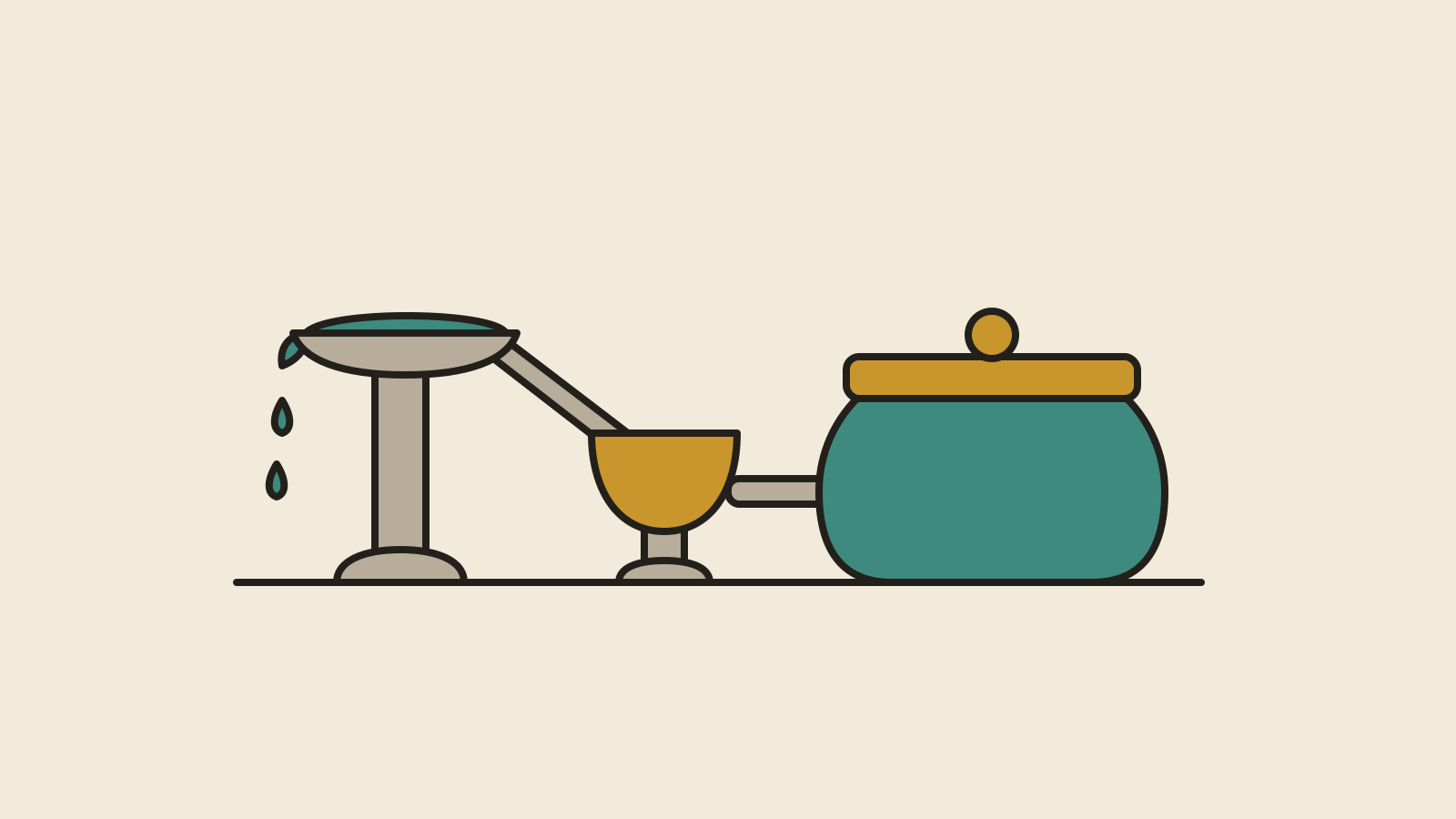
The multi-store model says that remembering depends on three separate stores through which information passes in order. A sensory register holds a detailed trace of what the eyes and ears have just taken in for a second or so. Whatever is attended to moves to a short-term store, which holds a handful of items for under half a minute unless they are rehearsed. Rehearsal also copies material to a long-term store of vast capacity, where it can last for years.
Someone calls out a door code as you walk past: 4, 7, 2, 9. The sound lingers for an instant even if you were not listening. If you attend, the digits enter the short-term store, and you mutter them until you reach the keypad. Use the code daily for a week and the muttering stops. The code has reached the long-term store.
Diagram
Information passes through three stores, and recall brings it back
Read as text
A flow of four steps. Input from the senses enters a sensory register, which holds it for about a second. Attended material passes to a short-term store, which holds a few items for under half a minute. Rehearsal copies material to a long-term store. An arrow loops back from the long-term store to the short-term store, showing that recall returns memories to the short-term store for use.
Key features
- The stores differ in capacity, in duration and in the way they lose information.
- Nothing reaches long-term memory without first passing through the short-term store.
- The structure is fixed, while control processes such as rehearsal, coding and search strategies are chosen by the person.
- The longer an item is rehearsed in the short-term store, the more likely it is to be copied into the long-term store.
- Recall brings long-term memories back into the short-term store for use.
Not to be confused with
| Look-alike | The difference | Differs on |
|---|---|---|
| Working memory | The multi-store model has one short-term store. Baddeley and Hitch's working memory model replaces it with separate verbal and visual stores run by an attentional controller. | Differs onClaim |
| Levels of processing | Fergus Craik and Robert Lockhart argued in 1972 that a memory lasts according to how deeply the material was processed for meaning. On their account the store it sits in and the amount of repetition settle little. | Differs onMechanism |
| Reconstructive memory | The model treats recall as fetching a stored item. Reconstruction theories hold that a memory is rebuilt at each recall from fragments and general knowledge, and may change in the process. | Differs onClaim |
| Spacing effect | The model predicts that more rehearsal means better long-term memory. The spacing effect shows that the timing of study matters as much as its amount. | Differs onClaim |
- Differs onClaim
The multi-store model has one short-term store. Baddeley and Hitch's working memory model replaces it with separate verbal and visual stores run by an attentional controller.
- Differs onMechanism
Levels of processing
Fergus Craik and Robert Lockhart argued in 1972 that a memory lasts according to how deeply the material was processed for meaning. On their account the store it sits in and the amount of repetition settle little.
- Differs onClaim
The model treats recall as fetching a stored item. Reconstruction theories hold that a memory is rebuilt at each recall from fragments and general knowledge, and may change in the process.
- Differs onClaim
The model predicts that more rehearsal means better long-term memory. The spacing effect shows that the timing of study matters as much as its amount.
Origins and development
Richard Atkinson and Richard Shiffrin published the model at Stanford in 1968 as a mathematical theory, drawing on a decade of findings. George Sperling had demonstrated the brief sensory trace in 1960. Lloyd and Margaret Peterson had shown rapid forgetting without rehearsal in 1959. The patient H.M. lost the ability to form new lasting memories after brain surgery while his short-term memory stayed normal, which suggested two systems. Because many theories of the time shared this outline, it became known as the modal model.
Why it matters
It is the picture of memory most people carry from a first psychology course, and its vocabulary of short-term and long-term memory has entered everyday speech. It gave researchers a precise target. Working memory and levels of processing were both written as corrections to it, and the box-and-arrow diagrams in psychology textbooks descend from it.
Critiques and limits
Craik and Lockhart objected that the model made structure do the work of processing, and Craik and Michael Watkins showed in 1973 that rote repetition alone adds little to long-term memory. Tim Shallice and Elizabeth Warrington described a patient, K.F., whose short-term memory for spoken items was badly impaired while his long-term learning was intact. That should be impossible if the short-term store is the only way in. The division between brief and lasting memory is well supported. The single gateway and the account of rehearsal are not.
Connections
Belongs to
It was the branch's standard picture of memory in the late 1960s and remains its usual starting point for teaching.
Influenced by
James had separated primary memory, the contents of the present moment, from secondary memory, the store of the past, in 1890.
Contrasts with
Differs on claim. The multi-store model has one short-term store, while working memory has separate verbal and visual stores run by an attentional controller.
Differs on claim. The model treats recall as fetching a stored item, while reconstruction says each memory is rebuilt at recall.
Differs on claim. The model ties lasting memory to the amount of rehearsal, while the spacing effect shows that equal rehearsal gives unequal memory.
Applied in
Cognitive architectureCognitive science & linguistics
Its fixed stores plus flexible control processes set a pattern that later computer models of the whole mind followed.
Extended by
It keeps the division between brief and lasting memory and splits the single short-term store into parts under a controller.
Cross with
Two distant entries to read beside this one, each with the question the pairing opens.
Computational theory of mindCognitive science & linguistics
Do the three stores resemble a computer's buffer, register and disk because minds compute, or because the model borrowed the machine's design? Set them side by side
BureaucracySociology
An office moves a case from in-tray to desk to archive: does an organisation forget at the transfer points the three-store model predicts? Set them side by side
Further reading
- Atkinson, R. C., & Shiffrin, R. M. (1968). Human memory: A proposed system and its control processes. In K. W. Spence & J. T. Spence (Eds.), The psychology of learning and motivation (pp. 89–195). Academic Press. https://doi.org/10.1016/S0079-7421(08)60422-3
- Craik, F. I. M., & Lockhart, R. S. (1972). Levels of processing: A framework for memory research. Journal of Verbal Learning and Verbal Behavior, 11(6), 671–684. https://doi.org/10.1016/S0022-5371(72)80001-X
- Malmberg, K. J., Raaijmakers, J. G. W., & Shiffrin, R. M. (2019). 50 years of research sparked by Atkinson and Shiffrin (1968). Memory & Cognition, 47(4), 561–574. https://doi.org/10.3758/s13421-019-00896-7
Cite this entry
Scholia. (2026). Multi-store model of memory. In Scholia: Notes in the margin of the human sciences. Retrieved November 28, 2026, from https://scholia.zennia.sg/ideas/multi-store-model-of-memory