IdeaPhilosophy
Pascal's wager
If reason cannot settle whether God exists, betting on God is the wise choice, because the possible gain is infinite and the cost small.
The idea
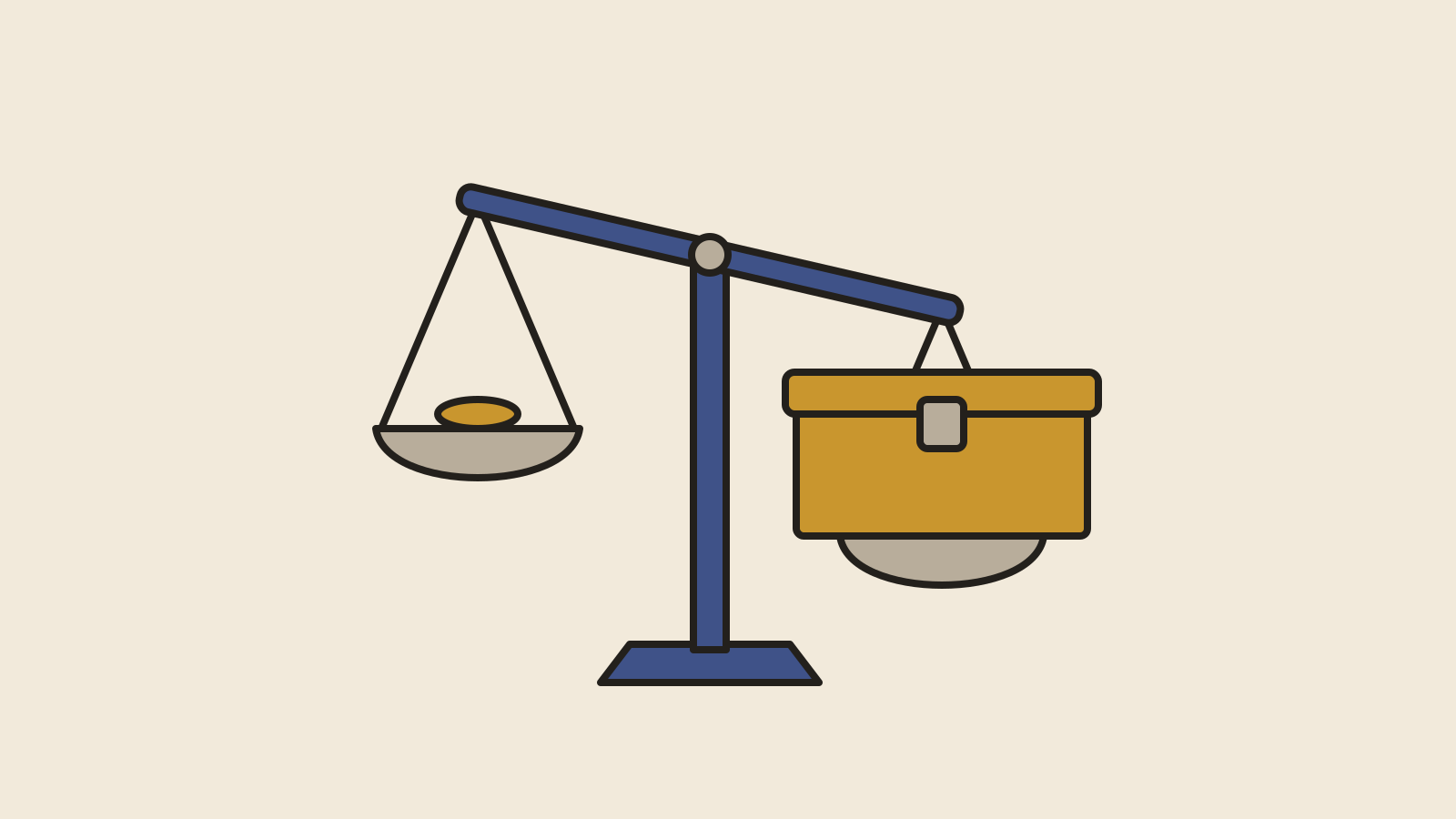
Pascal's wager is an argument that it is wise to believe in God even if nobody can prove that God exists. Pascal starts by granting the sceptic's point: reason can't settle the question either way. But you can't stay out of the game. You live as a believer or as a non-believer, so you have already placed a bet. Compare the stakes. If God exists, the believer gains an infinite happiness. If God does not, the believer has lost a few pleasures at most. Any chance of an infinite prize outweighs a small and certain cost.
People reason this way about insurance. A householder pays a modest premium each year against a fire that will probably never come, since the loss would be ruinous. Pascal asks his reader to treat belief as the premium. He knew that nobody can believe by decision, so he advised acting the part, going to mass and keeping the customs, until habit brings conviction.
Diagram
Betting on God risks little and could win everything
Read as text
A grid of four cells. Across the bottom runs the question of whether God exists, from does not exist on the left to exists on the right. Up the side runs your bet, from against God at the bottom to for God at the top. If you bet for God and God exists, you gain infinite happiness. If you bet for God and God does not exist, you lose little or nothing. If you bet against God and God does not exist, you gain little or nothing. If you bet against God and God exists, you miss infinite happiness. Only the top row holds an infinite prize, so Pascal concludes that betting for God is the wise choice at any odds above zero.
Key features
- The argument is about what it is prudent to do, and it offers no evidence that God exists.
- Staying neutral is impossible, because living without belief counts as betting against.
- An infinite reward multiplied by any probability above zero beats every finite gain.
- Belief can't be switched on at will, so the wagerer starts with practice and lets conviction follow.
- It was written for a particular reader, the worldly gambler who was open to Christianity and unmoved by proofs.
Not to be confused with
| Look-alike | The difference | Differs on |
|---|---|---|
| Ontological argument | The ontological argument, like other proofs of God, concludes that God exists. The wager concludes only that believing is the better bet, and it leaves the question of existence open. | Differs onClaim |
| Expected utility theory | Expected utility theory is the general rule of weighing each outcome's value by its probability. The wager is one early use of that reasoning, and an awkward one, since an infinite prize swamps every other number. | Differs onScope |
| Leap of faith | Kierkegaard's leap is a commitment made without calculation, in the face of missing proof. The wager is a calculation, and it recommends faith as the option with the best expected return. | Differs onStandard of judgement |
| The will to believe | William James argued in 1896 that one may believe ahead of the evidence when a choice is live, forced and momentous. He defended a right to believe and found Pascal's talk of payoffs cold. | Differs onScope |
- Differs onClaim
The ontological argument, like other proofs of God, concludes that God exists. The wager concludes only that believing is the better bet, and it leaves the question of existence open.
- Differs onScope
Expected utility theory is the general rule of weighing each outcome's value by its probability. The wager is one early use of that reasoning, and an awkward one, since an infinite prize swamps every other number.
- Differs onStandard of judgement
Kierkegaard's leap is a commitment made without calculation, in the face of missing proof. The wager is a calculation, and it recommends faith as the option with the best expected return.
- Differs onScope
The will to believe
William James argued in 1896 that one may believe ahead of the evidence when a choice is live, forced and momentous. He defended a right to believe and found Pascal's talk of payoffs cold.
Origins and development
The wager appears in a fragment headed Infini rien (infinity, nothing) among the notes Pascal left at his death in 1662. His friends at Port-Royal printed it in the first edition of the Pensées in 1670. Pascal had just helped to found probability theory, and the wager carries the new mathematics into religion. Earlier writers, among them the Christian apologist Arnobius around 300, had said that belief is the safer course. Pascal was the first to set the choice out as outcomes and chances. The philosopher Ian Hacking calls it the first real exercise in decision theory.
Blaise Pascal
A French mathematician and physicist who helped found probability theory, then argued that reason alone cannot bring people to God or to peace.
Why it matters
The wager is the standard example of a pragmatic argument for belief: a reason to hold a view because of what holding it brings, apart from whether it is true. That distinction now runs through debates on the ethics of belief. The same structure, a small chance of an enormous outcome, drives arguments about insurance, pandemic planning and catastrophic risks from new technology. Critics of such arguments speak of Pascal's mugging, after a thought experiment in which a stranger promises a vast reward in exchange for your wallet.
Critiques and limits
Denis Diderot gave the many-gods objection: an imam could reason the same way, so the wager can't say which God to back. Voltaire thought it indecent to treat faith as a game of profit and loss. William Clifford held that belief without evidence is always wrong. Alan Hájek argued in 2003 that the mathematics misfires, since any act with some chance of leading to belief also has infinite expected value. The argument is conceptual: it stands or falls on logic and values, and no data could settle it.
Voltaire
The French Enlightenment's most widely read writer, who used wit and public campaigns to attack religious persecution, censorship and unjust courts.
Connections
Belongs to
It is the best-known argument for religious belief that appeals to prudence and offers no proof.
It raises the question of whether the benefits of holding a belief can ever be a good reason to hold it.
Originated by
Pascal sketched it in a fragment of the Pensées, written for a defence of Christianity he never finished.
Influenced by
It begins by granting the sceptic that reason cannot decide whether God exists, then asks what to do next.
Contrasts with
Differs on standard of judgement. Pascal reaches belief by reckoning gains and losses, where the leap is made without odds and gives up that security.
Differs on claim. The ontological argument concludes that God exists, where the wager concludes only that believing is the better bet.
Expected utility theoryEconomics
Differs on scope. The wager is one early use of weighing outcomes by their chances, where expected utility theory is the general rule.
Further reading
- Hacking, I. (1975). The emergence of probability: A philosophical study of early ideas about probability, induction and statistical inference. Cambridge University Press. https://doi.org/10.1017/CBO9780511817557
- Hájek, A. (2003). Waging war on Pascal's wager. The Philosophical Review, 112(1), 27–56. https://doi.org/10.1215/00318108-112-1-27
- Jordan, J. (2006). Pascal's wager: Pragmatic arguments and belief in God. Oxford University Press. https://doi.org/10.1093/acprof:oso/9780199291328.001.0001
- Pascal, B. (1995). Pensées (Rev. ed.). Penguin. (Original work published 1670)
Cite this entry
Scholia. (2026). Pascal's wager. In Scholia: Notes in the margin of the human sciences. Retrieved November 28, 2026, from https://scholia.zennia.sg/ideas/pascals-wager