IdeaPhilosophy
Philosophical pessimism
The reasoned view that suffering outweighs the good in life, so that existence is on balance not worth having.
The idea
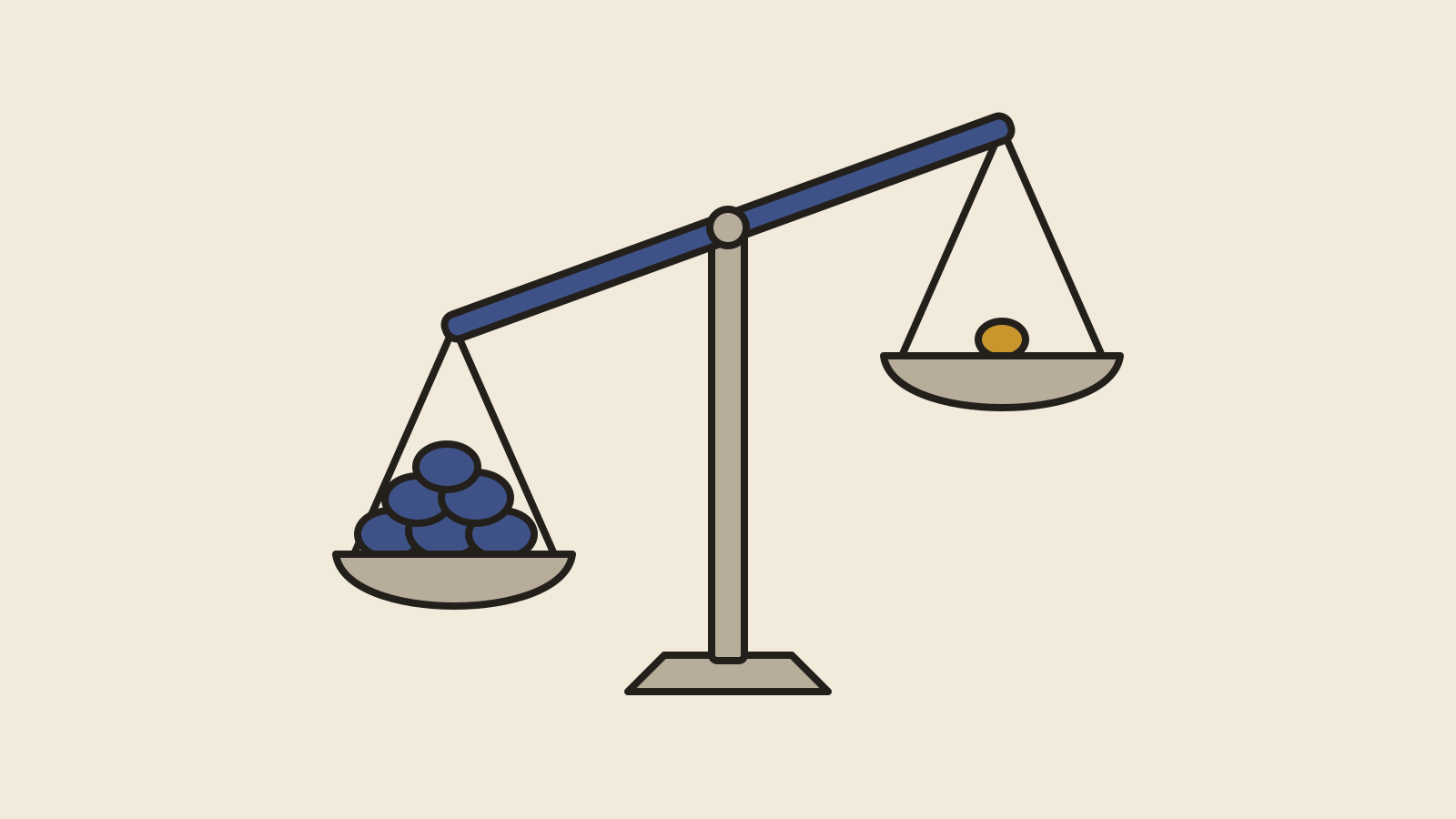
Philosophical pessimism is a thesis about the worth of life. It says that suffering is built into existence, that it outweighs whatever happiness there is, and that no reform or progress will change the balance. The pessimist offers this as the conclusion of an argument. A gloomy mood is beside the point.
Schopenhauer gave the classic argument. To want something is to lack it, and lacking hurts. Getting it brings a relief that fades fast, and then either a new want takes its place or boredom does. Think of someone saving for months for a new phone. The wanting fills the months. The pleasure lasts a week or two. Then the phone becomes ordinary and a better model is announced. Schopenhauer held that every desire runs this course, from hunger to ambition. Pain is what we feel, and pleasure is mostly the brief absence of it. A life is the sum of such cycles, so its balance must be negative.
Arthur Schopenhauer
The German philosopher who held that a blind, restless will lies beneath everything and that life therefore holds more suffering than satisfaction.
Diagram
On Schopenhauer's account every desire runs from pain to boredom and round again
Read as text
Four stages arranged in a circle round the will. Wanting, which is felt as a lack, leads to striving. Striving leads to a brief satisfaction. Satisfaction gives way to boredom, and boredom to a new want. On Schopenhauer's account only the short third stage is pleasant, so suffering predominates.
Key features
- It is a judgement about life as a whole, which it holds to be true of fortunate lives as well as hard ones.
- The suffering it points to comes from the structure of desire and of time, so better conditions can soften it and cannot remove it.
- It denies that history is progress towards happiness, which sets it against the optimism of the Enlightenment and of Hegel.
- Pessimists disagree on the response: Schopenhauer advised withdrawal from desire, while later writers advise compassion, art or defiance.
- Its strongest modern form says that coming into existence is always a harm, the ground of antinatalism, the view that having children is wrong.
Not to be confused with
| Look-alike | The difference | Differs on |
|---|---|---|
| Nihilism | The nihilist says life has no meaning or value either way. The pessimist says it has a value and that the value is negative. A pessimist can hold that suffering matters a great deal, which a nihilist cannot. | Differs onClaim |
| The absurd | For Camus the absurd is the mismatch between our demand for meaning and a world that gives no answer. He drew the conclusion that one should live on in revolt. Pessimism is a sum of pains and pleasures and makes no such demand. | Differs onClaim |
| Problem of evil | The problem of evil is an argument about God: can a good and all-powerful creator allow this much suffering? Pessimism asks whether life is worth having, whether or not there is a God. | Differs onScope |
| A gloomy temperament | Expecting the worst is a habit of mind and makes no claim. A cheerful person can accept the pessimist's argument, and many gloomy people have never met it. | Differs onClaim |
- Differs onClaim
The nihilist says life has no meaning or value either way. The pessimist says it has a value and that the value is negative. A pessimist can hold that suffering matters a great deal, which a nihilist cannot.
- Differs onClaim
For Camus the absurd is the mismatch between our demand for meaning and a world that gives no answer. He drew the conclusion that one should live on in revolt. Pessimism is a sum of pains and pleasures and makes no such demand.
- Differs onScope
The problem of evil is an argument about God: can a good and all-powerful creator allow this much suffering? Pessimism asks whether life is worth having, whether or not there is a God.
- Differs onClaim
A gloomy temperament
Expecting the worst is a habit of mind and makes no claim. A cheerful person can accept the pessimist's argument, and many gloomy people have never met it.
Origins and development
The word arose in the eighteenth century as the opposite of the optimism of Leibniz, who had called this the best of all possible worlds. Schopenhauer supplied the philosophy in The World as Will and Representation (1818), and the Italian poet Giacomo Leopardi reached similar views on his own. After 1860 Germany argued over pessimism for forty years, with Eduard von Hartmann its best-selling voice. In 2006 the South African philosopher David Benatar revived the case in Better Never to Have Been.
Gottfried Wilhelm Leibniz
A German polymath who invented the calculus independently of Newton and argued that God created the best of all possible worlds.
Why it matters
Pessimism is the standing challenge to every promise that life will be good once conditions improve. It surfaces in debates about whether having children is fair to them, in the novels of Hardy and Beckett, and in research on how people adapt to a pay rise or a new home and often drift back towards their old level of contentment. It also set the question that Nietzsche spent his career answering.
Friedrich Nietzsche
A German philosopher who declared the death of God, traced the hidden history of moral values and asked what could replace them.
Critiques and limits
Nietzsche replied that the value of life can't be estimated by someone living it, so every such verdict is only a symptom of the judge's own health. William James argued in 1895 that the answer depends partly on the person living, since trust and effort help make a life worth having. Eduard von Hartmann, a pessimist himself, rejected Schopenhauer's premise and held that many pleasures are positive and no mere relief from pain. Surveys in which most people call themselves satisfied don't settle the matter. The thesis is a judgement of value, weighed by argument.
Connections
Originated by
He gave pessimism its first systematic defence in 1818, arguing from the nature of desire to the predominance of suffering.
Extends
Pessimism is the verdict Schopenhauer drew from the will, since a world of endless striving must hold more pain than satisfaction.
Critiques
Schopenhauer answered Leibniz's best of all possible worlds by arguing that ours is the worst that could still hold together.
Contrasts with
Differs on claim. The pessimist says life has a value and that it is negative, where the nihilist says life has no value either way.
Differs on claim. Pessimism weighs suffering against happiness, where the absurd is the gap between our demand for meaning and a silent world.
Differs on scope. The problem of evil asks whether suffering fits with a good God, where pessimism asks whether life is worth living at all.
Critiqued by
It was devised as the opposite ideal to Schopenhauer's denial of life, a yes so complete that it wants everything again.
Further reading
- Beiser, F. C. (2016). Weltschmerz: Pessimism in German philosophy, 1860–1900. Oxford University Press. https://doi.org/10.1093/acprof:oso/9780198768715.001.0001
- Dienstag, J. F. (2006). Pessimism: Philosophy, ethic, spirit. Princeton University Press. https://doi.org/10.1515/9781400827480
- Schopenhauer, A. (1969). The world as will and representation. Dover. (Original work published 1818)
Cite this entry
Scholia. (2026). Philosophical pessimism. In Scholia: Notes in the margin of the human sciences. Retrieved November 28, 2026, from https://scholia.zennia.sg/ideas/philosophical-pessimism