IdeaEconomics
Quantity theory of money
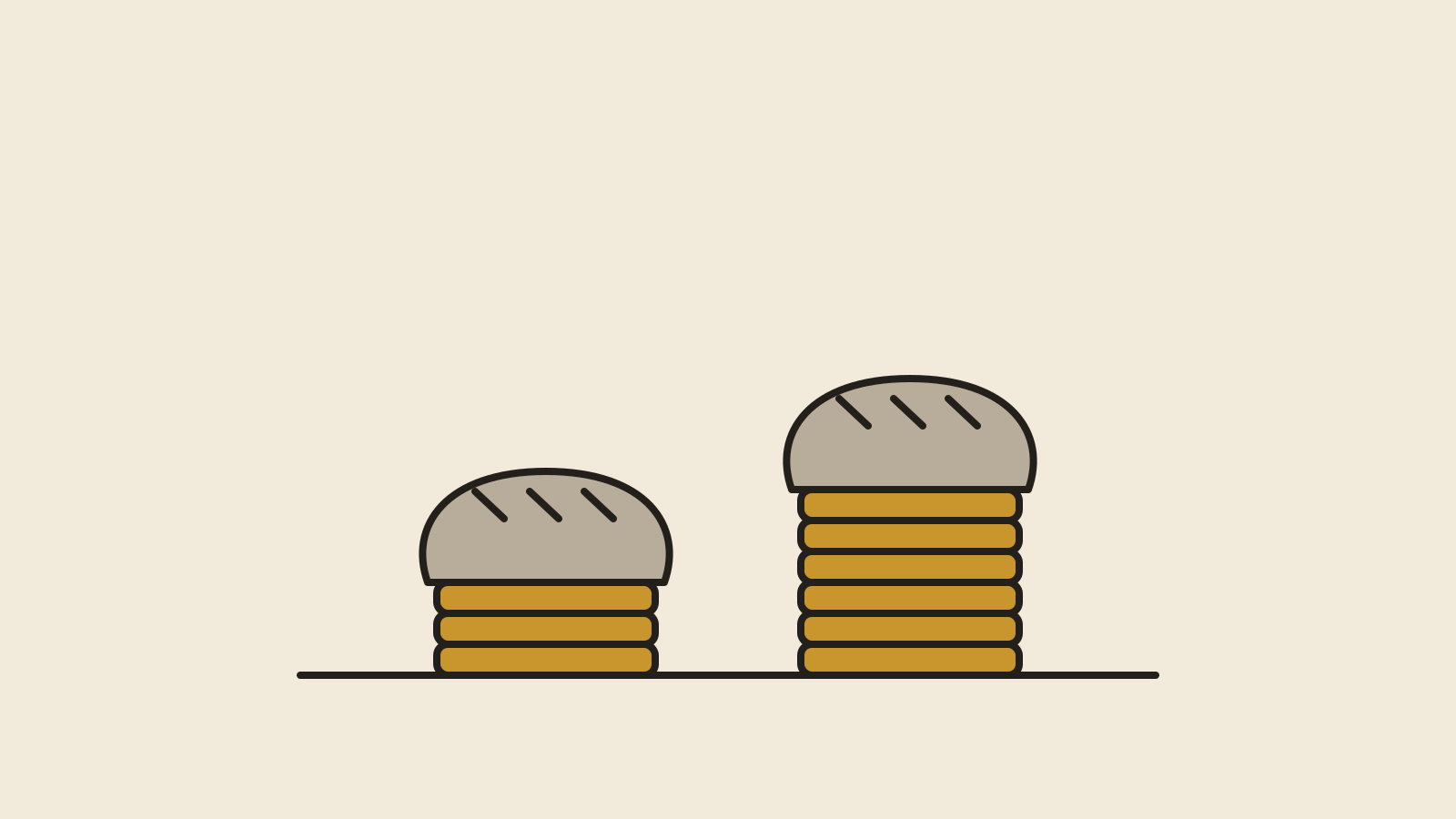
The more money there is chasing the same amount of goods, the higher prices go, roughly in proportion.
The idea
The quantity theory says that the general level of prices depends on how much money is in circulation. Double the money while the amount of goods stays the same, and in time prices roughly double too. Nobody ends up richer. Each note buys half as much.
Picture a school fair where the only currency is paper tokens and the stalls have 200 cakes to sell. If the organisers hand out 1,000 tokens, cakes settle at about five tokens each. Hand out 2,000 and the same cakes fetch ten. Printing tokens produced no extra cake.
Economists write the idea as the equation of exchange. The stock of money, multiplied by the number of times each unit is spent in a year (its velocity), equals the price level multiplied by the volume of goods sold. The equation is true by definition. The theory is the further claim that velocity and output are steady enough for money to drive prices.
Diagram
More money with the same output ends in higher prices
Read as text
A chain of five steps. The money supply grows. People find themselves holding more cash than they want. They spend it. Output cannot expand to match the extra spending. Prices rise roughly in proportion to the increase in money.
Key features
- Causation runs from money to prices, so a lasting inflation needs money growing faster than output.
Inflation
A sustained rise in the general level of prices, which means each unit of money buys less than it did.
- Velocity, the rate at which money changes hands, is taken to be stable or at least predictable.
- In the long run money is neutral: it changes prices and leaves output and employment where they were.
- Most versions accept that in the short run a monetary surprise can lift or depress trade for a year or two.
- The theory concerns the price level as a whole and says nothing about the price of any one good.
Not to be confused with
| Look-alike | The difference | Differs on |
|---|---|---|
| Monetarism | The quantity theory is a claim about money and prices. Monetarism is a twentieth-century school that built a policy programme on it, above all steady money growth set by rule. One can accept the theory and reject the programme. | Differs onScope |
| Inflation | Inflation is the thing to be explained, a sustained rise in prices. The quantity theory is one explanation of it. Older writers used "inflation" for the growth of money itself, which blurs the two. | Differs onClaim |
| Phillips curve | Both account for inflation. The Phillips curve traces it to a tight labour market that bids up wages. The quantity theory traces it to money growth, whatever the state of employment. | Differs onMechanism |
| Modern monetary theory | Modern monetary theory holds that a government issuing its own currency can spend new money without inflation until the economy runs out of spare workers and capacity. The quantity theory expects prices to respond to the money. | Differs onClaim |
- Differs onScope
The quantity theory is a claim about money and prices. Monetarism is a twentieth-century school that built a policy programme on it, above all steady money growth set by rule. One can accept the theory and reject the programme.
- Differs onClaim
Inflation is the thing to be explained, a sustained rise in prices. The quantity theory is one explanation of it. Older writers used "inflation" for the growth of money itself, which blurs the two.
- Differs onMechanism
Both account for inflation. The Phillips curve traces it to a tight labour market that bids up wages. The quantity theory traces it to money growth, whatever the state of employment.
- Differs onClaim
Modern monetary theory
Modern monetary theory holds that a government issuing its own currency can spend new money without inflation until the economy runs out of spare workers and capacity. The quantity theory expects prices to respond to the money.
Origins and development
The idea is usually dated to Jean Bodin, who argued in 1568 that the flood of American silver was the main cause of rising French prices. Martín de Azpilcueta of the Salamanca school had said much the same in 1556. David Hume gave it classic form in 1752, and Irving Fisher set out the equation of exchange in its modern notation in 1911. Milton Friedman revived it in 1956 as a theory of the demand for money, and with Anna Schwartz traced American booms and slumps to monetary swings.
David Hume
A Scottish philosopher who argued that our beliefs about causes, the self and morality rest on habit and feeling more than on reason.
Milton Friedman
An American economist who argued that money drives inflation and slumps, and who made the popular case for free markets over state direction.
Why it matters
It stands behind every warning that printing money to pay government bills ends in inflation, and hyperinflations such as Germany's in 1923 and Zimbabwe's in 2008 fit it closely. Central banks set money-supply targets for this reason in the late 1970s and 1980s. The argument over whether the money created after the 2008 financial crisis and during the pandemic would raise prices was an argument about this theory.
Critiques and limits
John Maynard Keynes argued that velocity is unsteady: in a slump people hoard new money, so prices need not move. Nicholas Kaldor reversed the causation, holding that banks create money in response to demand for loans, so money follows trade and prices. Paul De Grauwe and Magdalena Polan found in 2005 that money growth and inflation move together in high-inflation countries and hardly at all in low-inflation ones. The evidence is contested. The long-run claim holds best where inflation is high.
John Maynard Keynes
The British economist who argued that economies can get stuck in mass unemployment and that governments should spend to pull them out.
Connections
Belongs to
The theory is the field's oldest answer to what sets the general level of prices.
Influenced by
David HumePhilosophy
Hume's essays of 1752 argued that doubling a country's money would in time only double its prices.
Critiques
Hume used it to argue that hoarding gold through trade surpluses only raises a country's prices.
Contrasts with
Differs on scope. The quantity theory is one old proposition about money and prices, and monetarism is a modern school built round it.
Differs on mechanism. Both explain inflation, the Phillips curve through a tight labour market and the quantity theory through money growth.
Differs on claim. Inflation is the rise in prices to be explained, and the quantity theory is one claim about its cause.
Extended by
Monetarism revived the old link between money and prices and added an account of slumps and a policy rule.
Influenced
He restated the old theory as a claim about stable demand for money and built monetarism on it.
Cross with
Two distant entries to read beside this one, each with the question the pairing opens.
MeritocracySociology
When more degrees chase the same number of good positions, does each degree lose value roughly in proportion, as money is said to? Set them side by side
Social constructionismSociology
If money exists only through shared practice, why should its sheer quantity, and not belief about it, govern prices? Set them side by side
Further reading
- De Grauwe, P., & Polan, M. (2005). Is inflation always and everywhere a monetary phenomenon?. The Scandinavian Journal of Economics, 107(2), 239–259. https://doi.org/10.1111/j.1467-9442.2005.00406.x
- Fisher, I. (1911). The purchasing power of money: Its determination and relation to credit, interest and crises. Macmillan.
- Friedman, M., & Schwartz, A. J. (1963). A monetary history of the United States, 1867–1960. Princeton University Press.
- McCallum, B. T. (2008). Monetarism. The Concise Encyclopedia of Economics. https://www.econlib.org/library/Enc/Monetarism.html
Cite this entry
Scholia. (2026). Quantity theory of money. In Scholia: Notes in the margin of the human sciences. Retrieved November 28, 2026, from https://scholia.zennia.sg/ideas/quantity-theory-of-money
This topic is contested. The entry sets out the main positions rather than settling them.