IdeaSociologyAlso in Economics, Psychology
Strength of weak ties
Acquaintances link us to circles our close friends don't reach, so new information, news of jobs included, tends to arrive through weak ties.
The idea
Your close friends mostly know each other, and because they go to the same places and hear the same news, they can tell you little that you haven't already heard. Your acquaintances are different. The former colleague, the neighbour from two flats ago and the person you chat to at the gym each move in circles of their own. Mark Granovetter argued in 1973 that these weak ties do a job strong ties can't. They act as bridges between groups that would otherwise be cut off from one another.
Mark Granovetter
American sociologist who argued that acquaintances beat close friends as sources of new information, and that economic life runs through social relations.
Job-hunting is the standard case. A vacancy at a firm you have never heard of won't reach you through your best friend, who has never heard of it either. It reaches you through someone you bump into at a wedding. The claim scales up, because ideas, rumours and fashions cross a whole society along its weak ties.
Diagram
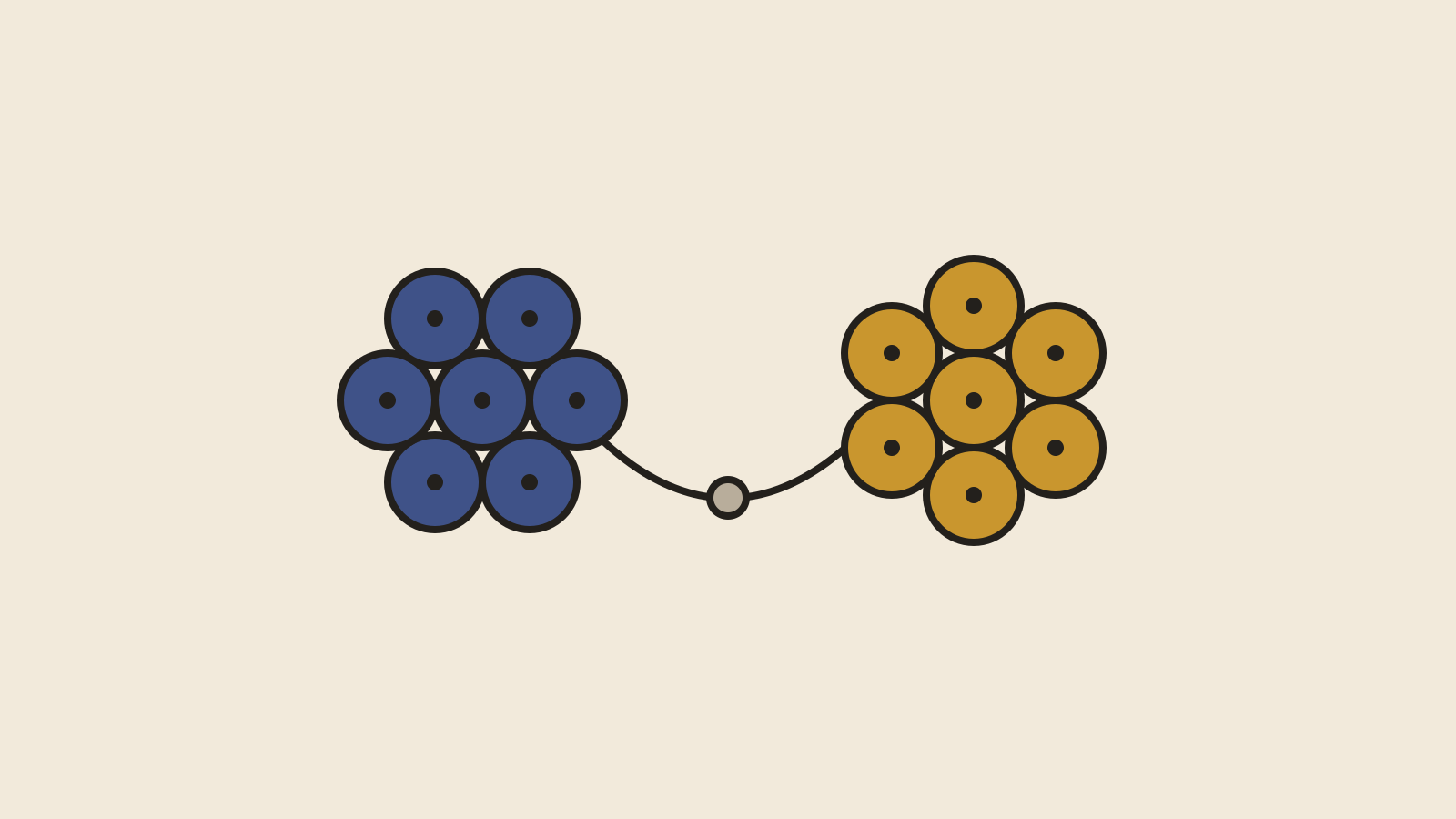
The only link between two tight groups is usually a weak tie
Read as text
Two clusters of three people each. In the first, you, a close friend and a family member are all connected to one another. In the second, an acquaintance, their friend and their colleague are all connected to one another. A single line labelled weak tie joins you to the acquaintance. It is the only route by which news can pass between the two clusters.
Key features
- Tie strength combines the time two people spend together, emotional intensity, mutual confiding and the favours they exchange.
- If one person has strong ties to two others, those two are very likely to know each other, so strong ties cluster into tight groups.
- It follows that a bridge, the only link between two groups, is almost always a weak tie.
- Weak ties supply reach and novelty, while strong ties supply trust, effort and support.
- A community of tight cliques with few weak ties between them finds it hard to organise.
Not to be confused with
| Look-alike | The difference | Differs on |
|---|---|---|
| Social capital | Social capital is the broad claim that relationships are a resource. Weak ties theory is a specific claim about which relationships deliver one resource, new information. | Differs onScope |
| Embeddedness | Embeddedness, Granovetter's later argument, says all economic action runs through social relations. The weak ties thesis says something narrower about which kind of relation carries news. | Differs onScope |
| Six degrees of separation | The small-world idea says any two people are linked by a short chain. Weak ties theory explains which links make the chain short. | Differs onClaim |
| Structural holes | Ronald Burt argued in 1992 that the advantage comes from spanning a gap between groups, whatever the strength of the tie. On his account weakness is a side effect. | Differs onMechanism |
- Differs onScope
Social capital is the broad claim that relationships are a resource. Weak ties theory is a specific claim about which relationships deliver one resource, new information.
- Differs onScope
Embeddedness, Granovetter's later argument, says all economic action runs through social relations. The weak ties thesis says something narrower about which kind of relation carries news.
- Differs onClaim
Six degrees of separation
The small-world idea says any two people are linked by a short chain. Weak ties theory explains which links make the chain short.
- Differs onMechanism
Structural holes
Ronald Burt argued in 1992 that the advantage comes from spanning a gap between groups, whatever the strength of the tie. On his account weakness is a side effect.
Origins and development
Granovetter wrote the paper as a Harvard graduate student. A first version was rejected in 1969, and the American Journal of Sociology published it in 1973. His book Getting a Job (1974) supplied the evidence: among professional workers near Boston who found work through a contact, most saw that contact only occasionally or rarely. He reviewed a decade of tests in 1983. Online platforms later made it possible to measure millions of ties at once.
Why it matters
The idea sits behind every piece of advice to "network", and behind the design of sites that suggest people you may know. It also suggests why a plant closure hits hardest those whose contacts all worked there. Granovetter's own example was a Boston neighbourhood of close-knit family groups that failed to organise against its demolition.
Critiques and limits
Yanjie Bian found in 1997 that in China's state sector jobs came through strong ties, because arranging one was a favour that needed trust. Laura Gee and colleagues, using Facebook data, found that a single strong tie helps more than a single weak one, though weak ties win by sheer number. A 2022 experiment on twenty million LinkedIn users confirmed the causal claim with a twist: moderately weak ties helped job moves most. The idea is supported, with its scope still being mapped.
Connections
Belongs to
The idea came from research on hiring and remains central to the study of labour markets and careers.
Originated by
Granovetter set out the argument in a 1973 paper and backed it with his study of how people found jobs.
Contrasts with
Differs on scope. Embeddedness says all economic action runs through relationships, where weak ties theory says which kind of relationship carries news.
Differs on scope. Social capital is the broad claim that relationships are a resource, and this is a specific claim about which ties deliver new information.
Applied in
Labour economicsEconomics
Models of job search use it to explain why so many vacancies are filled through referrals and personal contacts.
Organisers need weak ties between cliques, since a community of sealed groups struggles to act as one.
Cross with
Two distant entries to read beside this one, each with the question the pairing opens.
Contact hypothesisPsychology
Contact reduces prejudice best between equals with a shared goal: can the thin contact of acquaintanceship carry trust across groups as well as news? Set them side by side
Pidgin and creoleCognitive science & linguistics
Pidgins arise from contact between groups with no shared language: are they the speech of weak ties, and creoles of ties grown strong? Set them side by side
Further reading
- Bian, Y. (1997). Bringing strong ties back in: Indirect ties, network bridges, and job searches in China. American Sociological Review, 62(3), 366–385. https://doi.org/10.2307/2657311
- Granovetter, M. S. (1973). The strength of weak ties. American Journal of Sociology, 78(6), 1360–1380. https://doi.org/10.1086/225469
- Granovetter, M. (1983). The strength of weak ties: A network theory revisited. Sociological Theory, 1, 201–233. https://doi.org/10.2307/202051
- Rajkumar, K., Saint-Jacques, G., Bojinov, I., Brynjolfsson, E., & Aral, S. (2022). A causal test of the strength of weak ties. Science, 377(6612), 1304–1310. https://doi.org/10.1126/science.abl4476
Cite this entry
Scholia. (2026). Strength of weak ties. In Scholia: Notes in the margin of the human sciences. Retrieved November 28, 2026, from https://scholia.zennia.sg/ideas/strength-of-weak-ties