IdeaSociologyAlso in Political theory & science
Types of authority
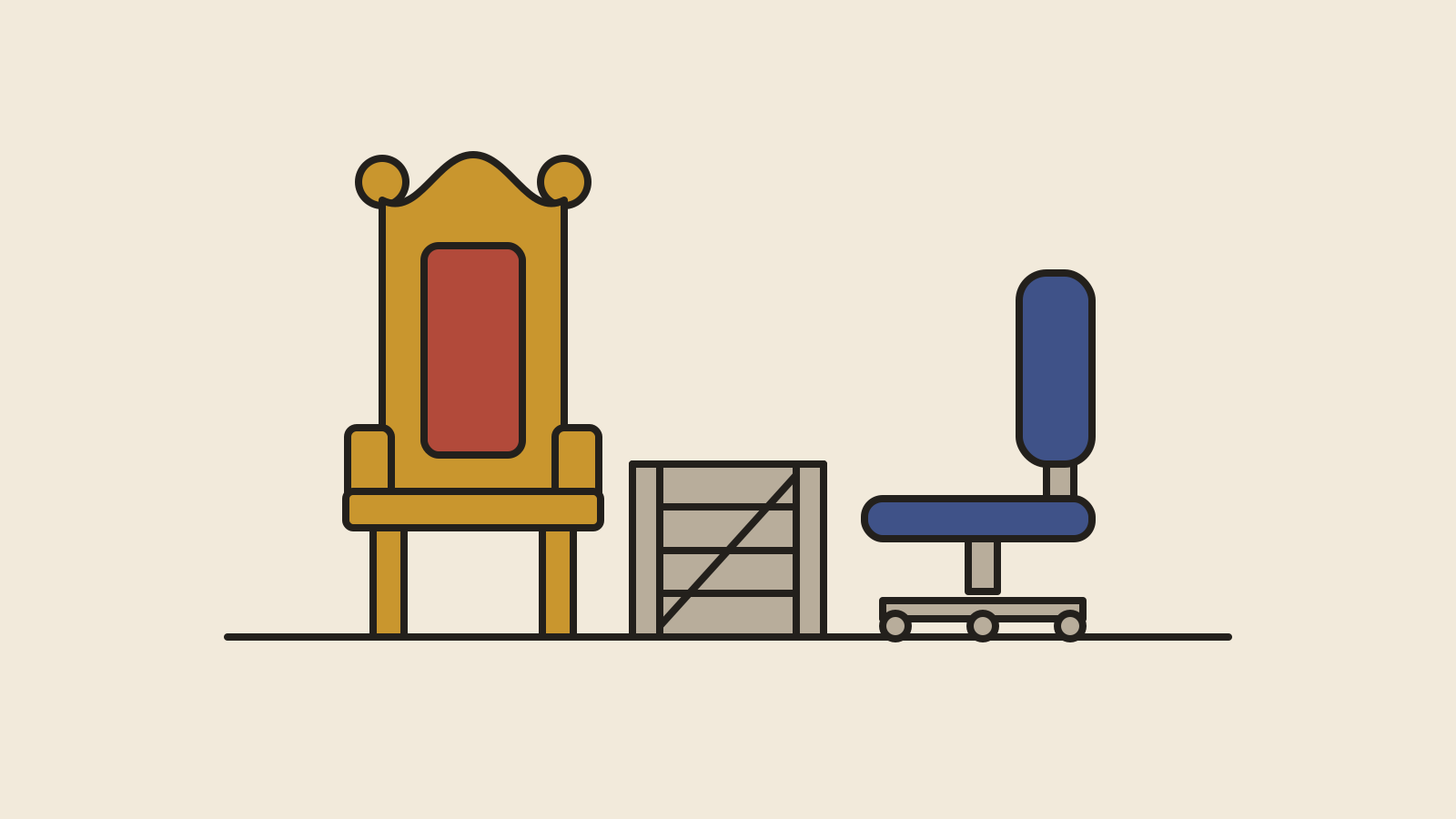
Weber's scheme of three grounds on which people accept commands as rightful: long custom, a leader's exceptional gifts and properly enacted rules.
The idea
People obey for many reasons, fear and habit among them. Max Weber was interested in a narrower case: obedience given because the command is believed to be rightful. His word for rule that is obeyed was Herrschaft, usually translated as authority or domination, and he argued that where such rule is accepted as rightful, the belief rests on one of three grounds.
Max Weber
A German scholar who made sociology the study of meaningful action and traced how calculation and rules came to organise modern life.
Traditional authority rests on custom. Things have always been done this way, and the ruler holds the place that custom assigns. Charismatic authority rests on devotion to a person thought to have extraordinary gifts. Legal-rational authority rests on rules properly enacted. Obedience is owed to the office and passes to whoever holds it next.
A family firm can show all three. The founder's word is law because she built the place from nothing. Her son takes over because sons always have. Then the company lists on the stock exchange, and the chief executive is whoever the board appoints under its articles.
Diagram
Weber traced accepted rule to three different grounds for obedience
Read as text
A tree with legitimate authority at the root and three branches. Traditional authority rests on custom and inheritance. Charismatic authority rests on a leader's exceptional gifts. Legal-rational authority rests on enacted rules and the office a person holds.
Key features
- The three are pure types and real regimes mix them, as a constitutional monarchy mixes custom with law.
- Each type has its own kind of staff: kin and retainers, disciples or salaried officials.
- Charisma is unstable, because it depends on continued proof of the leader's gift and can't easily be handed on.
- Followers must therefore routinise charisma once the leader goes, turning it into tradition or into rules.
- Weber saw modern states and firms moving towards the legal-rational type, with charismatic eruptions along the way.
Not to be confused with
| Look-alike | The difference | Differs on |
|---|---|---|
| Power | Weber defined power as the chance to get one's way even against resistance. Authority is the special case in which commands are obeyed because they are believed rightful, so force is seldom needed. | Differs onMechanism |
| Legitimacy | Legitimacy is the general quality of being accepted as rightful. The three types classify the grounds on which it is claimed and believed. | Differs onScope |
| Class, status and party | Both are three-part schemes by Weber. This one explains why people obey. The other explains how power is divided among groups in society. | Differs onClaim |
| Bureaucracy | Legal-rational authority is a ground for obedience. Bureaucracy is the administrative staff through which that authority usually works. | Differs onScope |
- Differs onMechanism
Power
Weber defined power as the chance to get one's way even against resistance. Authority is the special case in which commands are obeyed because they are believed rightful, so force is seldom needed.
- Differs onScope
Legitimacy is the general quality of being accepted as rightful. The three types classify the grounds on which it is claimed and believed.
- Differs onClaim
Both are three-part schemes by Weber. This one explains why people obey. The other explains how power is divided among groups in society.
- Differs onScope
Legal-rational authority is a ground for obedience. Bureaucracy is the administrative staff through which that authority usually works.
Origins and development
Weber worked the scheme out in the 1910s, and it appeared in Economy and Society in 1922, two years after his death. He took "charisma", a gift of grace, from the church historian Rudolph Sohm and stretched it to cover prophets, war leaders and demagogues. After 1945 the typology became a standard tool for comparing regimes. Charisma meanwhile entered everyday speech in a much weaker sense, meaning little more than personal magnetism.
Why it matters
The scheme helps in reading political news. A party built round one leader faces a succession crisis that a party built on rules does not. New states often lean on a founding figure, then struggle to move loyalty from the person to the constitution. Disputes over whether a court, a monarch or an elected populist truly speaks for the nation are often clashes between Weber's types.
Critiques and limits
David Beetham argued in 1991 that Weber reduced legitimacy to belief. A regime counts as legitimate if people think it is, which leaves no room to ask whether the belief is justified. Beetham added that consent shown in actions, such as voting, finds no place in the scheme. Peter Blau noted that the types describe how authority is justified better than they explain how it arises. The scheme is interpretive: a classification, judged by how well it sorts cases.
Connections
Originated by
Weber devised the three pure types to compare systems of rule across history.
Contrasts with
Differs on scope. Legal-rational authority is a ground for obedience, and bureaucracy is the staff through which it is usually exercised.
Differs on claim. Weber's three types of authority explain why people obey, where this scheme explains how power is divided among groups.
Obedience to authorityPsychology
Differs on level. Weber classifies the grounds on which whole systems of rule are accepted, where Milgram measures one person's response to one instruction.
LegitimacyPolitical theory & science
Differs on scope. Legitimacy is the general quality of rightful rule, and the three types classify the grounds on which it is claimed and believed.
Parallels
Mandate of HeavenPolitical theory & science
Both ground stable rule in the belief that it is rightful, not in force. The Mandate adds a condition for losing it.
HegemonyPolitical theory & science
Both explain why rule rarely needs force: Weber by belief in a ruler's right to command, Gramsci by consent built into common sense.
Applied in
Comparative politicsPolitical theory & science
Students of regimes use the types to ask how rulers justify themselves and how succession is handled.
Charismatic authority and its routinisation explain how a prophet's following hardens into a church.
The statePolitical theory & science
Weber's account of the modern state rests on legal-rational authority exercised through officials.
Cross with
Two distant entries to read beside this one, each with the question the pairing opens.
TransferencePsychology
What would Weber's account of charisma gain or lose if followers' devotion were explained as transference from earlier relationships? Set them side by side
DharmaPhilosophy
Does rule justified by dharma count as Weber's traditional authority, or is duty to a cosmic order a fourth ground he missed? Set them side by side
Further reading
- Beetham, D. (1991). The legitimation of power. Macmillan. https://doi.org/10.1007/978-1-349-21599-7
- Blau, P. M. (1963). Critical remarks on Weber's theory of authority. American Political Science Review, 57(2), 305–316. https://doi.org/10.2307/1952824
- Weber, M. (1978). Economy and society: An outline of interpretive sociology. University of California Press. (Original work published 1922)
Cite this entry
Scholia. (2026). Types of authority. In Scholia: Notes in the margin of the human sciences. Retrieved November 28, 2026, from https://scholia.zennia.sg/ideas/types-of-authority