IdeaPolitical theory & scienceAlso in Sociology, Philosophy
Tyranny of the majority
A majority can oppress as surely as a king, through the laws it passes and through the pressure of prevailing opinion.
The idea
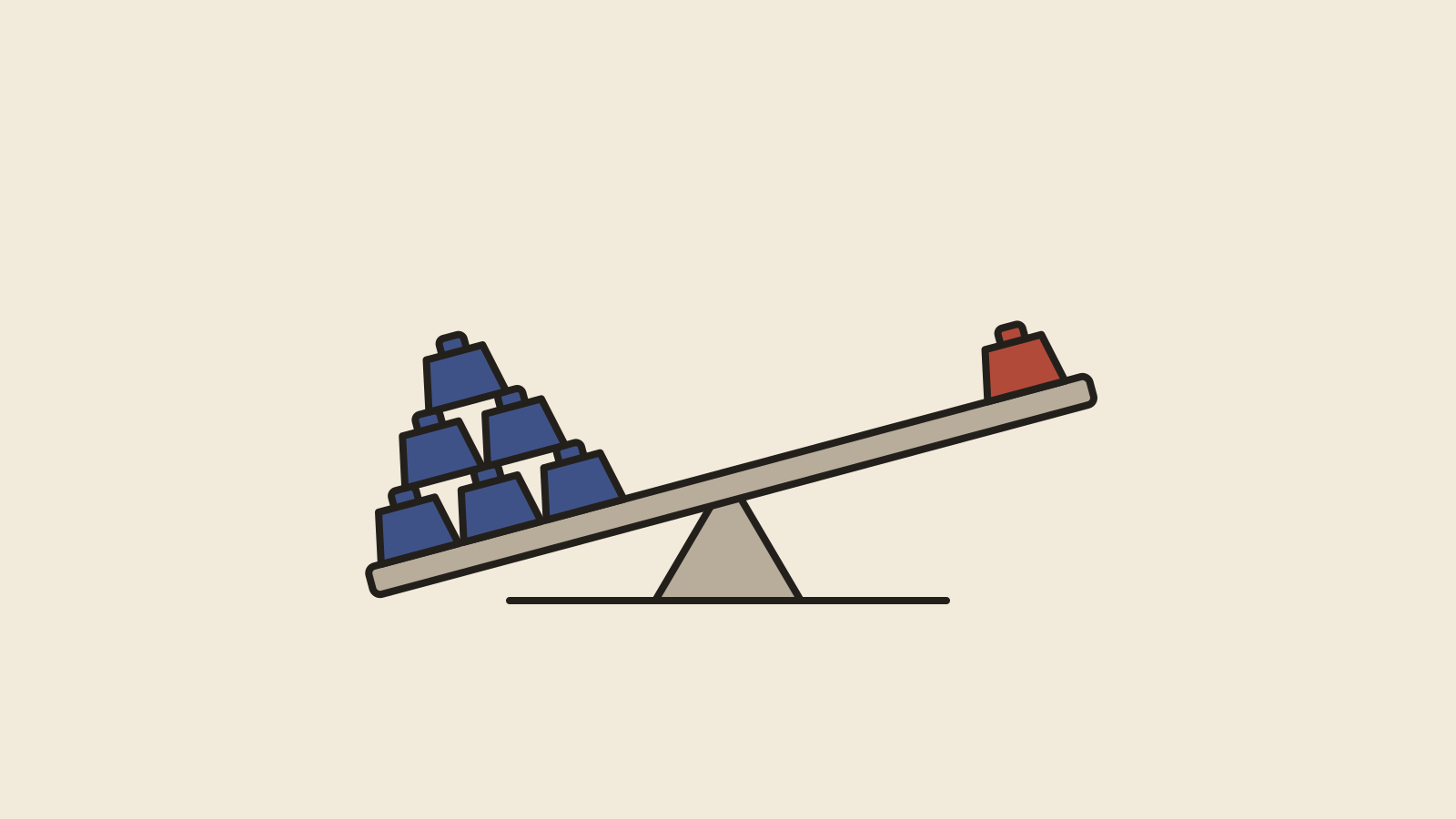
The tyranny of the majority is the claim that rule by the greater number can be as oppressive as rule by one man. Winning a vote settles who decides. It does not make the decision just, and a majority that can do anything may turn its power on those it outnumbers.
Take five flatmates who vote four to one that the fifth will do all the cleaning. The procedure was fair and the result plainly is not. On a national scale the losers may be a religious group, a language community or simply people with unpopular views. Alexis de Tocqueville saw the danger in American law-making in the 1830s, and in the way majority opinion silenced dissent. John Stuart Mill put that second form at the centre: prevailing opinion can police what people say and how they live with no law passed at all.
Alexis de Tocqueville
A French aristocrat who studied American democracy to learn what equality does to freedom, manners and the habits of citizens.
John Stuart Mill
The Victorian philosopher who gave utilitarianism its classic form and made the leading liberal case for free speech, individual liberty and women's equality.
Diagram
A majority can rule over dissenters through law or through opinion
Read as text
Two columns show how a majority can rule over dissenters. Through law, it uses votes and statutes enforced by officials. Through opinion, it uses custom and disapproval enforced by neighbours, with no law needed.
Key features
- The danger lies in unlimited power, whoever holds it, so a majority earns no exemption by being numerous.
- It works through two channels: laws passed by elected bodies, and social pressure that punishes dissent without any law.
- Permanent minorities are the most exposed, because a group that loses every vote has nothing to trade with tomorrow's majority.
- The usual remedies limit what majorities may decide: entrenched rights, the rule of law, the separation of powers, federalism and strong voluntary associations.
Rule of law
The principle that everyone, the government included, is bound by public, general laws applied by independent courts.
Not to be confused with
| Look-alike | The difference | Differs on |
|---|---|---|
| Majority rule | Majority rule is a procedure for settling disagreements by counting. The tyranny of the majority is a warning about one way the procedure can be abused. Accepting the warning does not mean rejecting the procedure. | Differs onClaim |
| General will | Rousseau held that a properly formed general will cannot wrong any citizen. Tocqueville and Mill held that majorities can oppress while sincerely believing they speak for all. | Differs onClaim |
| Harm principle | The tyranny of the majority is a diagnosis of what democratic societies tend to do. The harm principle is Mill's rule for when society may rightly interfere with an individual. | Differs onDescriptive or normative |
| Totalitarianism | Majority tyranny works through votes and public opinion inside a democracy. Totalitarian rule works through a single party, an official ideology and organised terror, and needs no majority behind it. | Differs onMechanism |
- Differs onClaim
Majority rule
Majority rule is a procedure for settling disagreements by counting. The tyranny of the majority is a warning about one way the procedure can be abused. Accepting the warning does not mean rejecting the procedure.
- Differs onClaim
Rousseau held that a properly formed general will cannot wrong any citizen. Tocqueville and Mill held that majorities can oppress while sincerely believing they speak for all.
- Differs onDescriptive or normative
The tyranny of the majority is a diagnosis of what democratic societies tend to do. The harm principle is Mill's rule for when society may rightly interfere with an individual.
- Differs onMechanism
Majority tyranny works through votes and public opinion inside a democracy. Totalitarian rule works through a single party, an official ideology and organised terror, and needs no majority behind it.
Origins and development
Fear of popular rule is ancient. Plato and Aristotle both warned that the many could plunder the few. James Madison's Federalist No. 10 (1787) treated a majority faction as the chief risk in a republic, and John Adams used the phrase itself in 1788. Tocqueville made it famous in the first volume of Democracy in America (1835), and Mill's On Liberty (1859) made the social form its main target. In 1994 the American legal scholar Lani Guinier applied it to racial minorities who are outvoted election after election.
Why it matters
The idea is the standard reason given for bills of rights, constitutional courts and rules that make some laws hard to change. It comes up whenever a referendum touches a minority's rights, when a court strikes down a popular law and when an online pile-on punishes an unpopular opinion. Arguments over proportional representation and minority vetoes draw on it too.
Critiques and limits
Robert Dahl argued in 1956 that Madison's fear was overdrawn: in practice shifting coalitions of minorities govern, and every device that restrains a majority hands a veto to some minority. Jeremy Waldron adds that losing a vote after a fair hearing is no tyranny, and that judges striking down laws are a small majority overruling a large one. The evidence status is interpretive. History supplies cases, like laws against religious minorities and racial segregation, but how common the danger is and which remedy works best remain matters of judgement.
Robert Dahl
An American political scientist who studied who holds power in democracies and gave real-world democracy its own name, polyarchy.
Connections
Belongs to
It is democratic theory's standard warning about what majority rule can do when nothing limits it.
Liberals use it to justify rights and courts that no majority may override.
Originated by
Tocqueville made the phrase famous in Democracy in America in 1835, though John Adams had used it in 1788.
Contrasts with
Arrow's impossibility theoremEconomics
Differs on claim. Tocqueville and Mill feared a settled majority that oppresses, where Arrow shows there may be no coherent majority will at all.
Differs on claim. Rousseau held that a true general will cannot wrong a citizen, where Tocqueville and Mill held that majorities can oppress in its name.
Differs on descriptive or normative. Majority tyranny is the danger Mill diagnosed in democratic societies, and the harm principle is the rule he set against it.
Differs on mechanism. Majority tyranny presses dissenters through votes and opinion in a democracy, where totalitarian rule uses party, ideology and terror.
Parallels
ConformityPsychology
Social psychology found in the laboratory the pull of a unanimous group that Tocqueville and Mill described in whole societies.
Influenced
John Stuart MillPhilosophy
Mill took the phrase from Tocqueville and made its social form, the pressure of prevailing opinion, the main target of On Liberty.
Cross with
Two distant entries to read beside this one, each with the question the pairing opens.
Moral panicSociology
A moral panic casts a group as a threat out of proportion to any harm. What separates it from Tocqueville's tyranny of opinion? Set them side by side
Pareto efficiencyEconomics
A Pareto test blocks any change that leaves someone worse off. Would it cure majority tyranny or hand every minority a veto? Set them side by side
Further reading
- Dahl, R. A. (1956). A preface to democratic theory. University of Chicago Press.
- Mill, J. S. (1859). On liberty. John W. Parker and Son.
- Tocqueville, A. de. (2000). Democracy in America. University of Chicago Press. https://doi.org/10.7208/chicago/9780226924564.001.0001 (Original work published 1835)
- Waldron, J. (2006). The core of the case against judicial review. The Yale Law Journal, 115(6), 1346–1406. https://doi.org/10.2307/20455656
Cite this entry
Scholia. (2026). Tyranny of the majority. In Scholia: Notes in the margin of the human sciences. Retrieved November 28, 2026, from https://scholia.zennia.sg/ideas/tyranny-of-the-majority