IdeaPhilosophy
Underdetermination
The claim that the evidence available never settles on its own which of several rival theories, or which of a theory's assumptions, to accept.
The idea
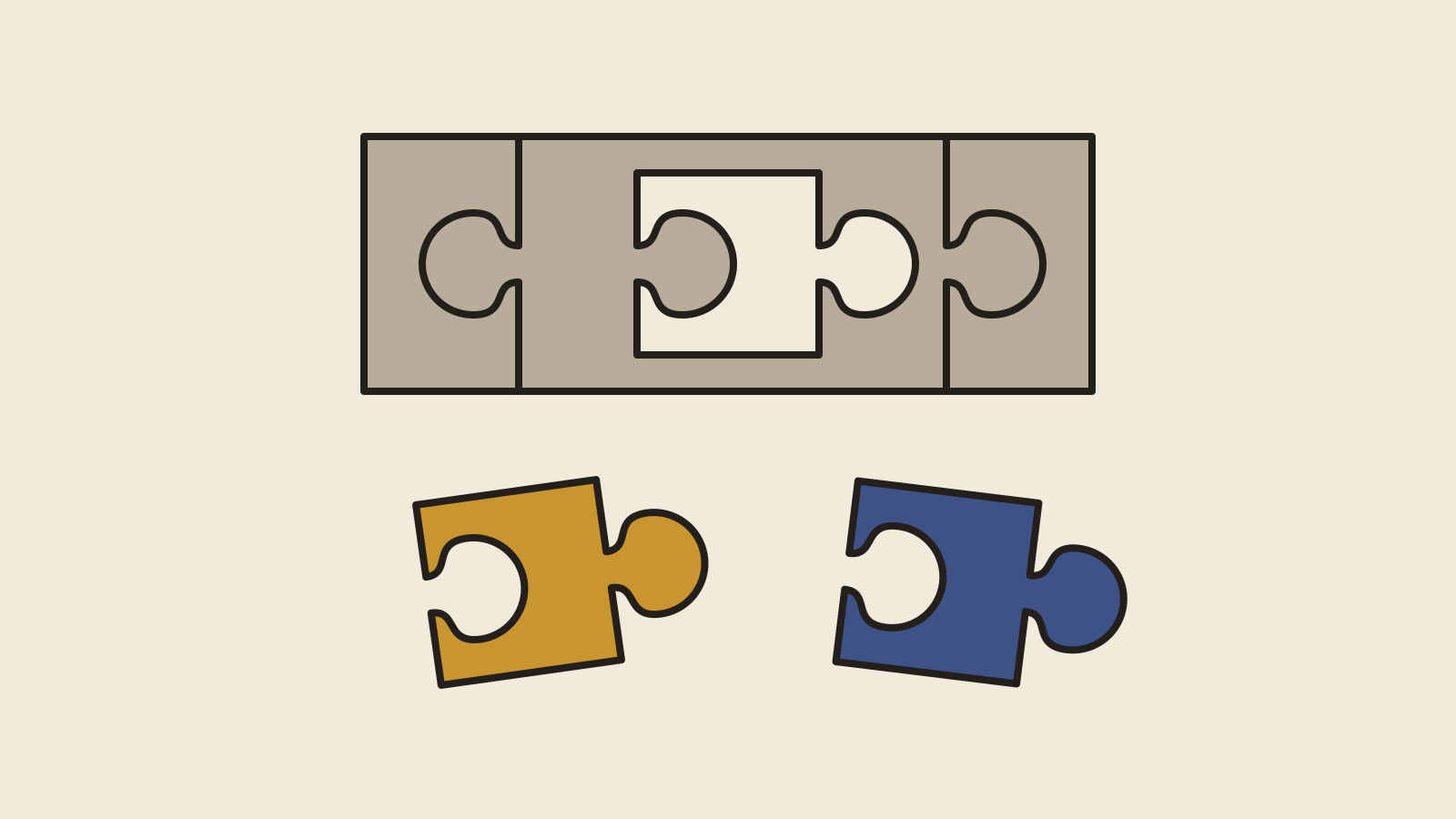
Underdetermination is the gap between evidence and theory. However much data you collect, it fits more than one explanation, so the data alone cannot tell you which to believe.
The warning light on your car's dashboard comes on. Perhaps the engine has a fault. Perhaps the sensor that watches the engine is faulty and the engine is fine. Both stories predict exactly what you see. To choose, you need something beyond the light, such as a mechanic's test, which brings its own assumptions with it.
Philosophers of science find the same gap in science, in two forms. A hypothesis never meets the evidence alone. It makes predictions only together with assumptions about instruments and background conditions, so a failed prediction does not say which part is wrong. And two quite different theories can agree on every observation made so far, or perhaps on every observation that could ever be made.
Diagram
Two theories can match every observation so far and still predict differently
Read as text
A graph of predicted measurement against the conditions tested. Two curves, Theory A and Theory B, pass through the same four observed points, so every observation made so far fits both. Beyond the last observation they part: Theory A keeps rising in a straight line, while Theory B climbs much more steeply. Only a test in the untested region could tell them apart. The caption notes that the strong form of underdetermination says no possible test would.
Key features
- Holist underdetermination says a test always checks a bundle of hypotheses together, never one in isolation, so blame for a failure can be moved.
- Contrastive underdetermination says rival theories can fit the same evidence equally well.
- The transient form concerns the evidence we have now, which later tests may settle. The strong form concerns all possible evidence.
- If evidence cannot decide, something else must, such as simplicity, fruitfulness or the shared judgement of scientists.
Not to be confused with
| Look-alike | The difference | Differs on |
|---|---|---|
| Paradigm shift | Underdetermination is a logical point about evidence and theory. Kuhn's paradigm shift is a historical account of how sciences change. Kuhn relied on underdetermination to argue that logic and evidence alone do not force the choice between paradigms. | Differs onScope |
| Indeterminacy of translation | Quine said that rival translations of a language could fit all the evidence with no fact deciding between them. For physics he held that there is a fact of the matter, even if the evidence cannot show which theory captures it. | Differs onClaim |
| Poverty of the stimulus | Any body of data fits more than one theory, and that holds for every learner and every scientist. The linguistic argument adds a factual claim, that children lack particular evidence they would need to learn grammar from scratch. | Differs onScope |
- Differs onScope
Underdetermination is a logical point about evidence and theory. Kuhn's paradigm shift is a historical account of how sciences change. Kuhn relied on underdetermination to argue that logic and evidence alone do not force the choice between paradigms.
- Differs onClaim
Quine said that rival translations of a language could fit all the evidence with no fact deciding between them. For physics he held that there is a fact of the matter, even if the evidence cannot show which theory captures it.
- Differs onScope
Any body of data fits more than one theory, and that holds for every learner and every scientist. The linguistic argument adds a factual claim, that children lack particular evidence they would need to learn grammar from scratch.
Origins and development
The French physicist Pierre Duhem argued in The Aim and Structure of Physical Theory (1906) that physicists can never test a hypothesis in isolation, which rules out a truly crucial experiment. Willard Van Orman Quine extended the point to all knowledge in "Two dogmas of empiricism" (1951), so the joint view is often called the Duhem–Quine thesis. In 1975 Quine weighed the stronger claim that rival theories could agree on every possible observation. Kyle Stanford argued in 2006 that scientists have repeatedly failed to think of rivals that later evidence favoured.
W. V. O. Quine
An American logician and philosopher who denied that any truths hold by meaning alone and treated philosophy as continuous with science.
Why it matters
When a drug trial fails, researchers must decide whether the drug or the trial design was at fault. The same evidence is read differently in disputes over climate models, economic forecasts and forensic findings. Underdetermination explains why such arguments can persist among honest and competent people, and why values and judgement enter science at the point of theory choice.
Critiques and limits
Larry Laudan and Jarrett Leplin argued in 1991 that theories with the same observable consequences need not be equally supported, since evidence can bear on a theory indirectly through other theories it links to. Laudan also warned against inflating a modest logical point into the claim that evidence decides nothing. This is a conceptual dispute and remains open, with most philosophers accepting the holist point and many doubting the strong form.
Connections
Belongs to
It is one of the field's central problems about how far evidence can decide between theories.
Originated by
Quine stretched Duhem's point about physics to all knowledge in 1951, hence the name Duhem–Quine thesis.
Critiques
A failed prediction refutes a theory only together with its auxiliary assumptions, so no single test can tell which to drop.
If rival theories fit the evidence equally, success gives no reason to believe one of them is true about unobservables.
Contrasts with
Differs on claim. Underdetermined theories still differ in which is true, while Quine held that rival translations leave no fact to be right about.
Poverty of the stimulusCognitive science & linguistics
Differs on scope. Underdetermination holds for every learner and scientist, while the linguistic argument adds that children lack specific evidence they would need.
Differs on scope. Underdetermination is a logical gap between evidence and theory, and Kuhn's paradigm shift is a historical account of change that relies on it.
Further reading
- Duhem, P. (1954). The aim and structure of physical theory. Princeton University Press. (Original work published 1906)
- Laudan, L., & Leplin, J. (1991). Empirical equivalence and underdetermination. The Journal of Philosophy, 88(9), 449–472. https://doi.org/10.2307/2026601
- Okasha, S. (2002). Philosophy of science: A very short introduction. Oxford University Press.
- Quine, W. V. (1951). Two dogmas of empiricism. The Philosophical Review, 60(1), 20–43. https://doi.org/10.2307/2181906
Cite this entry
Scholia. (2026). Underdetermination. In Scholia: Notes in the margin of the human sciences. Retrieved November 28, 2026, from https://scholia.zennia.sg/ideas/underdetermination