IdeaPhilosophy
Zeno's paradoxes
Ancient arguments by Zeno of Elea that motion and plurality lead to contradiction, built on dividing space and time without end.
The idea
Zeno's paradoxes are a set of short arguments that seem to prove that nothing moves. Each starts from ordinary assumptions about space and time and ends in absurdity. In the best known, swift Achilles races a tortoise that has a head start. By the time Achilles reaches the spot where the tortoise was, it has crept a little further. When he reaches that new spot, it has moved again. However small the gaps become, there is always another one, so Achilles seems never to catch up.
Anyone who has tried to close a door by pushing it halfway, then half the remaining gap, then half again, has met the same puzzle. The steps get tiny. They never run out. Zeno's aim was to defend his teacher Parmenides, who held that change is an illusion. If believers in motion fall into contradiction, he argued, their view is in no better shape than his.
Parmenides
A Greek philosopher from Elea who argued, by reasoning alone, that what exists cannot change, begin or end.
Diagram
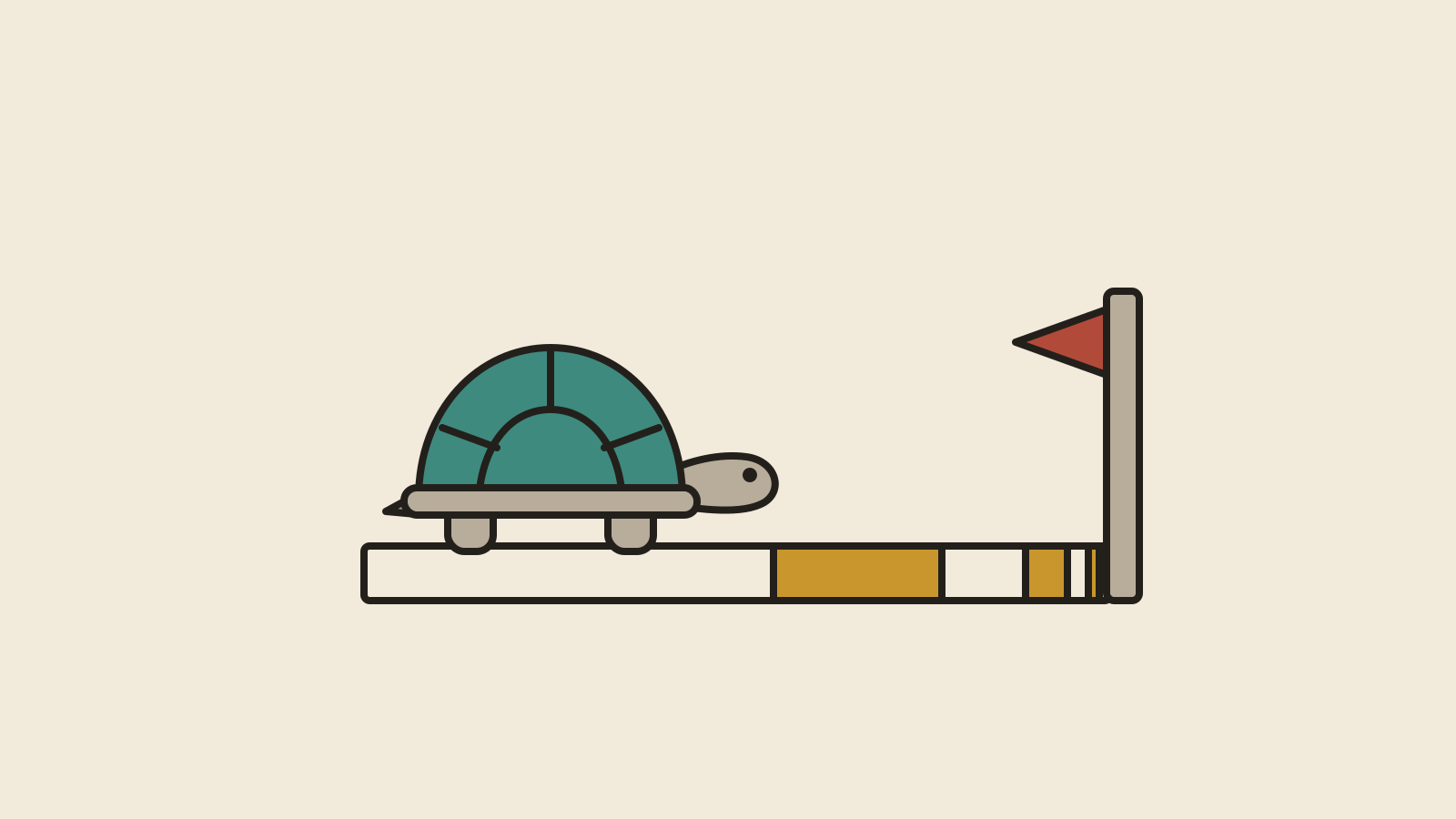
To reach the finish, a runner must first cross endlessly many halfway points
Read as text
A track runs from the start on the left to the finish on the right. Marks stand at the halfway point, three quarters, seven eighths and fifteen sixteenths of the way, each one closing half of the remaining gap. The marks crowd towards the finish without ever reaching it, which is Zeno's claim that the runner has endlessly many points to cross first.
Key features
- The Dichotomy says that to cross any distance you must first cross half of it, then half the rest, which makes infinitely many tasks.
- Achilles and the tortoise applies the same division to a chase, so the faster runner never closes the last gap.
- The Arrow claims that a flying arrow, at any single instant, fills a space just its own size and so is at rest.
- The Moving Rows compares bodies passing one another to argue that half a stretch of time equals its double.
- Further arguments against plurality claim that if many things exist, they must be both infinitely small and infinitely large.
Not to be confused with
| Look-alike | The difference | Differs on |
|---|---|---|
| Sorites paradox | Both creep forward by tiny steps. The sorites trades on vague words: one grain does not make a heap, so no number of grains seems to. Zeno's arguments trade on dividing space and time without end. | Differs onMechanism |
| Liar paradox | The sentence "this sentence is false" produces a contradiction by referring to itself. Zeno's paradoxes involve no self-reference. Their trouble comes from infinity and continuous space and time. | Differs onMechanism |
| Thought experiment | A thought experiment imagines a scenario to test a claim against our judgements. Zeno's paradoxes are strict arguments that deduce a contradiction from an opponent's premises, though the race of Achilles is often told as a story. | Differs onMethod |
- Differs onMechanism
Both creep forward by tiny steps. The sorites trades on vague words: one grain does not make a heap, so no number of grains seems to. Zeno's arguments trade on dividing space and time without end.
- Differs onMechanism
The sentence "this sentence is false" produces a contradiction by referring to itself. Zeno's paradoxes involve no self-reference. Their trouble comes from infinity and continuous space and time.
- Differs onMethod
A thought experiment imagines a scenario to test a claim against our judgements. Zeno's paradoxes are strict arguments that deduce a contradiction from an opponent's premises, though the race of Achilles is often told as a story.
Origins and development
Zeno wrote the arguments in the fifth century BCE, but his book is lost. Aristotle preserved the four paradoxes of motion in his Physics, mostly to refute them, and Simplicius later quoted the plurality arguments. For two thousand years Aristotle's answer, that the infinite divisions are only potential, was standard. In the nineteenth century mathematicians defined limits precisely and showed that a half plus a quarter plus an eighth, and so on, sums to exactly one. Georg Cantor's theory of infinite sets followed, and Bertrand Russell and others used both to declare the paradoxes solved.
Aristotle
Plato's pupil, who founded logic and biology and wrote the works on ethics, politics and nature that organised learning for two thousand years.
Bertrand Russell
The British logician who made the analysis of language philosophy's main method and became one of his century's best-known public intellectuals.
Why it matters
The paradoxes are the oldest arguments about infinity still taught. They pushed Greek thinkers to ask whether space and time are continuous or made of smallest units. Aristotle reports that the atomists, Democritus among them, answered partly by positing bodies too small to be cut. Students still meet the race of Achilles in first lessons on infinite series, as the standard case of an endless sum with a finite total. They remain a standard test for any theory of motion, time and the continuum.
Democritus
A Greek philosopher from Abdera who held that everything is made of tiny uncuttable atoms moving in empty space.
Critiques and limits
Most philosophers accept the mathematical reply: infinitely many distances can add up to a finite length, crossed in a finite time. Not everyone agrees. James Thomson argued in 1954 that completing infinitely many separate acts, a supertask, is still incoherent. Henri Bergson held that the mathematics treats motion as a series of still positions and so misdescribes it. Because the paradoxes are logical arguments, evidence does not decide them. The calculus answer is widely accepted, while the question of supertasks remains open.
Henri Bergson
The French philosopher who argued that real time is lived, flowing duration, which clocks and concepts cut into pieces and so misdescribe.
Connections
Belongs to
They test whether space, time and motion can be continuous, infinitely divisible quantities.
Originated by
Zeno wrote the arguments in a book defending Parmenides, now lost except for fragments and Aristotle's summaries.
Influenced by
The paradoxes defend Parmenides' claim that reality is one and unchanging by showing that motion and plurality are absurd.
Contrasts with
Differs on mechanism. Zeno's puzzles turn on dividing space and time without end, the sorites on how far a vague word stretches.
Differs on mechanism. The liar produces contradiction through a sentence that refers to itself, while Zeno's arguments arise from infinity and the continuum.
Differs on method. A thought experiment imagines a scenario to test a claim, while Zeno's paradoxes deduce a contradiction from an opponent's premises.
Parallels
Nagarjuna's analysis of motion, which finds no going in the path gone, not gone or being gone, reaches a similar impasse.
Influenced
Aristotle reports that the atomists posited bodies too small to be cut partly to escape Zeno's arguments from endless division.
Further reading
- Aristotle. (1996). Physics. Oxford University Press. (Original work published -350)
- Lee, H. D. P. (1936). Zeno of Elea: A text, with translation and notes. Cambridge University Press.
- Sainsbury, R. M. (2009). Paradoxes (3rd ed.). Cambridge University Press. https://doi.org/10.1017/CBO9780511812576 (Original work published 1988)
Cite this entry
Scholia. (2026). Zeno's paradoxes. In Scholia: Notes in the margin of the human sciences. Retrieved November 28, 2026, from https://scholia.zennia.sg/ideas/zenos-paradoxes