PersonCognitive science & linguisticsAlso in Psychology
David Rumelhart
The American psychologist who showed how networks of simple units can learn from their errors, and so revived the neural network approach to mind.
Why they matter
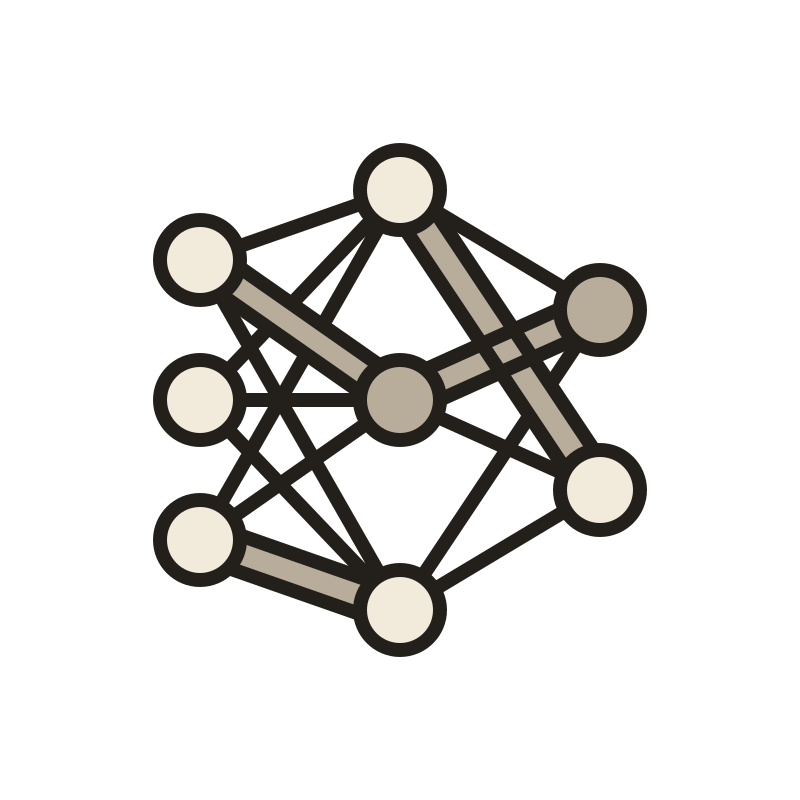
David Rumelhart showed how a network of simple units, loosely modelled on nerve cells, could learn for itself. Each unit only adds up the signals it receives and passes a signal on. What the network knows lies in the strengths of the connections between units, and learning means adjusting those strengths. In 1986, with Geoffrey Hinton and Ronald Williams, he showed that a method called backpropagation could train networks with hidden middle layers. It sends each error back through the network and nudges every connection that contributed to it.
A child learning English says went, then for a while goed, then went again. The usual explanation was that the child discovers the rule of adding -ed and applies it too widely. Rumelhart and James McClelland trained a network on verbs and reported a similar pattern, with no rule written anywhere inside it. The systems behind today's machine translation and chatbots are trained by backpropagation.
Key ideas
- Parallel distributed processing: thinking is many simple units working at once, with knowledge spread over many connections, the core of connectionism.
Connectionism
The view that minds are networks of simple connected units, with knowledge stored in connection strengths and learned from examples.
- Backpropagation: a network with hidden layers learns by passing its output error backwards and changing each connection according to its share of the blame.
- Rules without rules: behaviour that looks rule-governed, such as forming the past tense, can arise in a network that contains no explicit rule.
- Schemata: his earlier work described knowledge as packaged in a schema for each familiar object, event or story, with slots filled in by context.
Schema
A schema is an organised packet of general knowledge about a kind of thing or event that guides what we notice, expect and remember.
- Interactive activation: in reading, guesses about the word feed back to sharpen the perception of its letters.
Not to be confused with
| Look-alike | The difference | Differs on |
|---|---|---|
| Allen Newell | Newell's models hold knowledge as explicit symbols and rules that can be read off one by one. Rumelhart's hold it as connection strengths spread across a network, where no single part states a rule. | Differs onMechanism |
| Marvin Minsky | Rumelhart's networks are made of near-identical units and learn what they know from examples, through changes in connection strength. Minsky's agents are varied specialists, many of them built in or arranged by designed structures such as frames. | Differs onMechanism |
| Geoffrey Hinton | His co-author on backpropagation went on to treat neural networks mainly as a method for machine learning. Rumelhart was a psychologist, and his networks were meant as models of how people read, remember and speak. | Differs onScope |
- Differs onMechanism
Newell's models hold knowledge as explicit symbols and rules that can be read off one by one. Rumelhart's hold it as connection strengths spread across a network, where no single part states a rule.
- Differs onMechanism
Rumelhart's networks are made of near-identical units and learn what they know from examples, through changes in connection strength. Minsky's agents are varied specialists, many of them built in or arranged by designed structures such as frames.
- Differs onScope
Geoffrey Hinton
His co-author on backpropagation went on to treat neural networks mainly as a method for machine learning. Rumelhart was a psychologist, and his networks were meant as models of how people read, remember and speak.
Life and context
Rumelhart was born in South Dakota in 1942 and studied psychology and mathematics at the state university. He took a doctorate in mathematical psychology at Stanford in 1967 and joined the young psychology department at the University of California, San Diego. Through the 1970s he worked there on symbolic models of memory and of how readers follow a story.
Dissatisfaction with those models led him, with McClelland and Hinton, to form the PDP Research Group. Its two volumes of 1986 revived neural network research after some fifteen years of neglect. He moved back to Stanford in 1987. In the 1990s he developed Pick's disease, a degenerative illness of the brain, and he retired in 1998. He died in 2011.
Life strip
- 1942 Born
- 1942 Born in Mitchell, South Dakota
- 1963 Graduates in psychology and mathematics, Vermillion
- 1967 Takes a doctorate in mathematical psychology at Stanford, Palo Alto
- 1967 Joins the University of California, San Diego
- 1981 Publishes a network model of letter perception with James McClelland, San Diego
- 1986 Publishes Parallel Distributed Processing and the backpropagation paper, San Diego
- 1987 Moves to Stanford and receives a MacArthur Fellowship, Palo Alto
- 1998 Retires with Pick's disease, Palo Alto
- 2011 Dies aged 68, Chelsea, Michigan
- 2011 Died
Legacy
Backpropagation remains the standard way to train neural networks, including the very large ones behind speech recognition, image search and chatbots. In psychology, network models of reading, memory and language learning descend from his work with McClelland. The David E. Rumelhart Prize, funded by his former student Robert Glushko and first given in 2001, is awarded each year for contributions to the theoretical foundations of human cognition.
Critiques and limits
He was not the first to find backpropagation. Paul Werbos had described it in a 1974 thesis unknown to Rumelhart's group. What they added was the demonstration that it builds useful internal representations. Steven Pinker and Alan Prince argued in 1988 that the past-tense network owed its results to the order in which verbs were fed to it, and that it made errors no child makes. Jerry Fodor and Zenon Pylyshyn objected that networks without structured symbols cannot explain why anyone who can think one thought can think its rearrangements.
Jerry Fodor
An American philosopher who argued that thinking is computation in an inner language and that parts of the mind work as sealed modules.
Lineage
Influenced by

Influenced
None recorded yet
Connections
Belongs to
The two volumes he edited with James McClelland in 1986 are the school's founding statement.
Cognitive psychologyPsychology
He was an experimental psychologist, and his networks were built to explain laboratory findings on reading and memory.
Influenced by
Frederic BartlettPsychology
His schema theory of the 1970s revived Bartlett's idea that memory is organised by frameworks of past experience.
Critiques
His past-tense network produced rule-like behaviour without rules, against the view that grammar must be stored as explicit rules.
He put knowledge in connection strengths, denying that thinking has to be rules applied to sentence-like symbols.
Contrasts with
Differs on mechanism. Newell's models hold knowledge as explicit symbols and rules, where Rumelhart's hold it as connection strengths across a network.
Differs on mechanism. Rumelhart's networks are uniform units that learn from examples, where Minsky's agents are varied specialists with built-in structure.
Originated
The school proper dates from 1986, when Rumelhart and James McClelland published the Parallel Distributed Processing volumes.
Further reading
Read first
Rumelhart, D. E., McClelland, J. L., & the PDP Research Group. (1986). Parallel distributed processing: Explorations in the microstructure of cognition. Volume 1: Foundations. MIT Press. https://doi.org/10.7551/mitpress/5236.001.0001
- Buckner, C., & Garson, J. (2019). Connectionism. Stanford Encyclopedia of Philosophy. https://plato.stanford.edu/entries/connectionism/
- Rumelhart, D. E., Hinton, G. E., & Williams, R. J. (1986). Learning representations by back-propagating errors. Nature, 323(6088), 533–536. https://doi.org/10.1038/323533a0
- Rumelhart, D. E. (1980). Schemata: The building blocks of cognition. In R. J. Spiro & B. C. Bruce & W. F. Brewer (Eds.), Theoretical issues in reading comprehension (pp. 33–58). Lawrence Erlbaum Associates.
Cite this entry
Scholia. (2026). David Rumelhart. In Scholia: Notes in the margin of the human sciences. Retrieved November 28, 2026, from https://scholia.zennia.sg/people/david-rumelhart