PersonPsychology
Harry Harlow
The American psychologist whose experiments on infant monkeys showed that comfort, more than food, ties a baby to its mother, by methods still argued over.
Why they matter
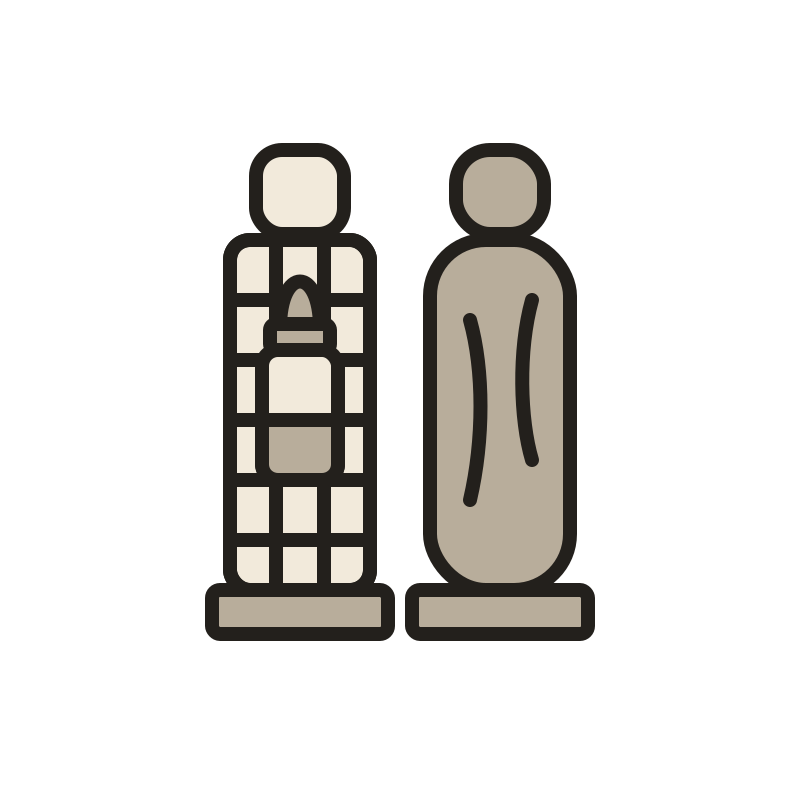
In the 1950s most psychologists explained a baby's love for its mother as a by-product of feeding. She brings milk, so the baby learns to want her near. Harry Harlow tested the idea on infant rhesus monkeys and broke it. He took newborns from their mothers and gave each a pair of dummies. One was bare wire and held a bottle. The other was wrapped in soft cloth and gave nothing. The infants fed at the wire figure and spent most of the day clinging to the cloth one. When frightened they ran to it.
Any parent whose toddler won't sleep without one worn blanket has watched the same need at work. Harlow called it contact comfort. His later studies went further. He raised monkeys alone to learn what the absence of all company does, and those experiments made him one of the most disputed figures in the history of his science.
Key ideas
- Contact comfort: an infant's tie to its mother rests on soft bodily contact and owes little to feeding, a finding attachment theory was built on.
Attachment theory
Infants are born needing a close tie to a carer, and the quality of that tie shapes how they explore and relate to others.
- The mother as a base: a monkey with its cloth figure nearby explored a strange room, and one without it froze and cried, as babies later did in the Strange Situation.
Strange Situation
Ainsworth's claim that how a one-year-old behaves when a carer leaves and returns reveals the quality of the bond between them.
- Social isolation: monkeys raised alone for months rocked, bit themselves and later could not mate, play or rear young, an extreme test of maternal deprivation.
Maternal deprivation
Bowlby's 1951 claim that a young child deprived of continuous loving care from a mother figure may suffer lasting emotional and intellectual harm.
- Learning sets: animals given many problems of one kind get faster at each new one, which he described as learning how to learn.
- Curiosity as a motive: his monkeys solved puzzles for no reward, an early finding on intrinsic motivation.
Intrinsic and extrinsic motivation
Intrinsic motivation is doing something for its own sake, and extrinsic motivation is doing it for a separate outcome such as pay or praise.
Not to be confused with
| Look-alike | The difference | Differs on |
|---|---|---|
| John Bowlby | Bowlby was a British psychiatrist who argued from clinical cases and evolution that human infants need a tie to a carer. Harlow was an experimenter who showed it in monkeys, which gave Bowlby his best evidence. | Differs onMethod |
| Konrad Lorenz | Lorenz studied imprinting, in which a gosling fixes within hours on the first moving thing it sees. The bond Harlow studied grows over weeks through bodily contact. | Differs onMechanism |
| René Spitz | Spitz filmed human infants wasting in institutions in the 1940s, which showed a link without proving its cause. Harlow could control what his animals lacked and so test causes. | Differs onMethod |
- Differs onMethod
Bowlby was a British psychiatrist who argued from clinical cases and evolution that human infants need a tie to a carer. Harlow was an experimenter who showed it in monkeys, which gave Bowlby his best evidence.
- Differs onMechanism
Konrad Lorenz
Lorenz studied imprinting, in which a gosling fixes within hours on the first moving thing it sees. The bond Harlow studied grows over weeks through bodily contact.
- Differs onMethod
René Spitz
Spitz filmed human infants wasting in institutions in the 1940s, which showed a link without proving its cause. Harlow could control what his animals lacked and so test causes.
Life and context
He was born Harry Israel in Fairfield, Iowa, in 1905 and studied at Stanford. In 1930 he took his doctorate, changed his surname to Harlow on a professor's advice and joined the University of Wisconsin, where he stayed for forty-four years. The university had no animal laboratory, so he made one in an empty building and later bred his own rhesus colony. Infants raised apart from their mothers to keep them free of disease grew attached to the cloth pads in their cages, and that observation led to the dummy mothers. Abraham Maslow took his doctorate under him. Harlow worked long hours, drank heavily and was treated for depression during his second wife's last illness. Around the same time he built isolation chambers meant to produce depression in monkeys. He retired in 1974 and died in Tucson in 1981.
Abraham Maslow
American psychologist who proposed the hierarchy of needs and helped found humanistic psychology by studying healthy people.
Life strip
- 1905 Born
- 1905 Born Harry Israel, Fairfield, Iowa
- 1930 Takes his doctorate at Stanford and changes his surname, Stanford, California
- 1930 Joins the University of Wisconsin, Madison, Wisconsin
- 1949 Publishes his work on learning sets, Madison, Wisconsin
- 1958 Presents the cloth and wire mothers as president of the American Psychological Association, Washington
- 1965 Reports the effects of total social isolation on infant monkeys, Madison, Wisconsin
- 1967 Receives the National Medal of Science
- 1974 Retires and moves to the University of Arizona, Tucson, Arizona
- 1981 Dies aged 76, Tucson, Arizona
- 1981 Died
Legacy
The cloth and wire mothers appear in nearly every introductory textbook. Harlow's findings helped discredit the advice, common from the 1920s, that parents should handle babies as little as possible, and they supported the move from orphanages to foster care. Attachment theory leaned on them. So, in a different way, did the campaign against animal experiments, which used his isolation studies as a leading example. Rules on housing laboratory primates now require attention to their social needs.
Critiques and limits
Peter Singer argued in Animal Liberation (1975) that the isolation studies inflicted severe suffering to show what was known already from children in institutions. John Gluck, once Harlow's student, later wrote that the laboratory had trained him not to see the animals' pain. Defenders such as Stephen Suomi, who worked with Harlow, reply that the experiments established cause where studies of children could not, and that they changed how infants are cared for. Harlow himself accepted that the animals suffered and held that the knowledge justified it.
Peter Singer
Australian philosopher who argues that suffering counts equally whoever feels it, and draws hard conclusions about animals, poverty and medicine.
Lineage
Influenced by
Influenced

Connections
Belongs to
His monkey studies gave the field its best-known evidence that early contact and company shape later social life.
Influenced by
The two corresponded from 1957, and Bowlby's ideas on separation shaped the experiments Harlow went on to run.
Critiques
He showed that an infant's tie to its mother does not come from being fed, as learning theorists had held.
His cloth-mother findings undercut Watson's 1928 advice that parents should not hug or kiss their children.
Contrasts with
Differs on method. Bowlby argued from clinical cases and evolution that infants need a carer, and Harlow showed it by experiment on monkeys.
Influenced
Maslow trained as an experimenter under Harlow at Wisconsin and wrote his 1934 doctoral thesis on dominance in monkeys.
Harlow's infant monkeys explored a strange room only with the cloth mother present, a precedent for Ainsworth's design.
Critiqued by
Peter SingerPhilosophy
Singer argued in Animal Liberation that Harlow's isolation studies inflicted severe suffering to show what was already known.
Further reading
Read first
Harlow, H. F. (1958). The nature of love. American Psychologist, 13(12), 673–685. https://doi.org/10.1037/h0047884
- Blum, D. (2002). Love at Goon Park: Harry Harlow and the science of affection. Perseus Publishing.
- Singer, P. (1975). Animal liberation: A new ethics for our treatment of animals. New York Review.
Cite this entry
Scholia. (2026). Harry Harlow. In Scholia: Notes in the margin of the human sciences. Retrieved November 28, 2026, from https://scholia.zennia.sg/people/harry-harlow
This topic is contested. The entry sets out the main positions rather than settling them.