PersonPhilosophy
Thomas Reid
A Scottish philosopher who answered Hume's scepticism by arguing that we perceive the world directly and may trust the principles of common sense.
Why they matter
Thomas Reid argued that philosophy had gone wrong at a single step. Since Descartes and Locke, philosophers had assumed that the mind never meets the world directly. What it meets are ideas, inner images that stand for things. Berkeley concluded that the things could be dropped, and Hume that we can't be sure of causes or even of a lasting self. Reid agreed that the conclusions follow. So he rejected the starting point.
René Descartes
A French philosopher and mathematician who doubted everything he could, then rebuilt knowledge on the one certainty that he was thinking.
John Locke
An English philosopher who argued that all our ideas come from experience and that governments rule only by the consent of the governed.
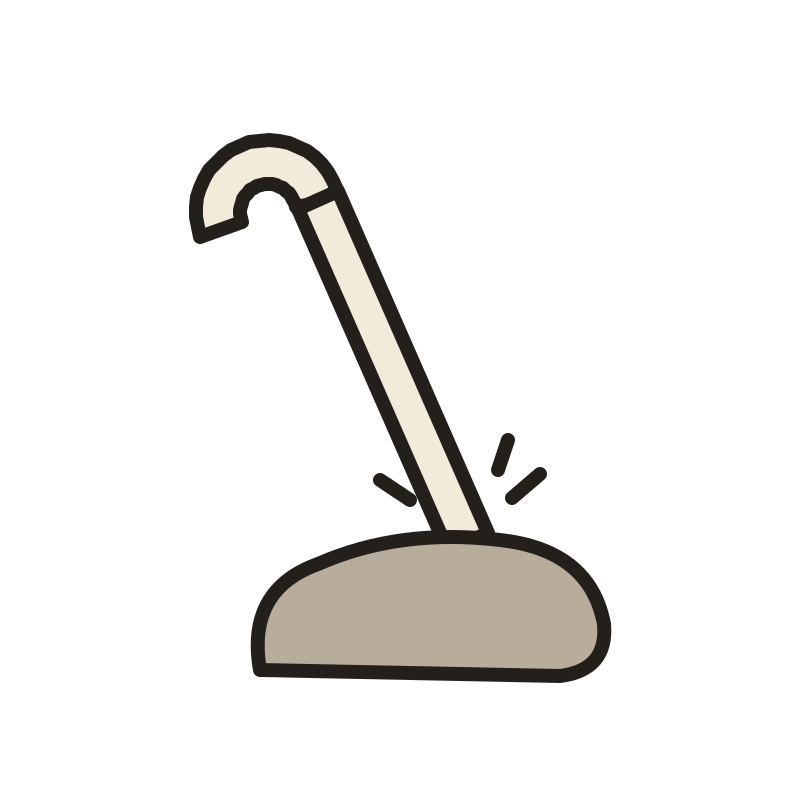
Tap a stone on the path with a walking stick. You feel a jolt in your hand, and you at once believe there is something hard out there. Reid said the feeling and the belief are different things. The belief isn't inferred from the feeling but comes with it, by the make of our minds. We perceive the stone itself. Trust of this kind can't be proved and needs no proof, since every proof already relies on it.
Key ideas
- Against the theory of ideas: nothing shows that we perceive mental images, and the assumption leads straight to scepticism.
Philosophical scepticism
The view that we cannot know what we ordinarily take ourselves to know, above all that a world exists outside our minds.
- Direct perception: a sensation prompts an immediate conception of an outside object and a belief in it, with no reasoning between.
- Principles of common sense: beliefs in the outside world, memory, other minds and one's own identity are first principles that all reasoning takes for granted.
Problem of other minds
The problem of how you can know that other people have thoughts and feelings, when all you ever observe is their behaviour.
- Testimony: we are built to tell the truth and to believe what we are told, which is how children learn anything.
- Agent causation: a free act is caused by the person, so free will is a real power to act or refrain.
Free will
The capacity to control one's own choices and actions in the way needed to be responsible for them.
Not to be confused with
| Look-alike | The difference | Differs on |
|---|---|---|
| David Hume | Hume reasoned from the theory of ideas to doubt about causes, the outside world and the self. Reid agreed that the reasoning was valid and took the absurd result as proof that the theory was false. | Differs onClaim |
| George Berkeley | Berkeley held that we perceive only ideas and that objects are bundles of them. Reid, once his follower, held that we perceive objects themselves and that they exist whether or not anyone perceives them. | Differs onClaim |
| Immanuel Kant | Both answered Hume by pointing to what the mind brings to experience. Reid rested on principles that need no proof. Kant thought that an evasion and tried to prove that experience would be impossible without such concepts. | Differs onClaim |
| Common sense in the everyday sense | Reid did not mean popular opinion or practical shrewdness. He meant a short list of principles that every sane adult acts on, sceptics included. | Differs onScope |
- Differs onClaim
Hume reasoned from the theory of ideas to doubt about causes, the outside world and the self. Reid agreed that the reasoning was valid and took the absurd result as proof that the theory was false.
- Differs onClaim
Berkeley held that we perceive only ideas and that objects are bundles of them. Reid, once his follower, held that we perceive objects themselves and that they exist whether or not anyone perceives them.
- Differs onClaim
Both answered Hume by pointing to what the mind brings to experience. Reid rested on principles that need no proof. Kant thought that an evasion and tried to prove that experience would be impossible without such concepts.
- Differs onScope
Common sense in the everyday sense
Reid did not mean popular opinion or practical shrewdness. He meant a short list of principles that every sane adult acts on, sceptics included.
Life and context
Reid was born in 1710 at Strachan, a village near Aberdeen, into a family of ministers and scholars. He studied at Marischal College and served for fourteen years as parish minister at New Machar. He read Hume's Treatise there and later said it had shaken his trust in the accepted philosophy. In 1751 he became a teacher at King's College, Aberdeen, where he helped found a philosophical club that debated Hume's arguments. His Inquiry into the Human Mind came out in 1764, and that year he succeeded Adam Smith as professor of moral philosophy at Glasgow. He admired Newton and Francis Bacon and wanted a science of the mind built on observation. He gave up lecturing in 1780 to write two volumes of Essays, and he died in Glasgow in 1796.
Adam Smith
The Scottish moral philosopher whose Wealth of Nations made economics a subject of its own, built on the division of labour and free exchange.
Francis Bacon
An English lawyer and statesman who argued that science should rest on organised experiment and serve the relief of human hardship.
Life strip
- 1710 Born
- 1710 Born into a family of ministers, Strachan
- 1737 Becomes parish minister, New Machar
- 1751 Appointed to teach philosophy at King's College, Aberdeen
- 1758 Helps found the Aberdeen Philosophical Society, Aberdeen
- 1764 Publishes the Inquiry and succeeds Adam Smith as professor, Glasgow
- 1785 Publishes Essays on the Intellectual Powers of Man, Edinburgh
- 1788 Publishes Essays on the Active Powers of Man, Edinburgh
- 1796 Dies aged eighty-six, Glasgow
- 1796 Died
Legacy
Reid's common-sense school dominated Scottish universities for decades and shaped college teaching in the early United States and in France. It faded after John Stuart Mill attacked its last major defender, William Hamilton, in 1865. Interest returned in the twentieth century. G. E. Moore defended common sense in a similar spirit. Alvin Plantinga and William Alston drew on Reid for the view that perception, memory and testimony are trustworthy until shown otherwise.
John Stuart Mill
The Victorian philosopher who gave utilitarianism its classic form and made the leading liberal case for free speech, individual liberty and women's equality.
G. E. Moore
The Cambridge philosopher who defended common sense against grand theories and argued that "good" cannot be defined.
Critiques and limits
Kant wrote that Reid and his followers had missed Hume's point: Hume asked what justifies our basic beliefs, and they answered by appealing to the judgement of the crowd. Joseph Priestley objected in 1774 that Reid multiplied instincts without limit, naming a new first principle wherever explanation ran out. Later critics ask how to tell a true principle of common sense from a widely shared prejudice. His tests, universal assent among them, have seemed to many too easy to pass.
Immanuel Kant
A Prussian philosopher who argued that the mind shapes the world we experience and that morality is a law reason gives itself.
Lineage
Influenced by

Influenced
None recorded yet
Connections
Belongs to
His work is a theory of knowledge in which perception, memory and testimony are basic sources that need no further support.
Influenced by
He took the inductive method of Bacon and Newton as the model for a science of the mind free of hypotheses.
Critiques
He argued that Hume's sceptical conclusions disprove the theory of ideas they rest on and reveal nothing about knowledge.
He rejected Locke's doctrine that the mind perceives only its own ideas, and his account of personal identity as memory.
He held that doubting the senses while trusting reason is arbitrary, since both faculties come from the same maker.
Contrasts with
Differs on claim. Berkeley held that we perceive only ideas, where Reid held that we perceive objects that exist unperceived.
Differs on claim. Hume followed the theory of ideas into doubt, where Reid took the doubt as proof that the theory is false.
Differs on claim. Reid rested on principles that need no proof, where Kant tried to prove that experience depends on such concepts.
Critiqued by
In the Prolegomena of 1783 Kant charged that Reid and his followers missed Hume's point and appealed to the judgement of the crowd.
Further reading
Read first
Reid, T. (1997). An inquiry into the human mind on the principles of common sense. Edinburgh University Press. (Original work published 1764)
- Cuneo, T., & van Woudenberg, R. (2004). The Cambridge companion to Thomas Reid. Cambridge University Press. https://doi.org/10.1017/CCOL0521812704
- Wolterstorff, N. (2001). Thomas Reid and the story of epistemology. Cambridge University Press. https://doi.org/10.1017/CBO9780511613845
Cite this entry
Scholia. (2026). Thomas Reid. In Scholia: Notes in the margin of the human sciences. Retrieved November 28, 2026, from https://scholia.zennia.sg/people/thomas-reid