VersusPsychology
Reliability vs validity
Reliability asks whether a measure gives consistent results. Validity asks whether those results mean what they are taken to mean.
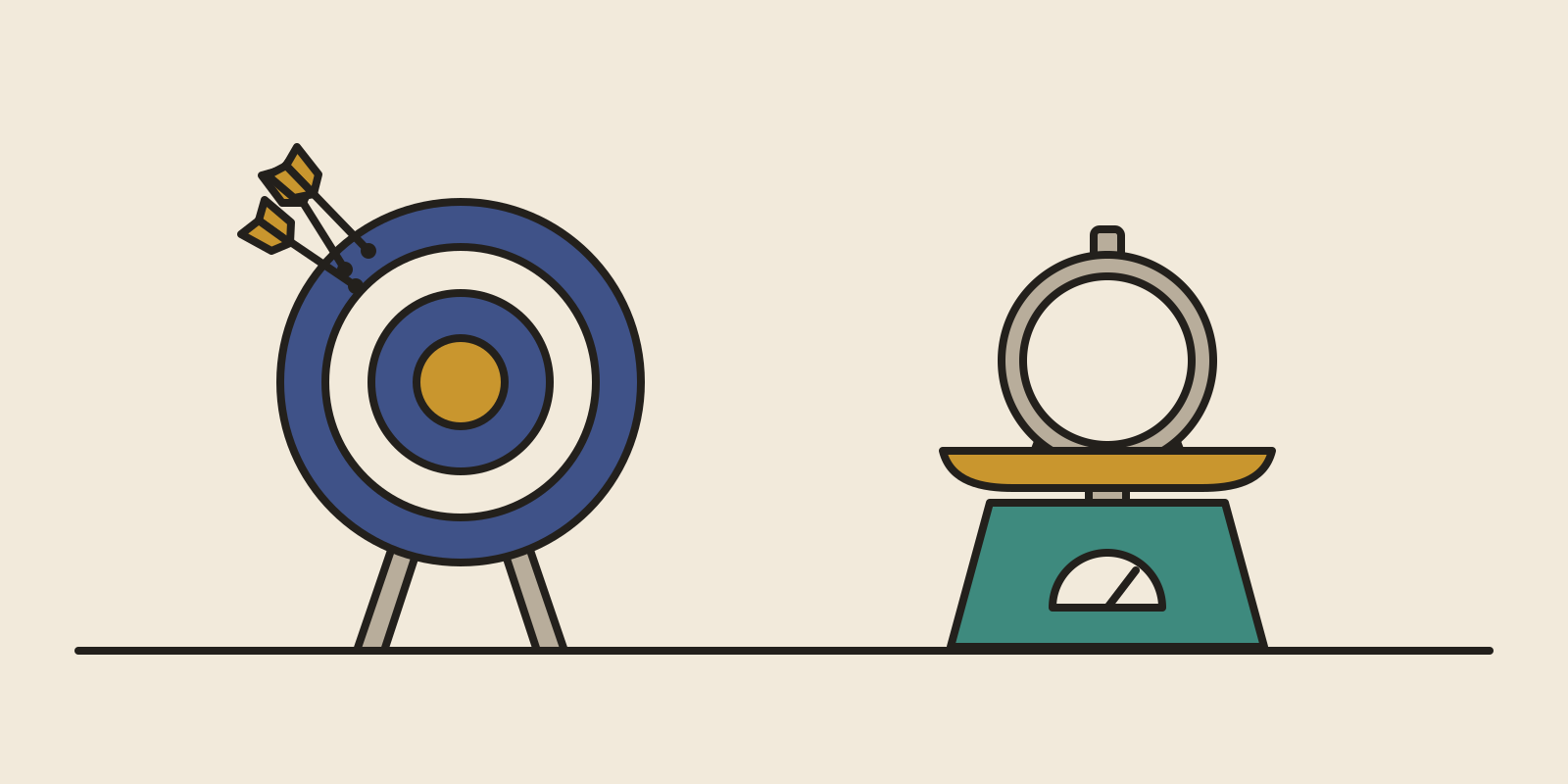
Comparison
| Reliability (measurement)Psychology | Validity (measurement)Psychology | |
|---|---|---|
| Question asked | Would the score come out much the same again? | Does the score stand for what the decision is about? |
| What it belongs to | The scores of a particular group on a particular occasion | An interpretation or use of the scores |
| Kinds of evidence | Test-retest agreement, agreement between raters, internal consistency | Content, criterion and construct evidence |
| How it is reported | A coefficient between 0 and 1 | A judgement of degree, argued from evidence and never proved |
| What spoils it | Random error that makes readings jump about | Measuring something other than the target, such as nerves in a reading test |
| Source | Charles Spearman in 1904, with Lee Cronbach's alpha in 1951 | Truman Kelley in the 1920s, then Cronbach and Paul Meehl in 1955 |
Question asked
- Reliability (measurement)
- Would the score come out much the same again?
- Validity (measurement)
- Does the score stand for what the decision is about?
What it belongs to
- Reliability (measurement)
- The scores of a particular group on a particular occasion
- Validity (measurement)
- An interpretation or use of the scores
Kinds of evidence
- Reliability (measurement)
- Test-retest agreement, agreement between raters, internal consistency
- Validity (measurement)
- Content, criterion and construct evidence
How it is reported
- Reliability (measurement)
- A coefficient between 0 and 1
- Validity (measurement)
- A judgement of degree, argued from evidence and never proved
What spoils it
- Reliability (measurement)
- Random error that makes readings jump about
- Validity (measurement)
- Measuring something other than the target, such as nerves in a reading test
Source
- Reliability (measurement)
- Charles Spearman in 1904, with Lee Cronbach's alpha in 1951
- Validity (measurement)
- Truman Kelley in the 1920s, then Cronbach and Paul Meehl in 1955
Diagram
Reliability and validity judge a measure by different standards
Read as text
Two panels divided by one dimension, the standard of judgement. The left panel, reliability, lists consistency of scores, spoiled by random error and a coefficient from 0 to 1. The right panel, validity, lists meaning of scores, spoiled by wrong target and argued from evidence.
Why people confuse them
They are usually taught as a pair in one breath, and everyday English makes the confusion worse, because calling a test "reliable" in ordinary speech means it can be trusted, which covers both ideas at once. Reliability also comes with a tidy number. A coefficient of 0.9 looks like a certificate of quality, and it is easy to forget that it says nothing about what the scores mean.
Reliability (measurement)
Reliability is the consistency of a measure: how far it gives the same result when the thing measured has not changed.
When the difference matters
A secondary school wants to find its strongest writers and sets a multiple-choice quiz on grammar rules. A machine marks it, and pupils who sit it twice get nearly the same score, so the quiz is highly reliable.
A head who stops there will be misled. A pupil can know every rule and still write muddled essays. The scores support one conclusion (who knows the rules) and say little about the one the school cares about. That is a problem of validity, and no amount of consistency will repair it.
Validity (measurement)
Validity is how well the evidence supports reading a score as a measure of what it is claimed to measure.
Now suppose the school switches to essays marked by two teachers, and their marks often disagree. The task is now the right one, but the scores are unreliable, and the cure is different: a clearer marking scheme and practice in applying it. Changing the task again would not help.
Where they overlap
Both are standards for judging a measure, and psychologists expect a report on each. Both belong to scores in use: a test has no fixed reliability and no validity apart from a purpose. They are also tied together in one direction. Consistency is necessary for validity, since scores that jump about cannot support any conclusion. It is nowhere near enough, as bathroom scales that always read two kilograms heavy will show.
Further reading
- American Educational Research Association, American Psychological Association, & National Council on Measurement in Education. (2014). Standards for educational and psychological testing. American Educational Research Association.
- Cronbach, L. J., & Meehl, P. E. (1955). Construct validity in psychological tests. Psychological Bulletin, 52(4), 281–302. https://doi.org/10.1037/h0040957
- Messick, S. (1995). Validity of psychological assessment: Validation of inferences from persons' responses and performances as scientific inquiry into score meaning. American Psychologist, 50(9), 741–749. https://doi.org/10.1037/0003-066X.50.9.741
- Spearman, C. (1904). The proof and measurement of association between two things. The American Journal of Psychology, 15(1), 72–101. https://doi.org/10.2307/1412159
Cite this entry
Scholia. (2026). Reliability vs validity. In Scholia: Notes in the margin of the human sciences. Retrieved November 28, 2026, from https://scholia.zennia.sg/versus/reliability-measurement-vs-validity-measurement