VersusPolitical theory & science
Sovereignty vs legitimacy
Sovereignty says who has the final say. Legitimacy says whether that say is rightful, or accepted as rightful by those who must obey.
- TermSovereigntySupreme authority within a territory: the right to make the final decision, with no higher power entitled to overrule it.Political theory & science
- TermLegitimacyThe quality that makes power rightful, so that people obey because they think they should and not only because they must.Political theory & science
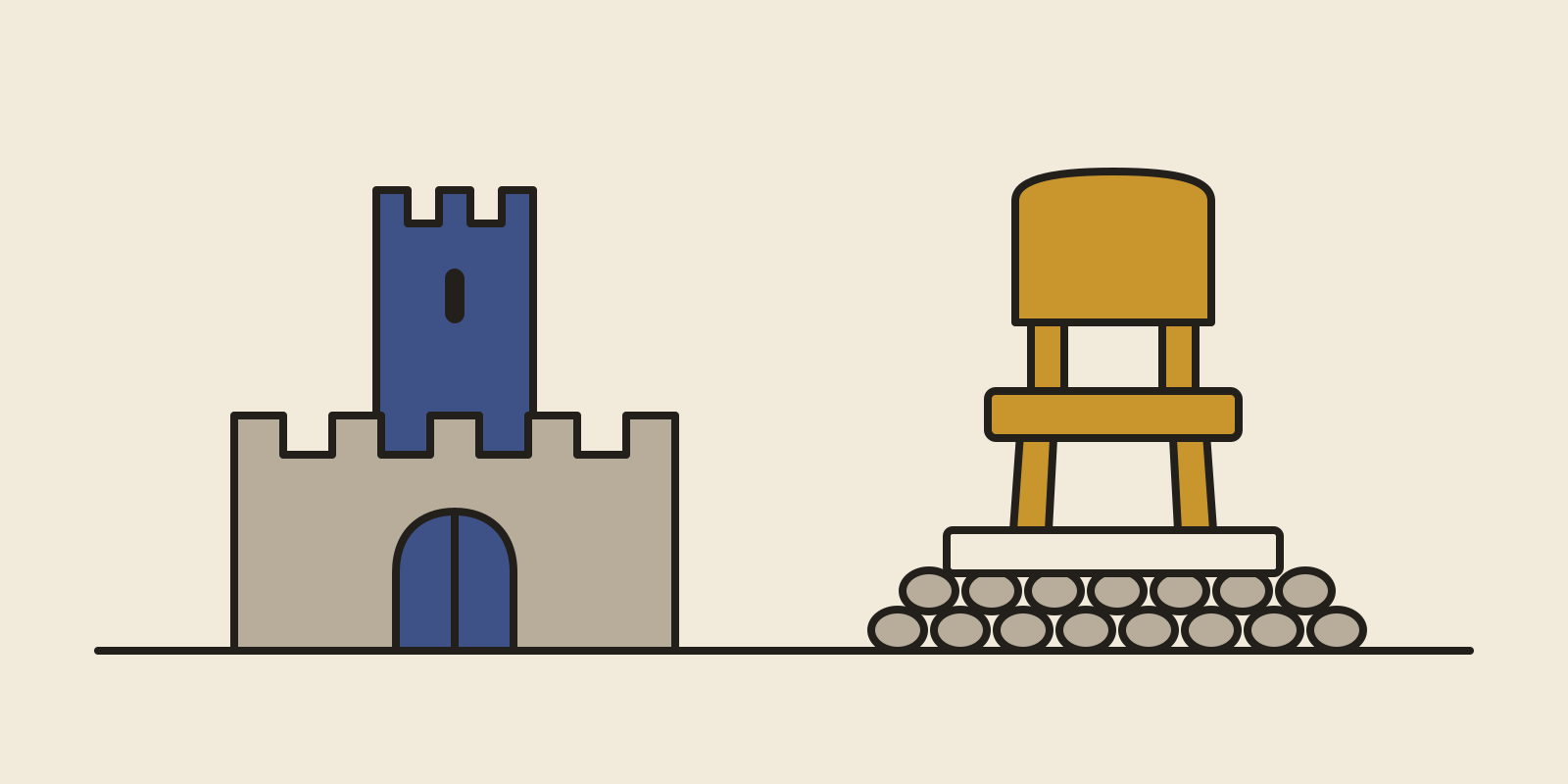
Comparison
| SovereigntyPolitical theory & science | LegitimacyPolitical theory & science | |
|---|---|---|
| Question it answers | Where does final authority lie? | Is that authority rightful, or accepted as rightful? |
| What it is | A standing: the last word within a territory, with no higher body entitled to overrule | A quality that power has in the eyes of its subjects, or when measured against a standard such as consent |
| Tied to | Territory and borders | Beliefs, procedures and fair treatment |
| Degrees | Stated as all or nothing, since the say is final or it isn't | Comes in degrees and can drain away through scandal or failure |
| Classic source | Jean Bodin, Six Books of the Commonwealth (1576) | Max Weber, Economy and Society (1922) |
| Sharpest critic | Stephen Krasner: a principle rulers endorse and break when it suits them | David Beetham: if belief is all it takes, propaganda could manufacture it |
Question it answers
- Sovereignty
- Where does final authority lie?
- Legitimacy
- Is that authority rightful, or accepted as rightful?
What it is
- Sovereignty
- A standing: the last word within a territory, with no higher body entitled to overrule
- Legitimacy
- A quality that power has in the eyes of its subjects, or when measured against a standard such as consent
Tied to
- Sovereignty
- Territory and borders
- Legitimacy
- Beliefs, procedures and fair treatment
Degrees
- Sovereignty
- Stated as all or nothing, since the say is final or it isn't
- Legitimacy
- Comes in degrees and can drain away through scandal or failure
Classic source
- Sovereignty
- Jean Bodin, Six Books of the Commonwealth (1576)
- Legitimacy
- Max Weber, Economy and Society (1922)
Sharpest critic
- Sovereignty
- Stephen Krasner: a principle rulers endorse and break when it suits them
- Legitimacy
- David Beetham: if belief is all it takes, propaganda could manufacture it
Diagram
Having the final say and being accepted as rightful can come apart
Read as text
A two by two grid. Legitimacy runs left to right from low to high. The final say runs bottom to top from lacking it to holding it. A junta ruling by force holds the final say with low legitimacy. An accepted elected government holds the final say with high legitimacy. A distrusted town council answers to a higher authority and has low legitimacy. A trusted regional government is accepted as rightful and also answers to a higher authority.
Why people confuse them
Both words concern the right to rule, as distinct from the raw ability to get one's way. Sovereignty is already defined as a claim of right, so it sounds as if rightfulness were built in. The doctrine of popular sovereignty then ties the two together on purpose: it makes the people the final authority and the source of every government's title. In the news, "sovereign" often works as a word of praise and "illegitimate" as a general complaint, which blurs them further.
When the difference matters
A football league's rulebook says the referee's decision is final. That settles who has the last word on the pitch and leaves open whether the players think he has earned it.
Now suppose a referee is widely believed to take bribes. His decisions still stand. What he has lost is the players' acceptance. They argue with every call and comply only because the alternative is a ban.
States come apart along the same line. A military junta that holds the capital and controls the courts has sovereignty in practice, and other governments must deal with it to sign a treaty. It may have very little legitimacy, and so must spend heavily on police and fear.
Sovereignty
Supreme authority within a territory: the right to make the final decision, with no higher power entitled to overrule it.
Legitimacy
The quality that makes power rightful, so that people obey because they think they should and not only because they must.
The remedies differ too. A dispute about sovereignty is settled by deciding who decides, through borders, treaties or a constitution. A shortage of legitimacy is repaired, where it can be, by earning acceptance through fairer procedure or better government.
Where they overlap
Each needs the other to work well. A sovereign without legitimacy has to rule by force, which is costly and brittle. Legitimacy without a final authority leaves nobody able to settle a dispute. The two meet in the doctrine of popular sovereignty. Once Jean-Jacques Rousseau moved sovereignty from the king to the citizens, the body with the last word and the source of rightful rule were meant to be one and the same.
Jean-Jacques Rousseau
A Genevan writer who argued that society corrupts naturally good people, and that only laws citizens make for themselves keep them free.
Further reading
- Beetham, D. (1991). The legitimation of power. Macmillan. https://doi.org/10.1007/978-1-349-21599-7
- Bodin, J. (1992). On sovereignty: Four chapters from the six books of the commonwealth. Cambridge University Press. https://doi.org/10.1017/cbo9780511802812 (Original work published 1576)
- Krasner, S. D. (1999). Sovereignty: Organized hypocrisy. Princeton University Press. https://doi.org/10.1515/9781400823260
- Weber, M. (1978). Economy and society: An outline of interpretive sociology. University of California Press. (Original work published 1922)
Cite this entry
Scholia. (2026). Sovereignty vs legitimacy. In Scholia: Notes in the margin of the human sciences. Retrieved November 28, 2026, from https://scholia.zennia.sg/versus/sovereignty-vs-legitimacy