CrossingAnthropology
Descent theory + balance of power
Feuding lineages and rival states both keep order by matched opposition with no ruler, but lineages inherit their sides and states must choose them.
- IdeaDescent theoryThe claim that societies without states are organised by lineages, lasting groups of people descended from one ancestor through a single line.Anthropology
- IdeaBalance of powerWhen one state grows strong enough to dominate, others arm or ally against it, so power stays divided and no state rules all.Political theory & science
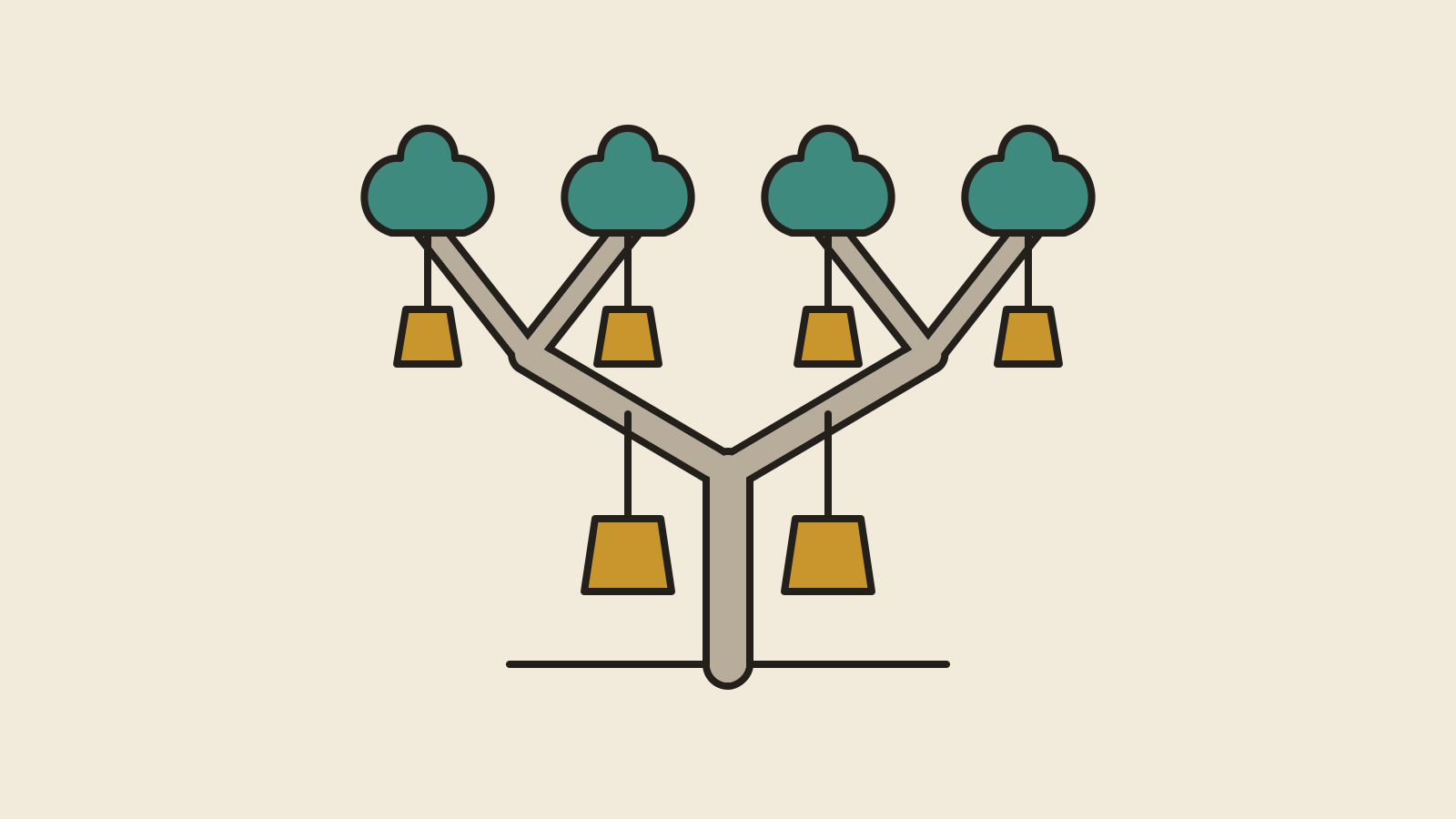
What each entry sees
Descent theory
Descent theory claims that societies without states are organised by lineages, lasting groups descended from one ancestor through a single line. A lineage acts like a corporation: it owns land or cattle and answers for its members' injuries. Among the Nuer of South Sudan, as E. E. Evans-Pritchard described them, two brothers' families may feud, join as one against their cousins and join those cousins against a more distant branch. Order comes from the balance of matched groups, with nobody in charge. Adam Kuper argued that the model fits no real society closely, and most anthropologists now treat it as an idealised picture.
Descent theory
The claim that societies without states are organised by lineages, lasting groups of people descended from one ancestor through a single line.
E. E. Evans-Pritchard
The English anthropologist whose studies in Sudan showed that witchcraft beliefs can be reasoned and that a people can keep order without government.
Balance of power
Balance of power theory says that when one state grows strong enough to dominate, others arm or ally against it, so power stays divided. The theory assumes anarchy: with no authority above them, states must check a rising power themselves. Alliances follow interest and are temporary, and Kenneth Waltz argued that balances form of themselves, whether or not anyone intends them. The evidence is contested. Paul Schroeder found European states hiding or joining the stronger side more often than balancing. A survey of two thousand years of state systems found that balances gave way to empire about as often as they held.
Balance of power
When one state grows strong enough to dominate, others arm or ally against it, so power stays divided and no state rules all.
Anarchy (international relations)
In international relations, anarchy means there is no government above states to make and enforce rules, which is different from chaos.
Diagram
Descent theory + balance of power
Read as text
Overlap of Descent theory (Idea, Anthropology) and Balance of power (Idea, Political theory & science). Only Descent theory: A. R. Radcliffe-Brown and Alliance theory. Only Balance of power: David Hume and Democratic peace theory. Shared: The question it opens.
What the crossing shows
The two theories were built for different worlds, cattle herders in South Sudan and the powers of Europe, and they give the same answer to one problem. With nobody to enforce a settlement, order rests on opposed groups of matching weight. Roger Masters drew the comparison in 1964, setting world politics beside stateless societies such as the Nuer.
The mechanisms differ, and the difference is the useful part. In the lineage model nobody decides to side with the weaker party. The family tree tells a man whom to join at every scale, so matched sides come ready-made. States have no tree. They pick allies by interest, which is why they can also join the stronger side, as Schroeder found they often did. One finding blurs the contrast. Remembered genealogies are often adjusted to fit present alliances, so the tree may record choices as much as dictate them.
The question it opens
Is balancing what any set of groups does when no one rules them? Two idealised cases can't settle it, and both are disputed within their own disciplines. A fair test would count, across rulerless systems of several kinds, how often the weaker sides combine and how often they give in. The count has been attempted for state systems and hardly at all elsewhere.
Further reading
- Evans-Pritchard, E. E. (1940). The Nuer: A description of the modes of livelihood and political institutions of a Nilotic people. Clarendon Press.
- Kuper, A. (1982). Lineage theory: A critical retrospect. Annual Review of Anthropology, 11, 71–95. https://doi.org/10.1146/annurev.an.11.100182.000443
- Waltz, K. N. (1979). Theory of international politics. Addison-Wesley.
- Wohlforth, W. C., Little, R., Kaufman, S. J., Kang, D., Jones, C. A., Hui, V. T., Eckstein, A., Deudney, D., & Brenner, W. L. (2007). Testing balance-of-power theory in world history. European Journal of International Relations, 13(2), 155–185. https://doi.org/10.1177/1354066107076951
Cite this entry
Scholia. (2026). Descent theory + balance of power. In Scholia: Notes in the margin of the human sciences. Retrieved November 28, 2026, from https://scholia.zennia.sg/crossings/descent-theory-plus-balance-of-power