IdeaPolitical theory & science
Balance of power
When one state grows strong enough to dominate, others arm or ally against it, so power stays divided and no state rules all.
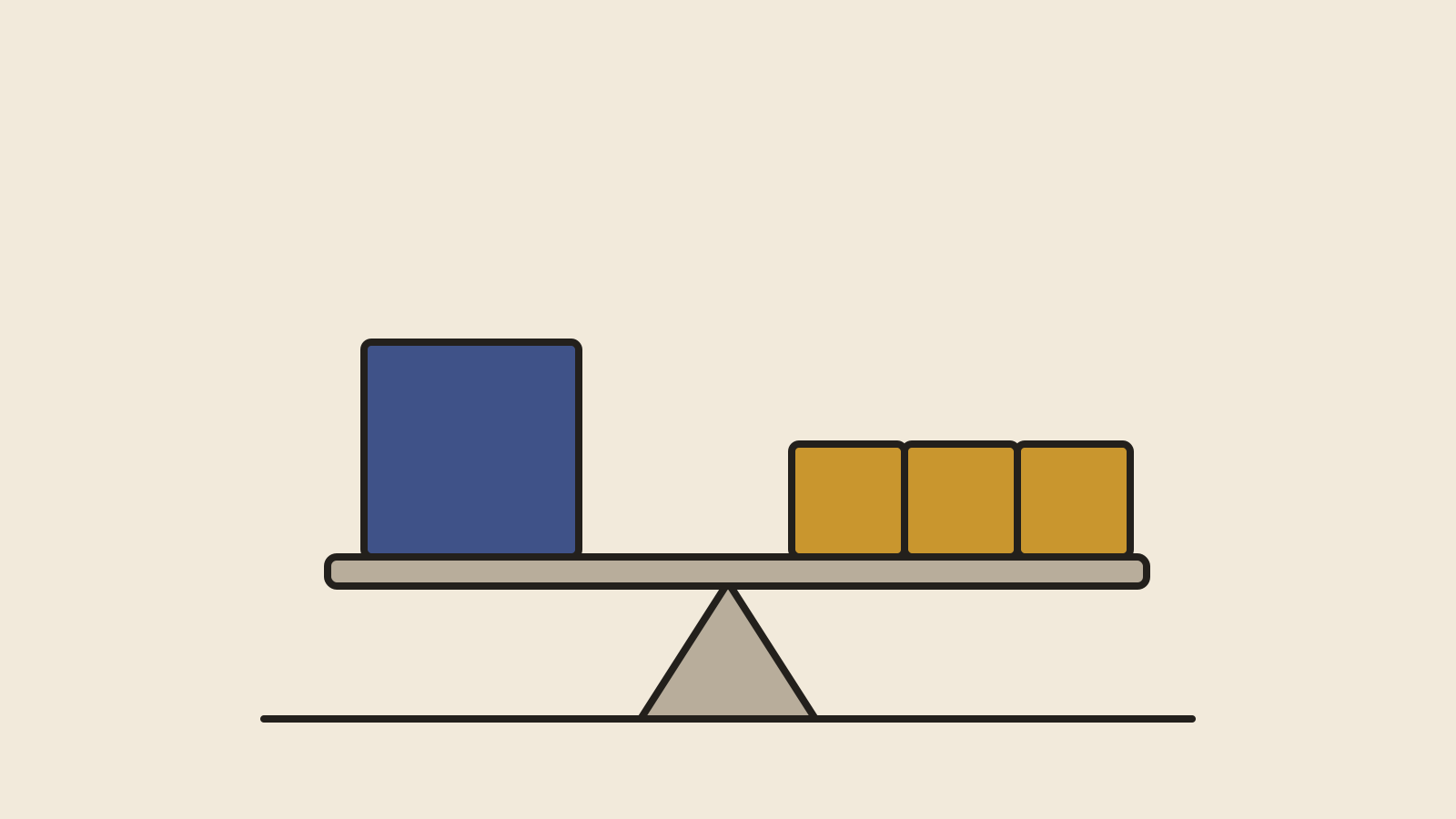
The idea
Balance of power theory makes a claim about what happens when one state threatens to become strong enough to dominate the rest. The others, fearing for their independence, build up their own forces or combine against it. Power ends up spread among several states, and none can impose its will on all.
A weekly card game shows the logic. When one player pulls far ahead, the others stop competing with each other and quietly gang up on the leader. Nobody plans the result, and nobody needs to like their temporary partners.
The phrase carries two claims that are worth keeping apart. The first is descriptive: balances tend to form whether or not anyone intends them. The second is a judgement, that a rough balance is good because it protects the independence of states and makes aggression unlikely to pay. The theory does not promise peace. States have fought many wars to restore a balance.
Diagram
A state's growing lead provokes the resistance that cuts it back
Read as text
A loop of three nodes. As one state's lead in power grows, fear among the other states grows with it. As their fear grows, they arm and form alliances. Their arming and alliances reduce the first state's lead. The loop is self-correcting: the more one state pulls ahead, the stronger the push against it. This is the theory's claim, and critics dispute how reliably the loop operates.
Key features
- States balance in two ways: by arming at home and by forming alliances abroad.
- Alliances are temporary and follow interest, so yesterday's enemy can be today's partner.
- The alternative is bandwagoning, which means joining the stronger side, and the theory predicts it will be the exception.
- The theory assumes anarchy: with no authority above them, states must check a rising power themselves.
Anarchy (international relations)
In international relations, anarchy means there is no government above states to make and enforce rules, which is different from chaos.
- The aim is the survival of independent states, and peace is at most a by-product.
Not to be confused with
| Look-alike | The difference | Differs on |
|---|---|---|
| Security dilemma | The security dilemma says that arming for defence alarms others and can leave everyone less safe. Balance of power theory says that arming and allying against a rising state keeps any one power from dominating. The same build-up can be read either way. | Differs onClaim |
| Separation of powers | The separation of powers divides authority among branches inside one state, under a constitution that courts enforce. The balance of power operates among states, with no constitution and no enforcer. | Differs onLevel |
| Democratic peace theory | Democratic peace theory traces peace to the kind of government states have. Balance of power theory looks only at how capabilities are distributed and treats the type of government as beside the point. | Differs onMechanism |
| Hegemonic stability theory | This rival view holds that order is most stable when one state is clearly dominant and supplies the rules. Balance of power theory expects dominance to provoke resistance. | Differs onClaim |
- Differs onClaim
The security dilemma says that arming for defence alarms others and can leave everyone less safe. Balance of power theory says that arming and allying against a rising state keeps any one power from dominating. The same build-up can be read either way.
- Differs onLevel
The separation of powers divides authority among branches inside one state, under a constitution that courts enforce. The balance of power operates among states, with no constitution and no enforcer.
- Differs onMechanism
Democratic peace theory traces peace to the kind of government states have. Balance of power theory looks only at how capabilities are distributed and treats the type of government as beside the point.
- Differs onClaim
Hegemonic stability theory
This rival view holds that order is most stable when one state is clearly dominant and supplies the rules. Balance of power theory expects dominance to provoke resistance.
Origins and development
David Hume traced the practice to ancient Greece in a 1752 essay, and Francesco Guicciardini had praised Lorenzo de' Medici for keeping the Italian states in equilibrium. The Treaty of Utrecht (1713) named a just balance of power as a foundation of European peace, and the Congress of Vienna rebuilt one in 1815. Hans Morgenthau and then Kenneth Waltz made it the centre of realism, with Waltz arguing that balances form of themselves. Stephen Walt amended the theory in 1987: states balance against threats, which depend on intentions and geography as well as raw power.
David Hume
A Scottish philosopher who argued that our beliefs about causes, the self and morality rest on habit and feeling more than on reason.
Realism (international relations)
The view that states, with no authority above them, must look to their own security, so world politics is a lasting contest for power.
Why it matters
The idea frames much commentary on alliances. The founding of NATO, American ties with Japan, India and Australia as China grows, and the habit smaller states have of keeping several large partners at once are all described in its terms. When analysts ask whether Asia's states will line up against a rising power or accommodate it, they are asking whether balance of power theory holds.
Critiques and limits
Ernst Haas showed in 1953 that writers used the phrase in at least eight senses, which makes the theory hard to pin down. A. F. K. Organski argued the opposite of its central judgement: war is likeliest when a challenger nears parity with the leader. Paul Schroeder found European states hiding or bandwagoning more often than balancing. William Wohlforth and colleagues, surveying two thousand years of state systems, found that balances gave way to empire about as often as they held. The evidence is contested.
Connections
Belongs to
Realism (international relations)
Realists from Morgenthau to Waltz made balancing the central regularity of international politics.
Influenced by
David HumePhilosophy
Hume's 1752 essay traced the practice to ancient Greece and defended it as prudent policy for Britain.
Contrasts with
Differs on claim. One says arming against a strong state prevents domination, the other that arming for defence can leave everyone less safe.
Differs on level. The separation of powers divides authority inside one state under a constitution, the balance of power operates among states with no enforcer.
Differs on mechanism. One explains peace by how capabilities are distributed among states, the other by how the states are governed.
Differs on mechanism. A balance keeps international order through rough equality among several powers, where hegemony keeps it through the lead of one.
Cross with
Two distant entries to read beside this one, each with the question the pairing opens.
General equilibrium theoryEconomics
Prices are said to settle markets at a balance nobody plans. What plays the part of price when states balance one another? Set them side by side
Descent theoryAnthropology
Lineages in stateless societies and states in world politics both lack a ruler above them. Do both keep order by setting equals against equals? Set them side by side
Further reading
- Haas, E. B. (1953). The balance of power: Prescription, concept, or propaganda?. World Politics, 5(4), 442–477. https://doi.org/10.2307/2009179
- Morgenthau, H. J. (1948). Politics among nations: The struggle for power and peace. Alfred A. Knopf.
- Waltz, K. N. (1979). Theory of international politics. Addison-Wesley.
- Wohlforth, W. C., Little, R., Kaufman, S. J., Kang, D., Jones, C. A., Hui, V. T., Eckstein, A., Deudney, D., & Brenner, W. L. (2007). Testing balance-of-power theory in world history. European Journal of International Relations, 13(2), 155–185. https://doi.org/10.1177/1354066107076951
Cite this entry
Scholia. (2026). Balance of power. In Scholia: Notes in the margin of the human sciences. Retrieved November 28, 2026, from https://scholia.zennia.sg/ideas/balance-of-power