CrossingAnthropology
Differential mode of association + ubuntu + self-construal
Fei's ranked rings and ubuntu's shared community are both relational selves, yet they disagree about who is owed what.
- IdeaDifferential mode of association (chaxu geju)Fei Xiaotong's model of Chinese society as rings of personal ties spreading from each person, with obligations that weaken as the rings widen.Anthropology
- IdeaUbuntuA southern African ethic holding that a person becomes fully human only through relationships with other people.Philosophy
- IdeaIndependent and interdependent self-construalThe theory that people define the self either by inner traits or by relationships, and that cultures favour one or the other.Psychology
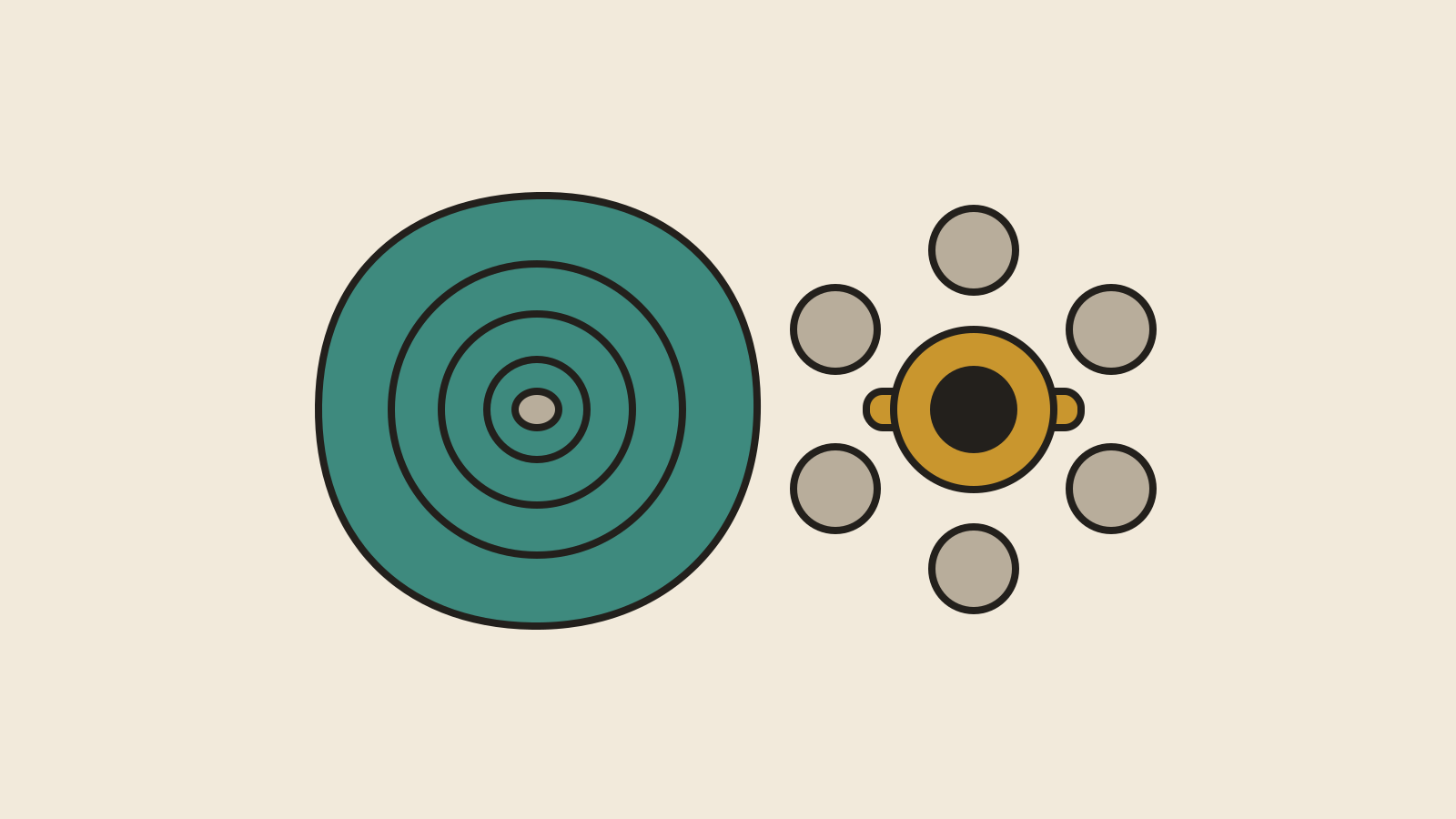
What each entry sees
Differential mode of association (chaxu geju)
Fei Xiaotong's differential mode of association pictures Chinese society as rings spreading from a stone dropped in a pond. Each person stands at the centre of their own rings, with parents and children closest and strangers at the edge. What you owe someone depends on their ring. Yan Yunxiang stresses a second half that readers often drop: the ties rank people as senior and junior too. Fei denied that this made China centred on groups. Loyalty runs to particular people.
Fei Xiaotong
The Chinese anthropologist who studied his own country's villages from the inside and pictured its society as ripples of personal ties.
Differential mode of association (chaxu geju)
Fei Xiaotong's model of Chinese society as rings of personal ties spreading from each person, with obligations that weaken as the rings widen.
Ubuntu
Ubuntu is the southern African teaching that a person becomes a person through other people. Humanity is earned by sharing, care and respect within a community. When a township family is bereaved, neighbours arrive unasked with food and labour and nobody keeps accounts, because the loss belongs to the neighbourhood. Ubuntu is an ethic, a claim about how people ought to live. Its age and unity are disputed.
Ubuntu
A southern African ethic holding that a person becomes fully human only through relationships with other people.
Independent and interdependent self-construal
Self-construal theory says people define the self in two ways, by inner traits or by relationships, and that everyone has some of each. Hazel Markus and Shinobu Kitayama placed the independent self in North America and western Europe, and the interdependent self in East Asia and much of the rest of the world. Questionnaires built on the idea have often failed to show the expected differences. The evidence is contested.
Independent and interdependent self-construal
The theory that people define the self either by inner traits or by relationships, and that cultures favour one or the other.
Diagram
Differential mode of association + ubuntu + self-construal
Read as text
Overlap of Differential mode of association (chaxu geju) (Idea, Anthropology), Ubuntu (Idea, Philosophy) and Independent and interdependent self-construal (Idea, Psychology). Only Differential mode of association: Fei Xiaotong. Only Ubuntu: Africana philosophy. Only Independent and interdependent self-construal: Amae. Shared: Individualism and collectivism.
What the crossing shows
Put Fei's China and ubuntu's southern Africa on the psychologists' map and both land on the interdependent side. Yet they answer one practical question, who should be helped, in different ways. Fei's model says to look at how close the person stands and how they rank. Ubuntu says a neighbour's trouble is partly yours because you share a community. One relational self is a centre with graded ties. The other is a member whose standing comes from the whole.
They differ in kind as well. Fei was describing how a society works, and he noted its costs, such as the shared canal nobody kept clean. Ubuntu is a standard that can be turned against any society. A single scale of interdependence records neither difference. Vivian Vignoles's study of 55 cultural groups points the same way, since it found seven separate ways of being independent or interdependent.
The question it opens
Does a relational self imply equal obligations to everyone in a community, or ranked ones that thin with distance? Both patterns exist, so the word "interdependent" cannot settle it. Fei's rings and ubuntu are seldom set side by side. Critics say ubuntu suits village life better than a plural city, and Fei wrote about rural China, so how either holds up in modern cities is also unknown.
Further reading
- Fei, X. (1992). From the soil: The foundations of Chinese society. University of California Press. https://doi.org/10.1525/9780520912489 (Original work published 1948)
- Markus, H. R., & Kitayama, S. (1991). Culture and the self: Implications for cognition, emotion, and motivation. Psychological Review, 98(2), 224–253. https://doi.org/10.1037/0033-295X.98.2.224
- Metz, T. (2007). Toward an African moral theory. Journal of Political Philosophy, 15(3), 321–341. https://doi.org/10.1111/j.1467-9760.2007.00280.x
- Vignoles, V. L., Owe, E., Becker, M., Smith, P. B., Easterbrook, M. J., Brown, R., González, R., Didier, N., Carrasco, D., Cadena, M. P., Lay, S., Schwartz, S. J., Des Rosiers, S. E., Villamar, J. A., Gavreliuc, A., Zinkeng, M., Kreuzbauer, R., Baguma, P., Martin, M., & Bond, M. H. (2016). Beyond the 'east–west' dichotomy: Global variation in cultural models of selfhood. Journal of Experimental Psychology: General, 145(8), 966–1000. https://doi.org/10.1037/xge0000175
Cite this entry
Scholia. (2026). Differential mode of association + ubuntu + self-construal. In Scholia: Notes in the margin of the human sciences. Retrieved November 28, 2026, from https://scholia.zennia.sg/crossings/differential-mode-of-association-plus-ubuntu-plus-self-construal