CrossingEconomics
Knightian uncertainty + heuristic
Knight's line between risk and uncertainty may mark where a rule of thumb stops being a shortcut and becomes the only method on offer.
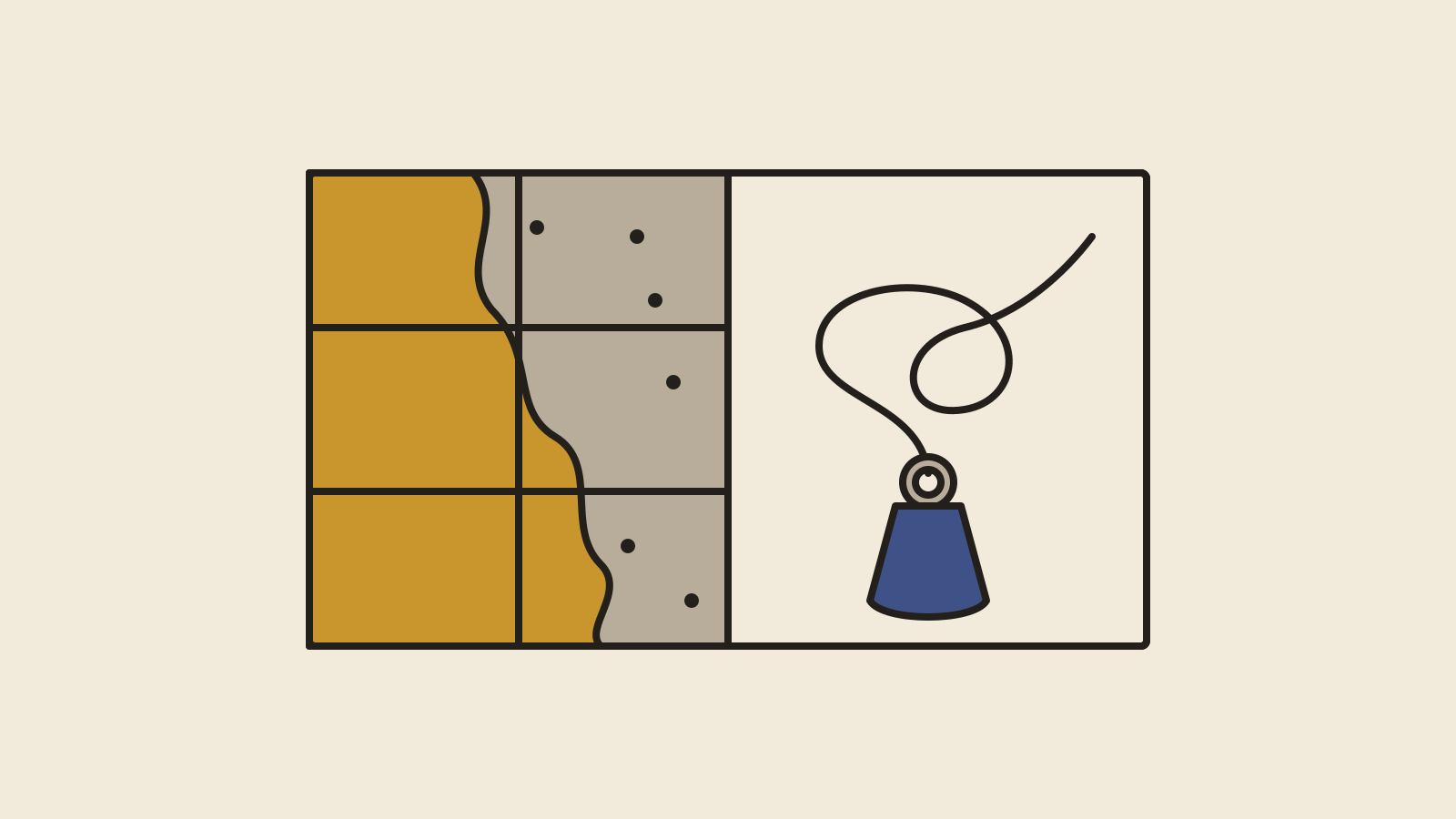
What each entry sees
Knightian uncertainty
Knightian uncertainty is the claim that some of what we don't know about the future can't be expressed as odds at all. Frank Knight drew the line in 1921. Risk is a chance that can be measured, as an insurer measures crashes from the records of millions of drivers. Uncertainty is what remains when no such records exist. Someone opening the first bubble tea shop in a small town has no table to consult and must use judgement. Knight added that people differ in how good their judgement is, and that profit rewards those who act where no insurer will follow.
Knightian uncertainty
Some futures can be given odds and insured against, while others are so novel that no probability can be calculated at all.
Heuristic
A heuristic is a simple rule for judging or deciding that uses only part of the available information. A driver on a long road picks the place to eat with the most lorries parked outside. The rule is fast and gives no guarantee, and its accuracy depends on the setting. Psychologists disagree about how far to trust such rules. The heuristics and biases programme stresses the errors they cause, while Gerd Gigerenzer's group stresses that simple rules can match complex statistical models when data are scarce and the future is uncertain.
Heuristic
A simple rule for judging or deciding that uses only part of the information, trading thoroughness for speed.
Heuristics and biases
People judge likelihood with a few quick mental shortcuts that usually serve well and go wrong in predictable directions.
Diagram
Knightian uncertainty + heuristic
Read as text
Overlap of Knightian uncertainty (Idea, Economics) and Heuristic (Term, Psychology). Only Knightian uncertainty: Expected utility theory and Keynesian economics. Only Heuristic: Cognitive architecture and Cognitive bias. Shared: Behavioural economics.
What the crossing shows
Calling a shortcut an error requires a correct answer to measure it against. In the heuristics and biases work that standard is usually probability theory. Knight's line asks when the standard is available. Under risk it is, because the odds exist and a rule that ignores part of the evidence can be scored against the full calculation. Under uncertainty, on Knight's account, there are no odds to ignore. A shop owner who copies the next town's success hasn't skipped a sum, because none was on offer.
Gigerenzer's group makes this case itself and cites Knight for it. Knight gains something as well. He said that uncertain decisions rest on judgement and left it there, and simple rules fitted to a setting are one account of what judgement contains. Each side brings its own dispute along, since Bayesians deny Knight's line and critics find the word heuristic too loose to test.
The question it opens
Is a rule of thumb a mistake, or the right tool when no odds can be calculated? An answer would need a way to tell beforehand which kind of situation one is in. Leonard Savage's followers hold that a consistent chooser can always supply personal probabilities, which would leave every shortcut open to scoring. The matter is unresolved.
Further reading
- Gigerenzer, G., & Gaissmaier, W. (2011). Heuristic decision making. Annual Review of Psychology, 62, 451–482. https://doi.org/10.1146/annurev-psych-120709-145346
- Kay, J., & King, M. (2020). Radical uncertainty: Decision-making for an unknowable future. The Bridge Street Press.
- Knight, F. H. (1921). Risk, uncertainty and profit. Houghton Mifflin.
- Tversky, A., & Kahneman, D. (1974). Judgment under uncertainty: Heuristics and biases. Science, 185(4157), 1124–1131. https://doi.org/10.1126/science.185.4157.1124
Cite this entry
Scholia. (2026). Knightian uncertainty + heuristic. In Scholia: Notes in the margin of the human sciences. Retrieved November 28, 2026, from https://scholia.zennia.sg/crossings/knightian-uncertainty-plus-heuristic