IdeaEconomicsAlso in Philosophy, Psychology
Knightian uncertainty
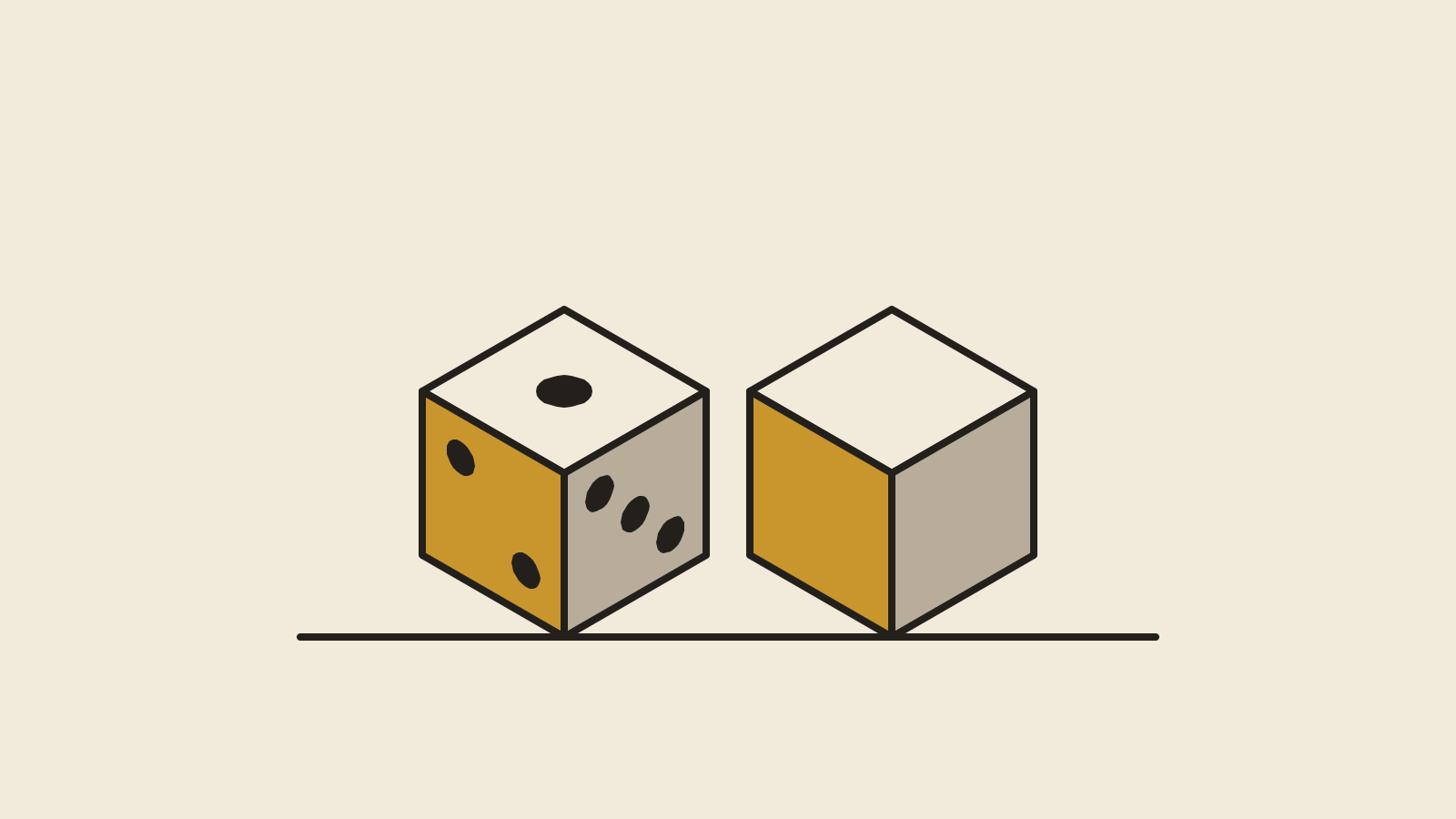
Some futures can be given odds and insured against, while others are so novel that no probability can be calculated at all.
The idea
Knightian uncertainty is the claim that some of what we don't know about the future cannot be expressed as odds at all. Frank Knight drew the line in 1921. Risk, in his usage, is a chance that can be measured: the fall of dice, or the share of drivers who will crash this year. Uncertainty is what remains when there is no basis for a number.
Compare an insurer with someone opening the first bubble tea shop in a small town. The insurer has records of millions of drivers and can price a policy to the dollar. The shop owner has no such table. Nobody has run this shop in this town before, and the outcome depends on tastes, rivals and luck with no track record. She must use judgement.
Knight argued that profit exists because of this second kind of ignorance. Measurable risks can be insured and become an ordinary cost. Only bearing the unmeasurable earns a true profit.
Diagram
Knight separated chances that can be measured from those that cannot
Read as text
Two columns compare situations by what is known of the odds in each. Under risk the odds can be measured, the chance can be insured and the examples are dice or accident rates. Under uncertainty there are no odds to measure, the chance cannot be insured and the example is a new business venture.
Key features
- Risk covers cases where odds are known from logic (dice) or from statistics on many similar cases.
- Uncertainty covers unique situations with no group of similar cases to count.
- Measurable risks can be pooled and insured, which turns them into a predictable cost of business.
- Decisions under uncertainty rest on judgement, and people differ in how good theirs is.
- Profit is the reward left to entrepreneurs who act where no insurer will follow.
Not to be confused with
| Look-alike | The difference | Differs on |
|---|---|---|
| Risk | In everyday speech risk means any chance of harm. Knight reserved it for chances that can be given a number. On his account the two words name different situations, and treating uncertainty as risk gives false precision. | Differs onScope |
| Expected utility theory | Expected utility theory tells a chooser to weigh each outcome by its probability, and later versions let people supply personal probabilities for anything. Knight's claim is that in unique cases no probability worth the name exists. | Differs onClaim |
| Ambiguity aversion | Ambiguity aversion is a preference observed in people: in Daniel Ellsberg's choice problems, and in experiments run since, they favour bets with known odds over bets with unknown ones. Knightian uncertainty is the situation they are reacting to. | Differs onUnit of analysis |
| Risk society | Ulrich Beck's sociological thesis is about whole societies organised around hazards that modern industry creates. Knight's distinction concerns what a single decision-maker can know about the odds. | Differs onLevel |
- Differs onScope
Risk
In everyday speech risk means any chance of harm. Knight reserved it for chances that can be given a number. On his account the two words name different situations, and treating uncertainty as risk gives false precision.
- Differs onClaim
Expected utility theory tells a chooser to weigh each outcome by its probability, and later versions let people supply personal probabilities for anything. Knight's claim is that in unique cases no probability worth the name exists.
- Differs onUnit of analysis
Ambiguity aversion
Ambiguity aversion is a preference observed in people: in Daniel Ellsberg's choice problems, and in experiments run since, they favour bets with known odds over bets with unknown ones. Knightian uncertainty is the situation they are reacting to.
- Differs onLevel
Ulrich Beck's sociological thesis is about whole societies organised around hazards that modern industry creates. Knight's distinction concerns what a single decision-maker can know about the odds.
Origins and development
Knight set out the distinction in Risk, Uncertainty and Profit (1921), a revision of his doctoral thesis, as part of a theory of why firms earn profits. John Maynard Keynes made a similar argument the same year and later rested his account of investment on it. From the 1950s Leonard Savage's theory of personal probability pushed the distinction aside. Ellsberg's thought experiments of 1961 revived it, and the 2008 financial crisis, when risk models failed, brought it back into public debate.
John Maynard Keynes
The British economist who argued that economies can get stuck in mass unemployment and that governments should spend to pull them out.
Why it matters
Banks, insurers and regulators lean on models that turn the future into probabilities. The idea warns that such numbers can be confident and wrong when the situation is new: a novel financial product, a pandemic, an untried technology. It also explains ordinary caution. People and firms hold cash, delay investment and prefer the familiar when they cannot put odds on what comes next.
Critiques and limits
Savage and later Bayesians reply that any consistent chooser acts as if holding probabilities, so every uncertainty can be treated as risk. Milton Friedman, Knight's own student, wrote that he did not think the distinction valid. Stephen LeRoy and Larry Singell (1987) argued that Knight is misread, and that he meant only situations where insurance markets fail. The distinction is conceptual. Experiments confirm that people treat unknown odds differently from known ones, which doesn't settle whether a rational chooser should.
Milton Friedman
An American economist who argued that money drives inflation and slumps, and who made the popular case for free markets over state direction.
Connections
Belongs to
The distinction belongs to the theory of how individuals and firms decide when outcomes are not certain.
Contrasts with
Differs on claim. Expected utility theory assumes every outcome can be weighted by a probability, which Knight denied for unique situations.
Risk societySociology
Differs on level. Knight's distinction concerns what one decision-maker can know, while Beck's thesis concerns whole societies organised around manufactured hazards.
Applied in
Keynes's account of unstable investment rests on the same unmeasurable uncertainty about distant returns.
Ellsberg's puzzles about bets with unknown odds made aversion to ambiguity a standard topic in the study of real choices.
Cross with
Two distant entries to read beside this one, each with the question the pairing opens.
Anthropology of religion and ritualAnthropology
Is ritual a society's way of acting where no odds can be calculated, and does it retreat as hazards become insurable? Set them side by side
Security dilemmaPolitical theory & science
When a state cannot put odds on a neighbour's intentions, is arming a response to risk or to uncertainty in Knight's sense? Set them side by side
Further reading
- Ellsberg, D. (1961). Risk, ambiguity, and the Savage axioms. The Quarterly Journal of Economics, 75(4), 643–669. https://doi.org/10.2307/1884324
- Kay, J., & King, M. (2020). Radical uncertainty: Decision-making for an unknowable future. The Bridge Street Press.
- Knight, F. H. (1921). Risk, uncertainty and profit. Houghton Mifflin.
- LeRoy, S. F., & Singell, L. D. (1987). Knight on risk and uncertainty. Journal of Political Economy, 95(2), 394–406. https://doi.org/10.1086/261461
Cite this entry
Scholia. (2026). Knightian uncertainty. In Scholia: Notes in the margin of the human sciences. Retrieved November 28, 2026, from https://scholia.zennia.sg/ideas/knightian-uncertainty