IdeaPsychologyAlso in Sociology
Agentic state
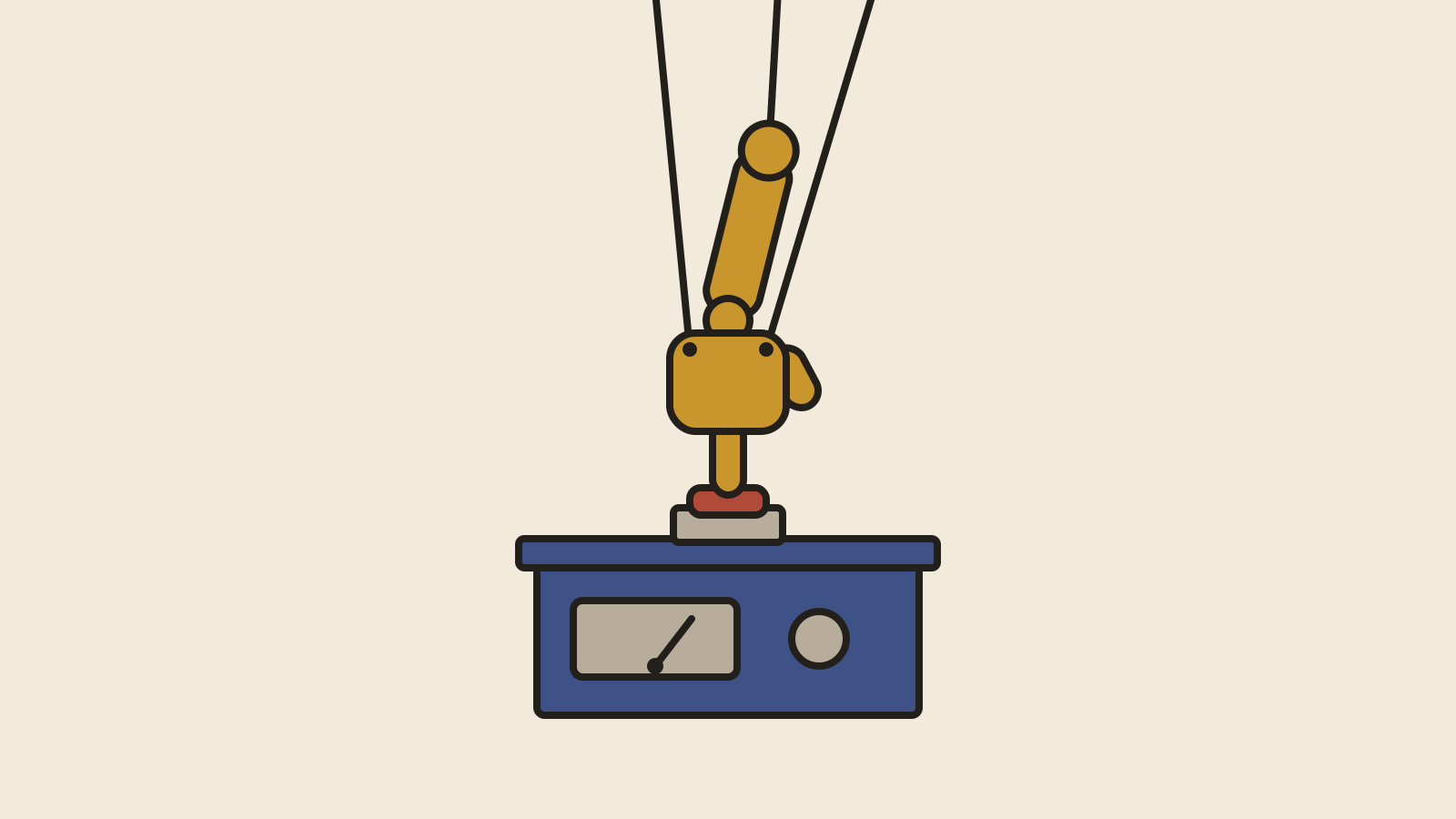
Milgram's name for the frame of mind in which a person under orders feels like someone else's instrument and hands responsibility upward.
The idea
A call-centre worker refuses a refund to a grieving customer and reads out the policy line by line. "I don't make the rules," she says. The agentic state is Stanley Milgram's name for the frame of mind behind that sentence. A person in it stops seeing themselves as the author of their acts. They see themselves as an agent: an instrument that carries out another's wishes.
Milgram proposed the idea in 1974 to explain his own shock experiments, in which most volunteers obeyed instructions to hurt a stranger. He held that people have two modes. In the autonomous mode they act on their own conscience. When they enter a hierarchy they accept as legitimate, they shift. Conscience stays switched on, he argued, with a new object. The person now feels answerable to the authority and judges themselves by how well they do the job. Responsibility for what the job does is handed upward.
Diagram
Milgram held that entering a hierarchy switches a person between two states
Read as text
A panel divided in two by one question: whose purposes the person is serving. On the left is the autonomous state, in which a person acts on their own conscience and feels responsible for the results. On the right, emphasised, is the agentic state, in which a person carries out another's wishes and answers to the authority for how well the task is done. Milgram held that stepping into a hierarchy accepted as legitimate moves a person from the left state to the right.
Key features
- It needs an authority the person accepts as legitimate, and usually a voluntary step into the hierarchy.
- Responsibility moves upward: the person feels answerable to the authority and no longer for the outcome.
- Attention narrows to the task and to the authority's wishes, so the victim fades from view.
- Unease remains and shows as what Milgram called strain: sweating, protest and nervous laughter.
- Binding factors such as politeness, an earlier promise and the step-by-step build-up make it hard to leave.
Not to be confused with
| Look-alike | The difference | Differs on |
|---|---|---|
| Obedience to authority | Obedience to authority is the finding: many people carry out harmful orders. The agentic state is Milgram's proposed explanation of the finding, and it has held up less well. | Differs onClaim |
| Banality of evil | Hannah Arendt traced great harm to a failure to think and held the thoughtless doer fully answerable. Milgram's claim is that people under authority feel responsibility pass upward, and he offered it as an explanation, not a verdict. | Differs onClaim |
| Conformity | Conformity follows the unstated example of equals, and people tend to deny that it moved them. A person in the agentic state follows a stated order from above and gives the order as their reason. | Differs onMechanism |
| Locus of control | Locus of control is a standing belief, carried between situations, about what decides one's outcomes. The agentic state is a temporary condition that a situation switches on. | Differs onUnit of analysis |
- Differs onClaim
Obedience to authority is the finding: many people carry out harmful orders. The agentic state is Milgram's proposed explanation of the finding, and it has held up less well.
- Differs onClaim
Hannah Arendt traced great harm to a failure to think and held the thoughtless doer fully answerable. Milgram's claim is that people under authority feel responsibility pass upward, and he offered it as an explanation, not a verdict.
- Differs onMechanism
Conformity follows the unstated example of equals, and people tend to deny that it moved them. A person in the agentic state follows a stated order from above and gives the order as their reason.
- Differs onUnit of analysis
Locus of control is a standing belief, carried between situations, about what decides one's outcomes. The agentic state is a temporary condition that a situation switches on.
Origins and development
Milgram ran his experiments at Yale in 1961 and 1962 and reported them in 1963 without a theory. The agentic state arrived eleven years later in his book Obedience to Authority. He borrowed from cybernetics, the study of control systems, and from evolution. Creatures that live in hierarchies, he reasoned, must be able to hand control to a coordinator. His volunteers' own words seemed to support him, since many said afterwards that the experimenter was responsible. Later researchers kept the experiments and mostly set the theory aside.
Why it matters
The idea names an excuse heard in courtrooms and offices alike: I was following orders. International law since the Nuremberg trials has refused to accept that as a full defence. The idea also guides safety training. Airlines and hospitals teach junior staff to challenge a captain or a surgeon, because a person who feels like an instrument will watch an error happen. Laboratory work by Emilie Caspar suggests the feeling is real: people who act under orders show a weaker sense of having caused the result.
Critiques and limits
Stephen Reicher and Alex Haslam argue that Milgram's own results fit the theory poorly. Obedience fell when the victim was brought into the room and when the experimenter phoned in his orders, though the chain of command was unchanged. The prompt worded most like an order was the one volunteers resisted most, and on their account people continued because they believed in the science. David Mantell and Robert Panzarella had found in 1976 that volunteers who obeyed did not reliably disown responsibility. The behaviour is well documented and the explanation contested.
Connections
Belongs to
It is the theory Milgram offered the branch for why people carry out orders they find repugnant.
Originated by
Milgram proposed it in his 1974 book to explain why most volunteers in his shock experiments kept going.
Influenced by
Hannah ArendtPolitical theory & science
Milgram's book cites her account of Eichmann as the real case his proposed state of mind was meant to explain.
Contrasts with
Differs on claim. Obedience to authority is the finding that people carry out harmful orders, and the agentic state is Milgram's disputed explanation of it.
Banality of evilPolitical theory & science
Differs on claim. The agentic state says responsibility is felt to pass upward, where Arendt blames a failure to think and holds the doer answerable.
Differs on mechanism. Conformity follows the unstated example of equals, while the agentic state follows a stated order from someone accepted as in charge.
Differs on unit of analysis. Locus of control is a standing belief a person carries everywhere, while the agentic state is a temporary condition a situation switches on.
Applied in
Organisations and workSociology
Analyses of corporate wrongdoing use it for employees who say they only carried out instructions.
Cross with
Two distant entries to read beside this one, each with the question the pairing opens.
Bad faithPhilosophy
Is feeling like a mere instrument a real change of state, or the self-deception Sartre said people use to escape their own freedom? Set them side by side
Further reading
- Caspar, E. A., Christensen, J. F., Cleeremans, A., & Haggard, P. (2016). Coercion changes the sense of agency in the human brain. Current Biology, 26(5), 585–592. https://doi.org/10.1016/j.cub.2015.12.067
- Milgram, S. (1974). Obedience to authority: An experimental view. Harper & Row.
- Reicher, S. D., Haslam, S. A., & Smith, J. R. (2012). Working toward the experimenter: Reconceptualizing obedience within the Milgram paradigm as identification-based followership. Perspectives on Psychological Science, 7(4), 315–324. https://doi.org/10.1177/1745691612448482
Cite this entry
Scholia. (2026). Agentic state. In Scholia: Notes in the margin of the human sciences. Retrieved November 28, 2026, from https://scholia.zennia.sg/ideas/agentic-state