School or branchPsychologyAlso in Sociology
Social psychology
The branch of psychology that studies how other people, present or only imagined, shape what each person thinks, feels and does.
Overview
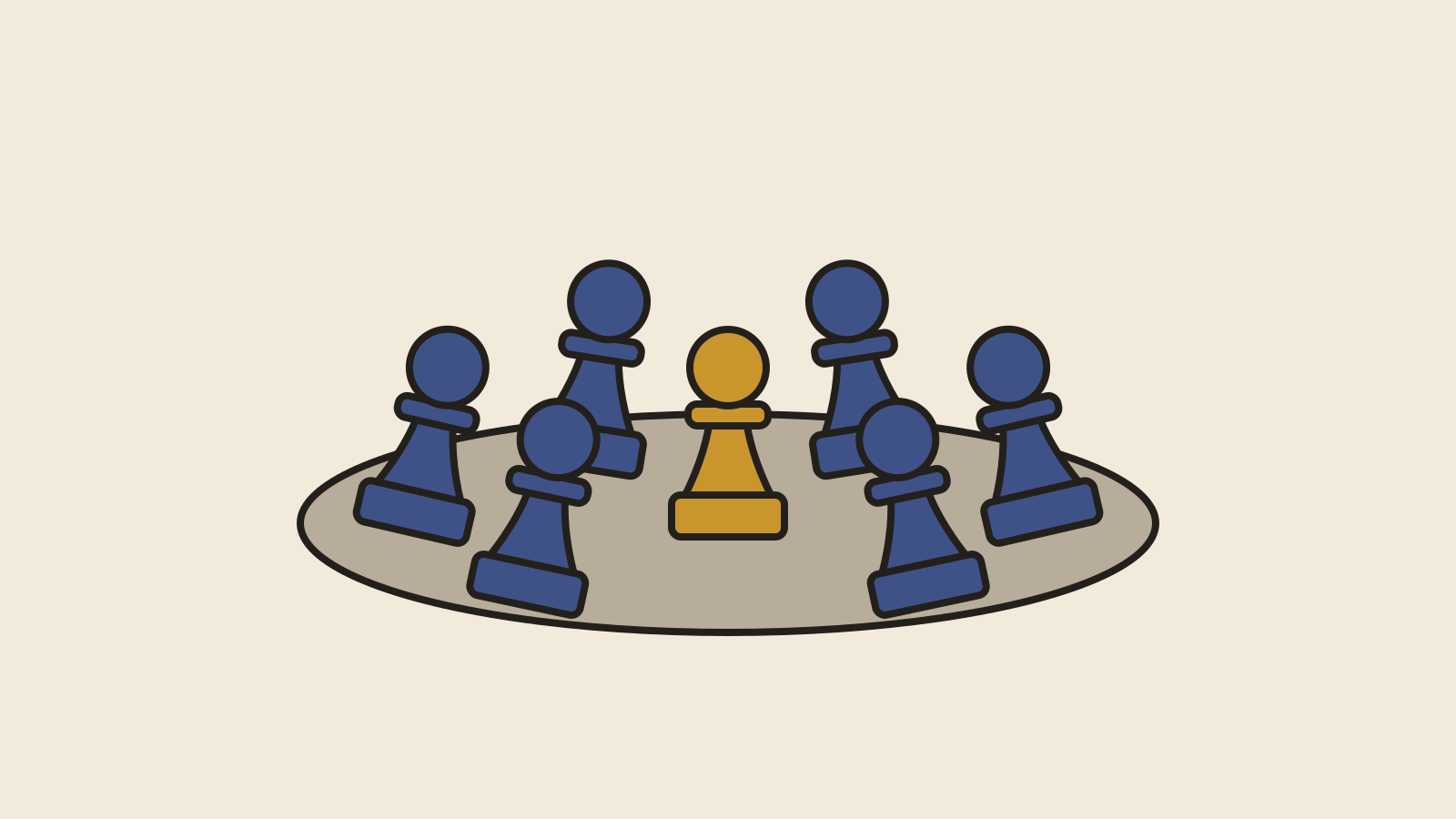
A student who would never cheat alone copies an answer because the whole row is doing it. A commuter walks past a man slumped on a station bench because everyone else is walking past, the bystander effect at work. Social psychology is the branch of psychology that studies moments like these. It asks how one person's thoughts, feelings and actions are shaped by other people, whether present, imagined or only implied.
Bystander effect
A person is less likely to help in an emergency when other people are present than when alone.
Its usual unit is the individual in a situation. Researchers change one feature of a setting, such as the size of a group or who gives an instruction, and measure what a person then does. The branch covers three broad territories. Social influence asks how people change one another, as in conformity and obedience. Social cognition asks how people make sense of each other, as in attribution. Intergroup relations asks how belonging to groups produces loyalty and prejudice, as in social identity theory and the contact hypothesis.
Conformity
Changing what you do or say to match the people around you, although nobody has asked you to.
Obedience to authority
Ordinary people will often harm a stranger against their own conscience when someone they accept as being in charge tells them to.
Diagram
Social psychology grew from one experiment into a field, then had to re-test itself
Read as text
A timeline from 1898 to the present. In 1898 Norman Triplett reports that children wind fishing reels faster in company. In 1908 William McDougall and Edward Ross each publish a textbook with social psychology in its title. In 1936 Muzafer Sherif publishes his studies of how groups form norms. In 1951 Solomon Asch reports his line-judging studies of conformity. In 1957 Leon Festinger publishes the theory of cognitive dissonance. In 1963 Stanley Milgram publishes his first obedience study. In 1979 Henri Tajfel and John Turner set out social identity theory. From 2011 the replication crisis leads the field to repeat its classic findings. The branch is active today.
Core commitments
- Situations are stronger than intuition suggests, and a small change in a setting can change what most people do.
- What counts is the situation as the person reads it, so two people in one room can be in different situations.
- Behaviour comes from person and environment together, which Kurt Lewin wrote as the formula B = f(P, E).
- Claims are tested by experiment where possible, with people assigned at random to different versions of a situation.
- Laboratory findings are meant to bear on real problems such as prejudice, persuasion and conflict.
Not to be confused with
| Look-alike | The difference | Differs on |
|---|---|---|
| Personality and individual differences | Personality psychology explains behaviour by what a person brings to every situation. Social psychology explains it by the situation the person is in. Most researchers now accept that both are needed. | Differs onMechanism |
| Deviance and social control | Both ask why people follow or break rules. Social psychologists test this in small experiments, where sociologists of deviance use fieldwork, official records and surveys of whole populations. | Differs onMethod |
| Symbolic interactionism | This sociological school also studies face-to-face life, but by watching and interviewing people in natural settings. It distrusts the laboratory and is sometimes called sociological social psychology. | Differs onMethod |
| Sociology | Sociology explains patterns across groups, institutions and whole societies. Social psychology stays with the individual and asks how those larger things reach one mind. | Differs onLevel |
- Differs onMechanism
Personality and individual differences
Personality psychology explains behaviour by what a person brings to every situation. Social psychology explains it by the situation the person is in. Most researchers now accept that both are needed.
- Differs onMethod
Both ask why people follow or break rules. Social psychologists test this in small experiments, where sociologists of deviance use fieldwork, official records and surveys of whole populations.
- Differs onMethod
This sociological school also studies face-to-face life, but by watching and interviewing people in natural settings. It distrusts the laboratory and is sometimes called sociological social psychology.
- Differs onLevel
Sociology
Sociology explains patterns across groups, institutions and whole societies. Social psychology stays with the individual and asks how those larger things reach one mind.
Origins and development
Norman Triplett's 1898 study, in which children wound fishing reels faster in company than alone, is often named the first experiment. Two textbooks carried the field's name in 1908, one by the psychologist William McDougall and one by the sociologist Edward Ross. The modern field took shape in the 1930s around Muzafer Sherif and Kurt Lewin, a refugee from Germany. The Second World War then set its agenda: persuasion, prejudice and the question of how ordinary people come to do harm. Classic studies by Solomon Asch, Leon Festinger and Stanley Milgram followed.
Kurt Lewin
German-American psychologist who helped found experimental social psychology and held that behaviour depends on the person and the situation together.
Leon Festinger
American social psychologist who proposed cognitive dissonance and social comparison theory, and set the standard for inventive laboratory experiments on belief.
Why it matters
Its findings turn up wherever people try to change what others do: advertising, public health campaigns, jury selection, diversity training and the design of online platforms. It also supplies a habit of mind. When someone behaves badly, the field's first question is what the situation was asking of them.
Critiques and limits
Kenneth Gergen argued in 1973 that the field records the habits of one time and place, so it is closer to history than to science. Joseph Henrich and colleagues later showed how heavily it leans on students from Western, educated, industrialised, rich and democratic societies, the WEIRD problem. Since 2011 the replication crisis has hit this branch hard, and several famous effects shrank or vanished when repeated with larger samples. Archival work has shown that some classic studies, the Stanford prison experiment among them, were less tidy than textbooks said.
The WEIRD problem
Most psychology studies people from Western, educated, industrialised, rich and democratic societies, who are unusual among humans, then generalises to everyone.
Replication crisis
The discovery, from about 2011, that many published findings in psychology and other sciences don't reappear when the studies are run again.
Key figures
- Kurt Lewin1890–1947
- Muzafer Sherif
- Solomon Asch
- Gordon Allport1897–1967
- Leon Festinger1919–1989
- Stanley Milgram1933–1984
- Henri Tajfel
- Albert Bandura1925–2021


Connections
Influenced by
Lewin's formula that behaviour depends on person and environment together, and his action research, set the field's method and practical bent.
Asch, Lewin and Heider brought from Gestalt psychology the view that people respond to a situation as they perceive it.
Failed replications after 2011 pushed the field towards larger samples, preregistered studies and open data.
Contrasts with
Deviance and social controlSociology
Differs on method. Social psychologists test conformity in small-group experiments, while sociologists of deviance use fieldwork, official records and population surveys.
Personality and individual differences
Differs on mechanism. Social psychology explains behaviour by the situation a person is in, personality psychology by what the person brings to every situation.
Symbolic interactionismSociology
Differs on method. Both study face-to-face life, one by controlled experiment and the other by watching and interviewing people in natural settings.
Contains
His studies of modelling, aggression and moral disengagement explain behaviour by the people around the actor.
The Nature of Prejudice set the terms for research on stereotypes, intergroup contact and discrimination.
Trained at Chicago, he wrote a two-volume textbook of social psychology built on Central American conditions.
His studies of how children take in racial attitudes made prejudice's effect on its targets a research topic.
His experiments on leadership, group decision and prejudice gave the branch its experimental method and many of its first researchers.
Dissonance theory and his staged experiments set the agenda of the branch for two decades after 1957.
His experiments are the field's best-known case for the power of the situation over character.
It is the branch's main account of social cognition, of how people make sense of what others do.
Darley and Latané's experiments are a standard case of the branch explaining behaviour by the situation and not by character.
It gave the branch its most productive theory of the 1960s and its account of self-justification.
It is the branch's oldest and most tested proposal for reducing prejudice between groups.
The idea came from social psychologists studying the self and was tested mainly in their laboratories.
It grew out of social cognition research on attitudes that operate without deliberate thought.
It is the branch's best-known demonstration that a situation can override a person's own moral judgement.
It is the branch's leading account of how group membership alone produces bias between groups.
A social psychological account of how a situation can change performance with no change in the person's ability.
Asch's line experiments are among the branch's founding demonstrations of social influence.
Social psychology treats prejudice as an attitude and studies how it is learned, measured and reduced.
Social psychology studies stereotypes as beliefs about groups and asks how they form, persist and steer judgement.
Influenced
SociolinguisticsCognitive science & linguistics
Lambert's matched-guise experiments and Giles's accommodation theory brought social psychology to accent attitudes and to how speakers converge on or diverge from each other.
Applications
Experimenters study the same self-protective distortions under the names self-deception and motivated reasoning.
DramaturgySociology
Psychologists study impression management in experiments as self-presentation, usually without the theatrical frame.
IntersectionalitySociology
Psychologists test whether people with two subordinate identities are overlooked or doubly penalised, with mixed results.
Looking-glass selfSociology
Psychologists test it as reflected appraisal, comparing how people see themselves with how they think others see them.
Purity and pollutionAnthropology
Research on moral disgust tests how far feelings of contamination shape judgements of right and wrong.
Self-fulfilling prophecySociology
Experiments on expectancy effects show one person's belief altering another's behaviour within a single conversation.
TotalitarianismPolitical theory & science
Post-war studies of conformity and obedience asked how ordinary people came to serve such regimes.
Trolley problemPhilosophy
Psychologists present the cases to volunteers to study how emotion and reasoning shape moral judgement.
AuthoritarianismPolitical theory & science
Psychologists use the word for a personal disposition to submit to authority, measured by scales since Adorno's 1950 study.
Participant observationAnthropology
Leon Festinger's team covertly joined a doomsday group in 1954 to watch what followed when its prophecy failed.
Social normsSociology
Laboratory studies since Sherif show how groups settle on shared standards and how members bend to them.
Susan Andersen's experiments show people filling in a stranger's character from a parent or partner the stranger resembles.
Zero-sum gameEconomics
Studies of zero-sum belief find that people who see one group's gain as another's loss are more hostile to outsiders.
Cross with
Two distant entries to read beside this one, each with the question the pairing opens.
Tyranny of the majorityPolitical theory & science
A majority can oppress through social pressure as well as law: what do conformity experiments say about how strong that pressure is? Set them side by side
Spontaneous orderEconomics
Which findings on conformity help explain how conventions such as money and manners arise without anyone designing them? Set them side by side
Further reading
- Aronson, E. (1972). The social animal. W. H. Freeman.
- Gergen, K. J. (1973). Social psychology as history. Journal of Personality and Social Psychology, 26(2), 309–320. https://doi.org/10.1037/h0034436
- Lewin, K. (1951). Field theory in social science: Selected theoretical papers (D. Cartwright, Ed.). Harper & Brothers.
- Ross, L., & Nisbett, R. E. (1991). The person and the situation: Perspectives of social psychology. McGraw-Hill.
Cite this entry
Scholia. (2026). Social psychology. In Scholia: Notes in the margin of the human sciences. Retrieved November 28, 2026, from https://scholia.zennia.sg/schools/social-psychology