IdeaPhilosophy
Anekāntavāda
The Jain doctrine that reality has many aspects, so any claim about a thing is true only in some respect and never the whole truth.
The idea
Anekāntavāda, the Jain doctrine of non-one-sidedness, holds that reality has endless aspects and that no single statement captures it. A claim can be true from one standpoint and false from another, with neither view mistaken.
Take an ordinary man called Ravi. Is he a father? Yes, in relation to his daughter. Is he a son? Yes, in relation to his own mother. Is he tall? Next to his daughter, certainly. Next to a basketball team, no. None of these answers contradicts another, because each is tied to a respect. Jains apply the same reasoning to the largest questions. Is the soul permanent? As a substance, yes. In its changing states, no.
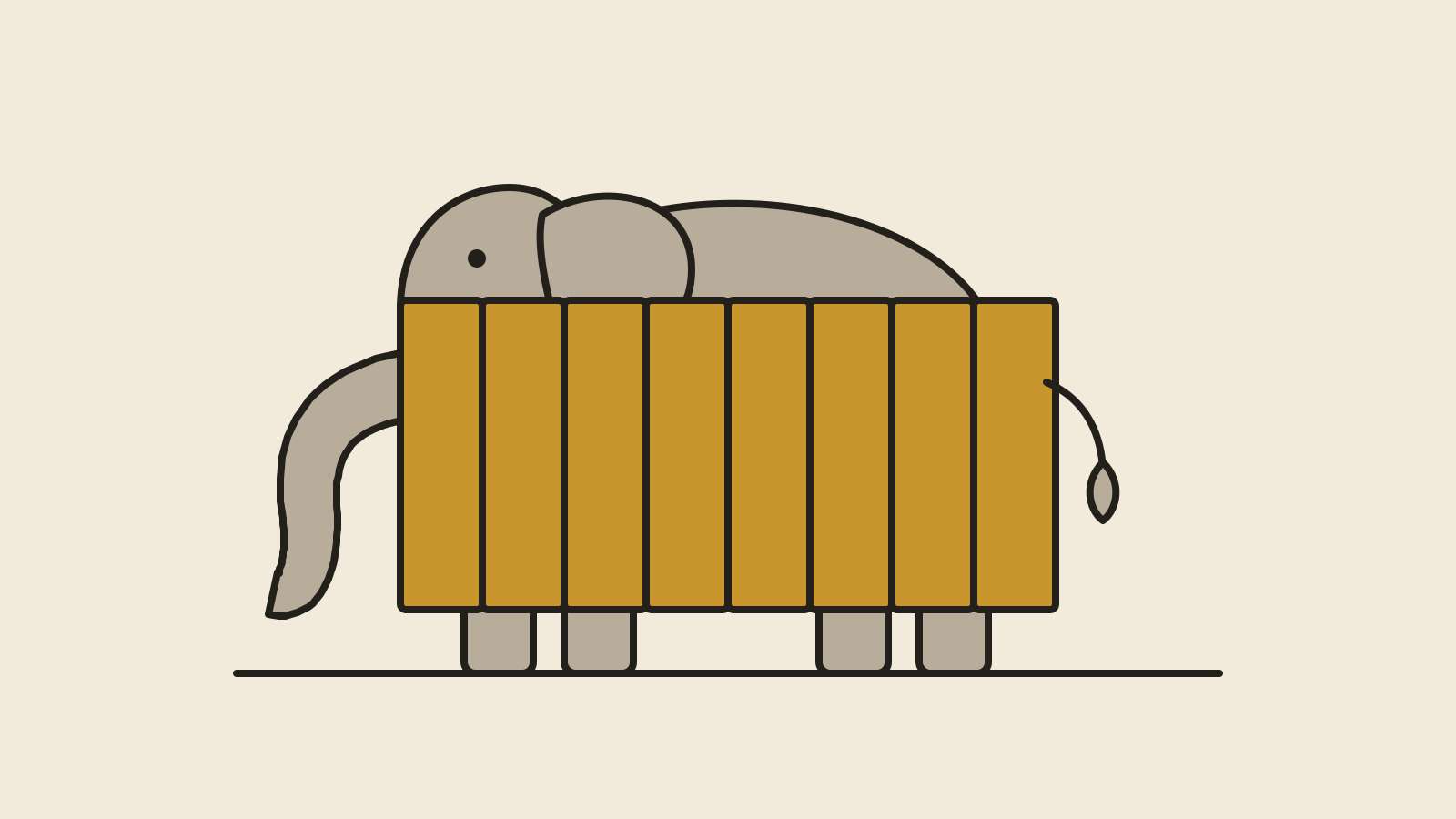
The doctrine's best-known image, also told by Buddhists and Hindus, is of blind men touching an elephant. One feels the trunk and says rope, another the side and says wall. Each holds part of the truth and errs only in taking it for the whole.
Diagram
Jain sevenfold predication gives seven qualified answers about any one thing
Read as text
A tree with one root and seven branches. The root reads: a jar, in some respect. The seven branches give the seven qualified answers. In some respect it is. In some respect it is not. In some respect it is and is not. In some respect it is inexpressible. In some respect it is, and is inexpressible. In some respect it is not, and is inexpressible. In some respect it is, it is not and it is inexpressible. Each answer holds from its own standpoint, such as the jar's material, place, time or form.
Key features
- The doctrine of standpoints (nayavāda) lists the angles from which a thing can be described, such as its lasting substance or its passing states.
- The doctrine of "in some respect" (syādvāda) prefixes each claim with syāt to mark that it holds from a stated standpoint.
- Sevenfold predication combines "is", "is not" and "inexpressible" to give seven qualified answers to any question about a thing.
- A partial view becomes an error only when it is taken for the whole truth, which Jains call one-sidedness.
- Complete knowledge is possible, but only for an omniscient liberated soul, which grasps every aspect at once.
Not to be confused with
| Look-alike | The difference | Differs on |
|---|---|---|
| Moral relativism | The relativist ties moral truth to a culture or person and denies any standpoint above them. Anekāntavāda is about how things are, and holds that partial views add up to one complete truth. Jain ethics stays absolute about non-violence. | Differs onClaim |
| Perspectivism (Nietzsche) | Nietzsche holds that there is no view from nowhere, only perspectives ranked by their richness. Jains hold that an omniscient soul does see every aspect at once, and that each partial view is true of the thing within its scope. | Differs onClaim |
| Standpoint theory | Standpoint theorists tie partial knowledge to social position and credit the subordinate with the less distorted view. A Jain standpoint is an angle on the object, such as its substance or its states, open to anyone. | Differs onClaim |
| Catuṣkoṭi (the tetralemma) | The Buddhist four-cornered scheme lists "is", "is not", "both" and "neither". Nāgārjuna used it to reject every option. Jains use their sevenfold scheme to accept every option, each in its own respect. | Differs onClaim |
- Differs onClaim
The relativist ties moral truth to a culture or person and denies any standpoint above them. Anekāntavāda is about how things are, and holds that partial views add up to one complete truth. Jain ethics stays absolute about non-violence.
- Differs onClaim
Nietzsche holds that there is no view from nowhere, only perspectives ranked by their richness. Jains hold that an omniscient soul does see every aspect at once, and that each partial view is true of the thing within its scope.
- Differs onClaim
Standpoint theorists tie partial knowledge to social position and credit the subordinate with the less distorted view. A Jain standpoint is an angle on the object, such as its substance or its states, open to anyone.
- Differs onClaim
Catuṣkoṭi (the tetralemma)
The Buddhist four-cornered scheme lists "is", "is not", "both" and "neither". Nāgārjuna used it to reject every option. Jains use their sevenfold scheme to accept every option, each in its own respect.
Origins and development
The early Jain scriptures show Mahāvīra answering hard questions with "in one respect this, in another that". Siddhasena Divākara, around the fifth century CE, gave the theory of standpoints its classic form, and Samantabhadra, of uncertain date, set out sevenfold predication. Malliṣeṇa's Syādvādamañjarī of 1292 became a standard textbook. In the twentieth century Bimal Krishna Matilal presented the doctrine as the central philosophy of Jainism, and Graham Priest modelled it with the tools of many-valued logic.
Why it matters
Modern Jains present it as the intellectual side of non-violence: refusing to force your own view on others is a way of doing no harm in argument. Mohandas Gandhi wrote that he liked the doctrine and tied it to truth and non-violence. It is cited in interfaith dialogue and in teaching about disagreement. Logicians study it as an early system in which a claim and its denial can both hold, each in a different respect.
Mohandas Gandhi
The lawyer who led India's mass campaigns against British rule and turned nonviolent resistance into a method of politics used worldwide.
Critiques and limits
Adi Shankara argued that opposite properties such as being and not being cannot belong to one thing at once, and that a doctrine making everything indefinite leaves itself indefinite too. The Buddhist logician Dharmakīrti mocked it: if everything is in some respect everything else, a man told to eat curd might as well eat a camel. Jains reply that each predicate holds in a different respect, so no contradiction arises. The doctrine is a philosophical thesis, settled by argument and not by evidence.
Adi Shankara
The Indian philosopher who argued that the self and ultimate reality are one, and gave Advaita Vedanta its classic form.
Connections
Belongs to
The doctrine of many-sidedness is Jainism's distinctive contribution to Indian logic and the theory of knowledge.
Critiques
Jain logicians called the Buddhist view one-sided, since it sees only changing states and denies the substance that persists through them.
Later Jain logicians called Advaita one-sided for treating reality as unchanging alone and change as mere appearance.
Contrasts with
Differs on claim. Relativism denies any standpoint above cultures, where Jains hold that partial views add up to one truth, known to the omniscient.
Differs on claim. Nietzsche denies any view from nowhere, where Jains hold that an omniscient soul sees every aspect of a thing at once.
Standpoint theorySociology
Differs on claim. Standpoint theory ties partial knowledge to social position, where a Jain standpoint is an angle on the object open to anyone.
Applied in
Modern Jain writers offer it as a ground for religious pluralism, with each faith grasping one aspect of the truth.
Influenced
Mohandas GandhiPolitical theory & science
Gandhi wrote that he liked the Jain doctrine of many-sidedness and tied it to truth and non-violence.
Critiqued by
Shankara argued that being and not being cannot belong to one thing at once, so the Jain doctrine of many-sidedness fails.
Further reading
- Matilal, B. K. (1981). The central philosophy of Jainism (Anekānta-vāda). L. D. Institute of Indology.
- Priest, G. (2008). Jaina logic: A contemporary perspective. History and Philosophy of Logic, 29(3), 263–278. https://doi.org/10.1080/01445340701690233
- Umāsvāti. (1994). That which is: Tattvārtha sūtra. HarperCollins. (Original work published 400)
Cite this entry
Scholia. (2026). Anekāntavāda. In Scholia: Notes in the margin of the human sciences. Retrieved November 28, 2026, from https://scholia.zennia.sg/ideas/anekantavada