IdeaPhilosophyAlso in Psychology
Determinism
The thesis that the state of the world at any moment, together with the laws of nature, fixes everything that happens afterwards.
The idea
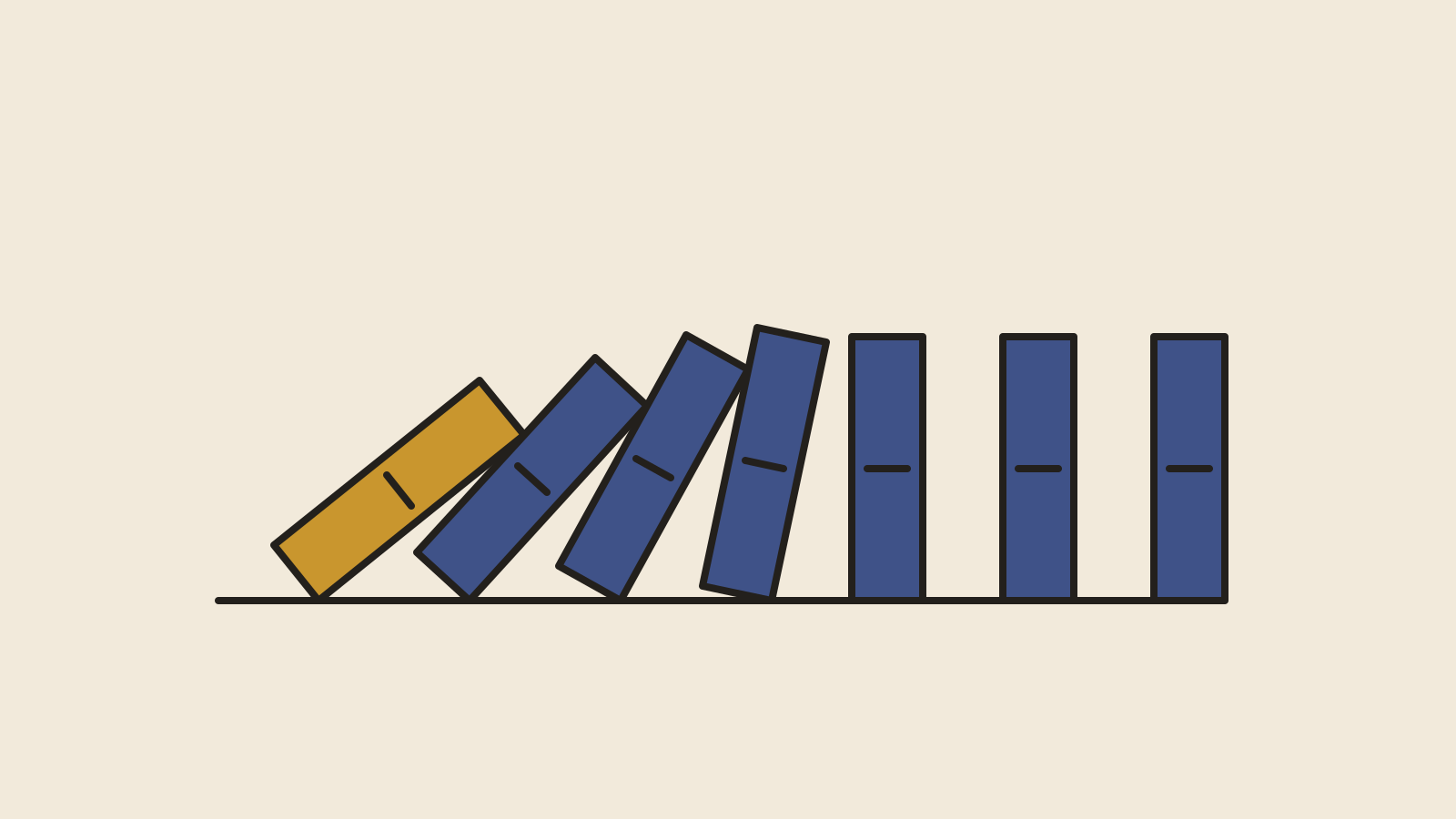
Determinism is the claim that, given how the world is at one moment and given the laws of nature, there is only one way it can go on. Every later event, down to the last detail, is fixed by what came before. Rewind the universe to the same state and let it run again, and it would unfold in exactly the same way.
A game of snooker shows the thought. Once the cue ball is struck, its speed, spin and angle settle where every ball will come to rest. A player cannot predict the result exactly, but nobody thinks the balls decide anything. Determinism says the whole universe is like that table, people included. What you chose for breakfast this morning was settled by the state of your brain a moment earlier, which was settled by earlier states, back to before you were born.
Whether the claim is true remains open.
Diagram
The past and the laws of nature together leave one possible future
Read as text
Two factors combine to produce one outcome. The first is the state of the world at any one moment, including every particle and force. The second is the laws of nature, which are the same everywhere and have no exceptions. Together they fix one possible future. The diagram shows what determinism claims. Whether the claim is true is disputed.
Key features
- It is a claim about how the world is built and holds or fails whether or not anyone can predict the future, as chaotic systems such as the weather show.
- Prior conditions and laws do the fixing together, and neither settles anything alone.
- The fixing is conditional: had the past been different, the future would have been different too.
- It covers all events, so it applies to thoughts and decisions as much as to planets.
- Taken alone it says nothing about whether people are free or responsible, which needs a further argument.
Not to be confused with
| Look-alike | The difference | Differs on |
|---|---|---|
| Fatalism | Fatalism says an outcome will happen whatever you do, so effort is pointless. Determinism says outcomes come about through their causes, your efforts among them. The patient recovers because she took the medicine. | Differs onClaim |
| Compatibilism | Determinism says only that earlier events fix later ones. Compatibilism is the further claim that people can be free and responsible even so. Hard determinists accept determinism and reject that addition. | Differs onClaim |
| Free will | Determinism is a thesis about every event in the universe. Free will is a capacity of agents. Whether the first rules out the second is what philosophers dispute. | Differs onUnit of analysis |
| Karma | Karma links a person's intentional acts to their later fortunes by a moral law and holds that the next choice is still open. Determinism says every event is fixed by physical law, choices included. | Differs onClaim |
- Differs onClaim
Fatalism
Fatalism says an outcome will happen whatever you do, so effort is pointless. Determinism says outcomes come about through their causes, your efforts among them. The patient recovers because she took the medicine.
- Differs onClaim
Determinism says only that earlier events fix later ones. Compatibilism is the further claim that people can be free and responsible even so. Hard determinists accept determinism and reject that addition.
- Differs onUnit of analysis
Determinism is a thesis about every event in the universe. Free will is a capacity of agents. Whether the first rules out the second is what philosophers dispute.
- Differs onClaim
Karma links a person's intentional acts to their later fortunes by a moral law and holds that the next choice is still open. Determinism says every event is fixed by physical law, choices included.
Origins and development
The first Greek atomists and the Stoics held that everything happens by necessity. Newton's mechanics, published in 1687, seemed to supply the laws. Pierre-Simon Laplace gave the classic statement in 1814: an intellect that knew every force and the position of every particle at one instant could calculate the whole future and past. Quantum mechanics, developed in the 1920s, replaced certainties with probabilities on its standard reading and reopened the question. Predestination is a theological cousin, the doctrine that God settled each soul's salvation in advance.
Stoicism
An ancient school teaching that good character is the only true good, and that distress comes from our judgements about events, which we can change.
Why it matters
The idea turns up whenever someone says a criminal was the product of genes and upbringing, or that an algorithm knows what you will buy next. Courts, schools and parents assume that people could have acted otherwise, and determinism asks whether that assumption survives. In psychology, behaviourists such as B. F. Skinner treated behaviour as fully caused. Phrases such as genetic determinism and economic determinism borrow the word for a narrower claim, that one kind of cause dominates.
Behaviourism (psychology)
The school that held psychology should be a science of observable behaviour, explained by learning, with no appeal to inner mental states.
B. F. Skinner
American psychologist who showed how consequences shape behaviour and argued that the same process explains everything people do.
Critiques and limits
Physicists dispute whether the world is deterministic. The standard reading of quantum mechanics makes some events a matter of irreducible chance, while the rival Bohmian and many-worlds readings keep determinism. Karl Popper argued in The Open Universe that even classical physics does not support it. John Earman showed that Newtonian mechanics, examined closely, allows cases in which the past fails to fix the future. The evidence status is contested. No experiment has settled the matter, and the answer may turn on which reading of physics is right.
Karl Popper
An Austrian-born philosopher who argued that science advances by testing bold guesses to destruction and that free societies correct themselves the same way.
Connections
Belongs to
Whether the past and the laws leave only one possible future is a standing question of metaphysics.
Influenced by
The Stoics held that every event follows from earlier causes in an unbroken chain they called fate.
Spinoza argued that everything follows from the nature of God with the necessity of a geometrical proof.
Contrasts with
Differs on claim. Determinism says earlier events fix later ones, while compatibilism adds that freedom and responsibility survive that.
Differs on unit of analysis. Determinism is a thesis about every event in the universe, where free will is a capacity of agents.
Differs on claim. Karma ties intentional acts to later fortunes and leaves the next choice open, where determinism says every event is fixed.
Applied in
Behaviourism (psychology)Psychology
Skinner treated behaviour as fully fixed by genes and reinforcement history and called inner freedom a pre-scientific idea.
Critiqued by
He rejected the fate taught by earlier atomists, and his school added an uncaused swerve of atoms to make room for choice.
William JamesPsychology
His 1884 lecture argued that a world without real alternatives makes regret and moral effort senseless.
Sartre held that no cause, whether heredity, upbringing or passion, fixes what a person will choose.
Cross with
Two distant entries to read beside this one, each with the question the pairing opens.
Efficient-market hypothesisEconomics
Efficient markets make price changes unpredictable from public information: what separates a world that is determined from one that can be predicted? Set them side by side
HeritabilityPsychology
Heritability describes variation across a population, not what fixes one person's traits: what kind of evidence could bear on determinism about an individual? Set them side by side
Further reading
- Earman, J. (1986). A primer on determinism. D. Reidel. https://doi.org/10.1007/978-94-010-9072-8
- Kane, R. (2005). A contemporary introduction to free will. Oxford University Press.
- Laplace, P. S. (1951). A philosophical essay on probabilities. Dover. (Original work published 1814)
Cite this entry
Scholia. (2026). Determinism. In Scholia: Notes in the margin of the human sciences. Retrieved November 28, 2026, from https://scholia.zennia.sg/ideas/determinism