IdeaPhilosophy
Existence precedes essence
Sartre's claim that people have no fixed nature or purpose given in advance and make themselves what they are through their choices.
The idea
A paper knife exists because someone first had an idea of it: what it is for and how it should be made. Its essence, meaning what it is and what it is for, comes before its existence. Jean-Paul Sartre argued that with human beings the order is reversed. A person first exists, turns up in the world, and only afterwards becomes this or that kind of person through what they do. No blueprint, divine or natural, fixes in advance what a human being is for.
Take someone who says they are just not a brave person. Sartre would answer that there is no such fact about them waiting to be discovered. Cowardice is a pattern of choices, and the next choice can break it. This is why he said people are condemned to be free. Nobody chose to exist, yet each person is responsible for what they make of themselves.
Diagram
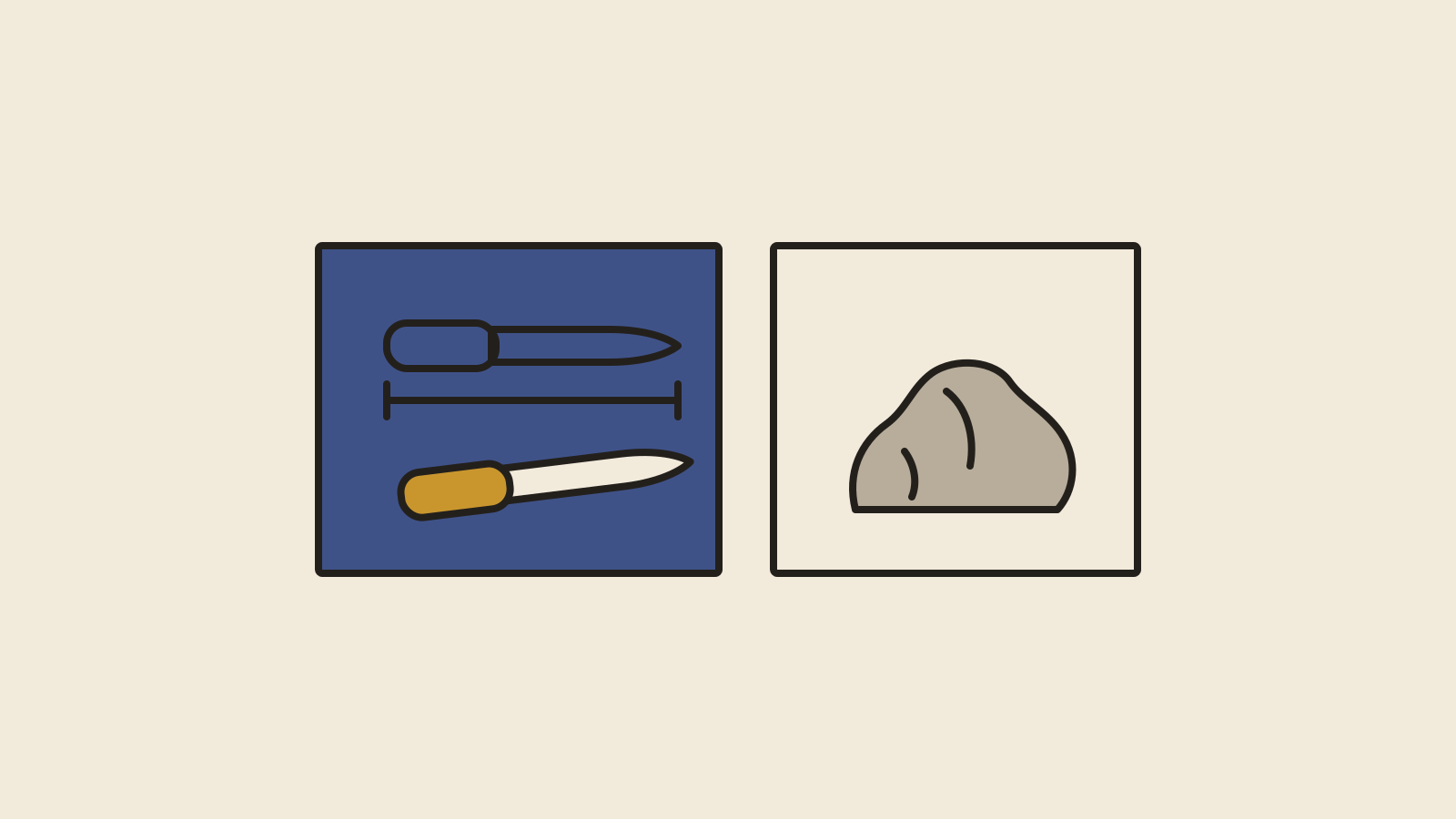
A tool is designed before it exists, a person exists before being defined
Read as text
Two cases set side by side, distinguished by which comes first. On the left, a made thing such as a paper knife: its purpose and design are conceived first and then it is made, so essence comes before existence. On the right, a human being: the person exists first and is defined afterwards by their own choices, so existence comes before essence.
Key features
- No human nature is given in advance, because on Sartre's atheist premise there is no designer to have conceived one.
- Freedom is radical: circumstances limit what is possible, but how a person takes them up is always a choice.
- Responsibility is total, and in choosing for themselves people show what they think a human being should be.
- Anguish is the awareness of this freedom, felt when nothing outside the self settles what to do.
- Bad faith is the common escape: pretending to be a fixed thing, such as a role or a temperament, so as to disown one's freedom.
Not to be confused with
| Look-alike | The difference | Differs on |
|---|---|---|
| Essence | Essence is the older term for what makes a thing the kind of thing it is. The formula keeps the term and denies that human beings have an essence before they act. | Differs onClaim |
| Tabula rasa | The blank slate says the mind starts empty and experience writes on it, so people are made by their surroundings. Sartre says people make themselves by choosing, whatever their surroundings. | Differs onMechanism |
| Social constructionism | Social constructionism holds that categories and identities are produced by societies. Sartre's maker is the single individual, who is answerable even for the roles society hands out. | Differs onUnit of analysis |
| Nihilism | Both deny that values are given from outside. Nihilism concludes that nothing matters. Sartre concludes that people must create values and answer for them. | Differs onClaim |
- Differs onClaim
Essence is the older term for what makes a thing the kind of thing it is. The formula keeps the term and denies that human beings have an essence before they act.
- Differs onMechanism
The blank slate says the mind starts empty and experience writes on it, so people are made by their surroundings. Sartre says people make themselves by choosing, whatever their surroundings.
- Differs onUnit of analysis
Social constructionism holds that categories and identities are produced by societies. Sartre's maker is the single individual, who is answerable even for the roles society hands out.
- Differs onClaim
Both deny that values are given from outside. Nihilism concludes that nothing matters. Sartre concludes that people must create values and answer for them.
Origins and development
Sartre worked out the view in Being and Nothingness (1943), where a longer version of the phrase already appears, and made the short formula famous in a public lecture in Paris on 29 October 1945, printed the next year as Existentialism Is a Humanism. He was adapting a line of Heidegger's, and behind both stands Kierkegaard. Simone de Beauvoir applied the idea to gender in The Second Sex (1949), arguing that one becomes a woman. Sartre later qualified it and gave more weight to class, scarcity and upbringing in his Marxist period.
Martin Heidegger
The German philosopher whose Being and Time recast human existence as practical involvement in a world, and whose Nazism still shadows his work.
Søren Kierkegaard
A Danish thinker who made the single individual's choices, anxiety and faith the centre of philosophy and is often called the father of existentialism.
Why it matters
The idea is in the air whenever someone says a person is not defined by their background, their diagnosis or their job title. It underlies much modern talk of authenticity and self-invention, and existential therapists use it to ask clients what they are choosing. It also sharpens arguments about identity. If nothing fixes what a person is, appeals to what is natural for a man, a woman or a people lose their force.
Critiques and limits
Heidegger replied in his Letter on Humanism (1947) that reversing a metaphysical formula leaves it metaphysical, and he rejected Sartre's reading of his work. Maurice Merleau-Ponty argued that freedom is always situated in a body and a history, so no choice starts from nothing. Claude Lévi-Strauss attacked Sartre's sovereign subject in The Savage Mind (1962). Steven Pinker argues from evidence on inherited temperament that there is a human nature. The claim is conceptual, a thesis about how to understand human life, and cannot be tested directly.
Connections
Belongs to
Sartre offered it as the one claim common to all existentialists, though Heidegger and others refused the label.
Originated by
Sartre made the formula famous in his Paris lecture of October 1945, as the thesis existentialists share.
Influenced by
Sartre adapted the line in Being and Time that the essence of human being lies in its existence.
Kierkegaard's picture of the individual who must choose a life without guarantees is the formula's oldest source.
Critiques
Sartre held that no cause, whether heredity, upbringing or passion, fixes what a person will choose.
Contrasts with
Differs on claim. Essence names what makes a thing the kind it is, and the formula denies that people have one before they act.
Differs on mechanism. The blank slate is filled in by experience, where Sartre's person is made by their own choices.
Social constructionismSociology
Differs on unit of analysis. Constructionism says societies make identities, where Sartre says each individual makes and answers for their own.
Differs on claim. Both deny that values are given from outside, but Sartre concludes that people must create them and nihilism that nothing matters.
Differs on claim. Sartre's slogan turns Heidegger's remark about Dasein into a doctrine of free self-creation that Heidegger rejected.
Applied in
Humanistic psychologyPsychology
Existential and humanistic therapists took up the view that clients are responsible for who they become.
Sociology of genderSociology
Beauvoir applied the formula to womanhood, arguing that one becomes a woman, a root of the distinction between sex and gender.
Critiqued by
Claude Lévi-StraussAnthropology
In The Savage Mind Lévi-Strauss argued that unconscious structures, and no freely choosing subject, shape what people think and do.
Cross with
Two distant entries to read beside this one, each with the question the pairing opens.
TemperamentPsychology
Infants show a style of reacting from their first months: how much room does inborn temperament leave for Sartre's claim that we make ourselves? Set them side by side
CasteSociology
A caste is entered at birth and hard to leave: what does Sartre's freedom to make oneself amount to for someone born into one? Set them side by side
Further reading
- Flynn, T. R. (2006). Existentialism: A very short introduction. Oxford University Press. https://doi.org/10.1093/actrade/9780192804280.001.0001
- Sartre, J.-P. (2007). Existentialism is a humanism. Yale University Press. https://doi.org/10.12987/9780300242539 (Original work published 1946)
- Sartre, J.-P. (1956). Being and nothingness: An essay on phenomenological ontology. Philosophical Library. (Original work published 1943)
Cite this entry
Scholia. (2026). Existence precedes essence. In Scholia: Notes in the margin of the human sciences. Retrieved November 28, 2026, from https://scholia.zennia.sg/ideas/existence-precedes-essence