IdeaEconomicsAlso in Psychology
Endowment effect
People value a thing more once they own it, and ask more to give it up than they would pay to get it.
The idea
The endowment effect is the finding that people value a thing more once it is theirs. The lowest price at which they will sell is usually well above the highest price they would have paid to buy.
Someone given a concert ticket that resells for $200 often won't sell it, though they would never have paid $200 for a ticket. Standard consumer theory says the two attitudes are inconsistent, since keeping the ticket amounts to buying it for $200.
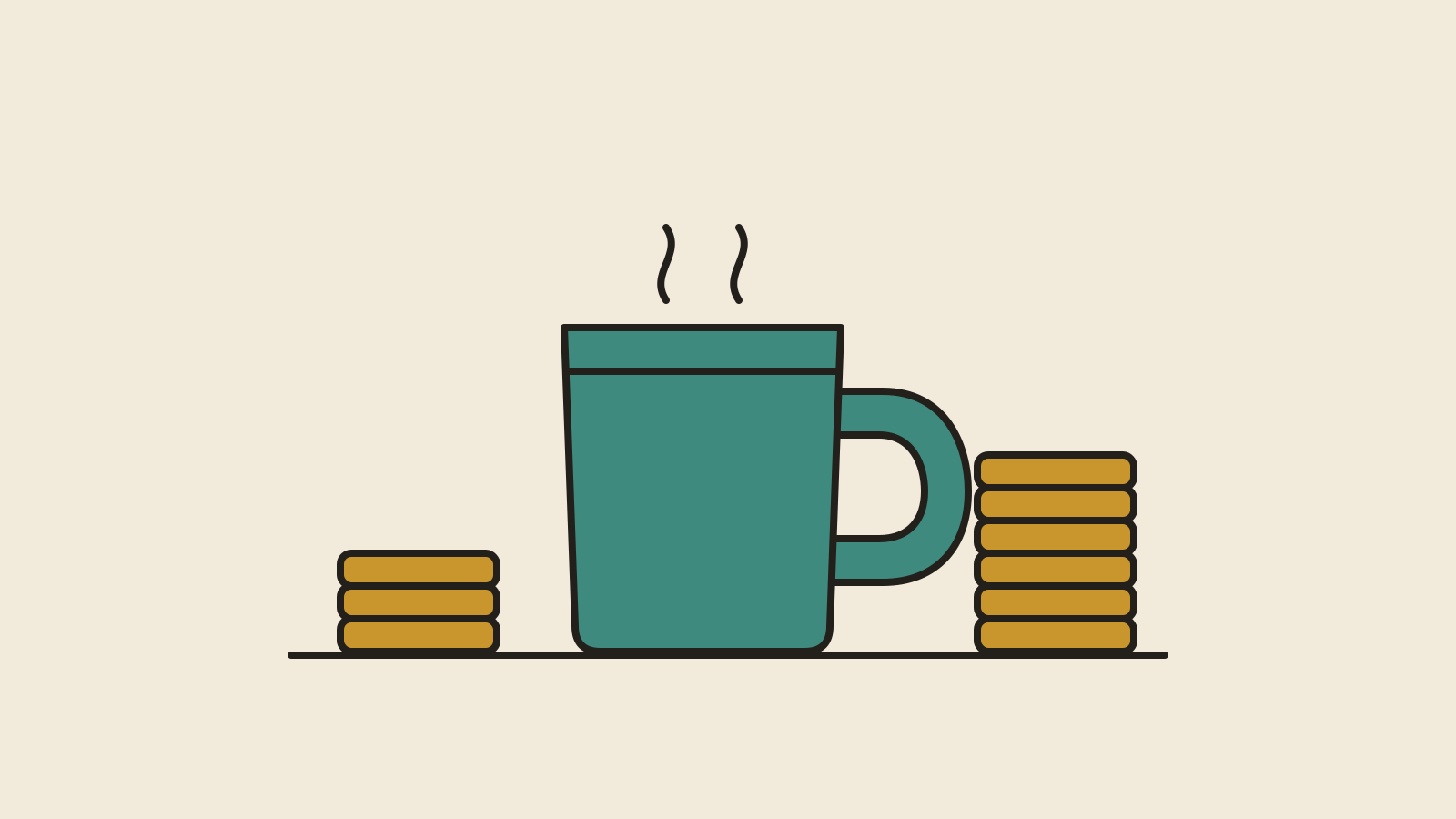
In the classic experiment, half the students in a class were each handed a university coffee mug, and a market was opened. Owners asked about twice what the others offered, and few mugs changed hands. The usual explanation is loss aversion, a part of prospect theory. Giving up the mug registers as a loss, and a loss weighs more than the gain of getting one.
Prospect theory
People judge risky options as gains or losses from a reference point, and a loss hurts more than an equal gain pleases.
Diagram
The same mug is worth more to its owner than to a buyer
Read as text
Two columns divided on who is pricing the same coffee mug. A buyer, who would gain a mug, offers a low price. An owner, who would lose a mug, asks about double that price. Standard theory expects the two prices to be close.
Key features
- The gap between selling and buying prices appears within minutes of ownership, with ordinary goods and no time for attachment to develop.
- It does not appear for money itself or for goods held only to be sold on, such as a shopkeeper's stock.
- It makes people trade less than standard theory predicts, because owners and buyers seldom agree on a price.
- Experienced traders show it weakly or not at all.
- Economists measure it as the gap between willingness to accept and willingness to pay.
Not to be confused with
| Look-alike | The difference | Differs on |
|---|---|---|
| Prospect theory | Prospect theory is a general account of choice under risk. The endowment effect is one finding about riskless trades, usually explained by the theory's loss aversion and open to other explanations. | Differs onScope |
| Mental accounting | Both are Thaler's. The endowment effect says that owning a thing raises its value to you. Mental accounting says that the label on money changes how you spend it. | Differs onClaim |
| Status quo bias | Status quo bias is the wider pull towards whatever option is already in place, such as a default pension plan. The endowment effect concerns owned goods and their prices. | Differs onScope |
| Sentimental value | A wedding ring gains value from its history. The endowment effect shows up for a mug owned for five minutes. | Differs onMechanism |
- Differs onScope
Prospect theory is a general account of choice under risk. The endowment effect is one finding about riskless trades, usually explained by the theory's loss aversion and open to other explanations.
- Differs onClaim
Both are Thaler's. The endowment effect says that owning a thing raises its value to you. Mental accounting says that the label on money changes how you spend it.
- Differs onScope
Status quo bias
Status quo bias is the wider pull towards whatever option is already in place, such as a default pension plan. The endowment effect concerns owned goods and their prices.
- Differs onMechanism
Sentimental value
A wedding ring gains value from its history. The endowment effect shows up for a mug owned for five minutes.
Origins and development
Richard Thaler named the effect in 1980. One of his cases was a wine lover who refused $100 a bottle for wine he would never pay more than $35 to buy. Jack Knetsch showed in 1989 that students given a mug rarely swapped it for a chocolate bar, and students given the chocolate rarely swapped it for a mug. Daniel Kahneman, Knetsch and Thaler published the mug markets in 1990 as a test of the Coase theorem, which implies that who owns a good at the start shouldn't affect who ends up with it.
Richard Thaler
The American economist who catalogued the regular ways real choices depart from economic theory and turned the findings into nudge policy.
Daniel Kahneman
An Israeli-American psychologist who showed that human judgement errs in predictable ways and changed how economists think about choice.
Why it matters
Free trials, test drives and thirty-day returns all put the product in the customer's hands first. Homeowners in a falling property market hold out for prices that buyers are unwilling to pay. In law the effect bears on how to value a loss such as a polluted river. Asking what residents would pay to clean it gives a much lower figure than asking what they would accept to give it up.
Critiques and limits
Charles Plott and Kathryn Zeiler reran the mug studies in 2005 with training, practice and anonymity. The gap disappeared, and they attribute the original result to participants misunderstanding the procedure. John List found in 2003 that seasoned dealers at sports card shows traded freely while newcomers didn't. Carey Morewedge and Colleen Giblin argue that owning a thing changes which of its features come to mind, which explains the gap better than loss aversion does. The gap is well documented in laboratories. Its cause and its reach in markets are disputed.
Connections
Belongs to
The mug experiments of 1990 are among the school's most cited evidence against standard consumer theory.
Originated by
Thaler named the effect in 1980 from cases such as a wine lover who would neither sell nor buy at the same price.
Influenced by
Loss aversion, taken from prospect theory, is the usual explanation for why giving up a good hurts more than getting it pleases.
Daniel KahnemanPsychology
Kahneman ran the 1990 mug markets with Knetsch and Thaler and read the result as loss aversion in riskless choice.
Critiques
If owners overvalue what they hold, who gets a right first affects who ends up with it, even when bargaining is free.
Contrasts with
Differs on scope. Prospect theory is a general account of risky choice, while the endowment effect is one finding about riskless trades.
Differs on claim. The endowment effect says owning a thing raises its value, mental accounting that a label on money changes how it is spent.
Applied in
Surveys valuing clean air or rivers get far higher figures by asking what people would accept to lose them than what they would pay.
Further reading
- Kahneman, D., Knetsch, J. L., & Thaler, R. H. (1990). Experimental tests of the endowment effect and the Coase theorem. Journal of Political Economy, 98(6), 1325–1348. https://doi.org/10.1086/261737
- Morewedge, C. K., & Giblin, C. E. (2015). Explanations of the endowment effect: An integrative review. Trends in Cognitive Sciences, 19(6), 339–348. https://doi.org/10.1016/j.tics.2015.04.004
- Plott, C. R., & Zeiler, K. (2005). The willingness to pay–willingness to accept gap, the "endowment effect," subject misconceptions, and experimental procedures for eliciting valuations. American Economic Review, 95(3), 530–545. https://doi.org/10.1257/0002828054201387
- Thaler, R. (1980). Toward a positive theory of consumer choice. Journal of Economic Behavior & Organization, 1(1), 39–60. https://doi.org/10.1016/0167-2681(80)90051-7
Cite this entry
Scholia. (2026). Endowment effect. In Scholia: Notes in the margin of the human sciences. Retrieved November 28, 2026, from https://scholia.zennia.sg/ideas/endowment-effect