School or branchEconomicsAlso in Political theory & science
Environmental economics
The branch of economics that explains pollution as a cost nobody is charged for, and designs prices, permits and rules to correct it.
Overview
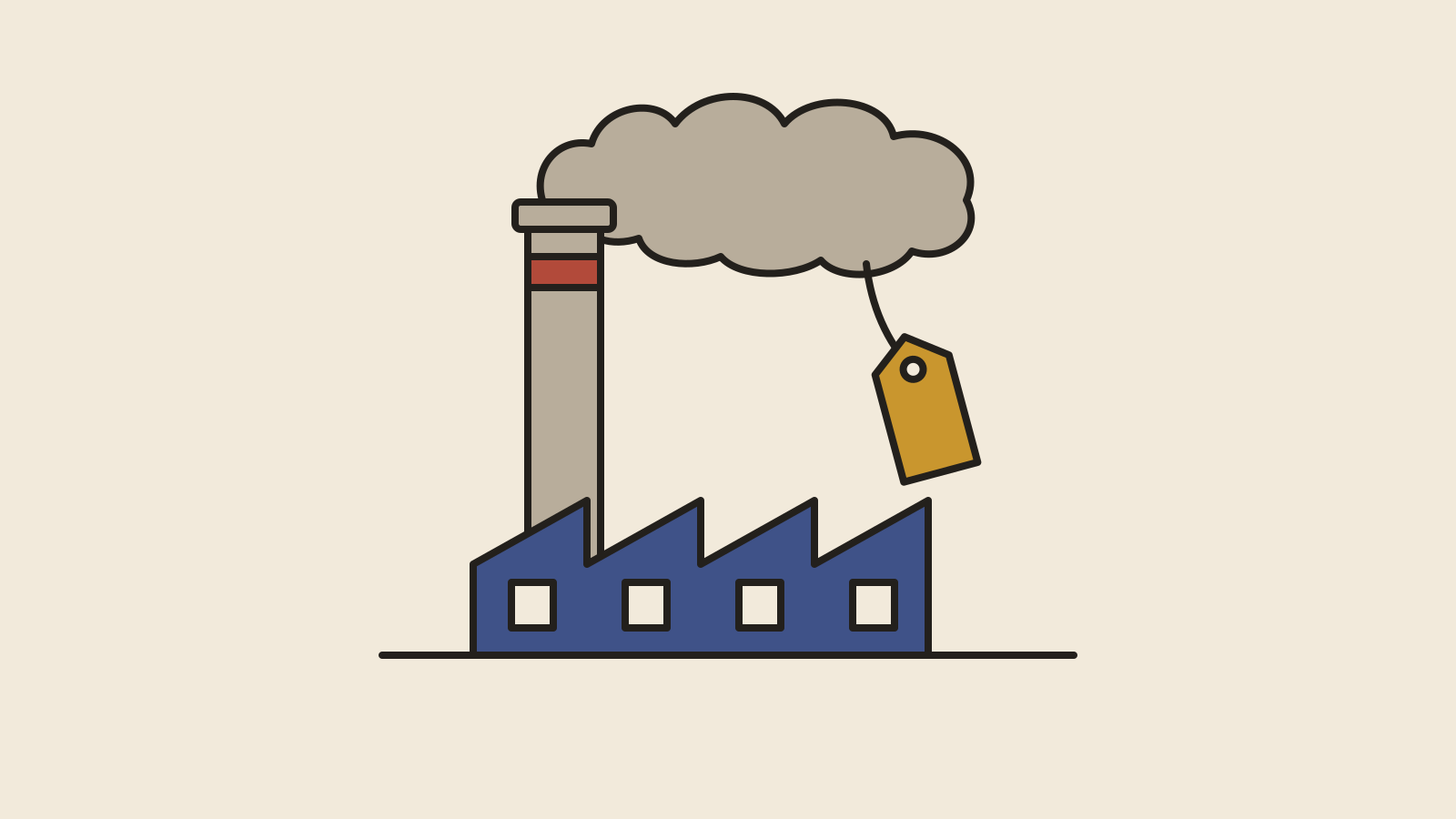
Environmental economics asks why markets left alone produce too much pollution and too little protection of nature, and what would correct that. Its central diagnosis is the externality: a cost that falls on people outside a transaction. A power station pays for its coal and its staff. It pays nothing for the soot that settles in the lungs of people living downwind, so it burns more than it would if the bill were complete.
Externality
A cost or benefit of an activity that falls on people who took no part in deciding it.
The branch's remedies all put a price or a limit where none existed. The few cents charged for a supermarket carrier bag is a small case. The charge stands in for litter and waste that the shopper never used to pay for. Carbon taxes and emissions trading apply the same logic to the climate. Behind each remedy sits a harder question, which the branch treats as measurable: how much is clean air, a wetland or a stable climate worth?
Diagram
The efficient level of pollution is where cutting more would cost more than it saves
Read as text
A graph with pollution emitted on the horizontal axis, from none to the unregulated level, and cost per extra tonne on the vertical axis. One curve, the harm done by one more tonne, rises as pollution rises. The other, the cost of cutting one more tonne, is zero at the unregulated level and climbs steeply as pollution approaches none. The curves cross at the efficient level, where cutting one tonne more would cost exactly as much as the harm it prevents. To the right of that point the harm exceeds the cost of cutting. To the left the cost of cutting exceeds the harm.
Core commitments
- Pollution is a market failure, caused by missing prices and missing property rights more than by bad intentions.
Market failure
A case in which a market, left alone, leaves some possible gain unclaimed, so that resources do less good than they could.
- The right amount of pollution is rarely zero. Cutting should continue until the next unit of clean-up costs more than the harm it prevents.
- Environmental goods can be valued in money, by asking what people would pay or by observing what they already pay to avoid harm.
- Taxes and tradable permits usually reach a target more cheaply than uniform rules, because the firms that can cut cheaply cut most.
- Future costs and benefits are weighed against present ones through a discount rate, and the choice of rate has to be argued openly.
Not to be confused with
| Look-alike | The difference | Differs on |
|---|---|---|
| Ecological economics | Environmental economics treats nature as a set of goods the economy has failed to price. Ecological economics, associated with Herman Daly, treats the economy as one part of a finite biosphere. It sets physical limits first and doubts that manufactured wealth can replace natural wealth. | Differs onClaim |
| Resource economics | Resource economics studies how fast to extract what is taken from nature: oil, fish, timber and minerals. Environmental economics studies what is put back as waste. Most university departments now teach the two together. | Differs onScope |
| Environmentalism | Environmentalism is a movement, and many of its members hold that nature has worth apart from human wants. The branch weighs harms and benefits to people, and will accept some damage when preventing it costs more. | Differs onStandard of judgement |
- Differs onClaim
Ecological economics
Environmental economics treats nature as a set of goods the economy has failed to price. Ecological economics, associated with Herman Daly, treats the economy as one part of a finite biosphere. It sets physical limits first and doubts that manufactured wealth can replace natural wealth.
- Differs onScope
Resource economics
Resource economics studies how fast to extract what is taken from nature: oil, fish, timber and minerals. Environmental economics studies what is put back as waste. Most university departments now teach the two together.
- Differs onStandard of judgement
Environmentalism
Environmentalism is a movement, and many of its members hold that nature has worth apart from human wants. The branch weighs harms and benefits to people, and will accept some damage when preventing it costs more.
Origins and development
Arthur Pigou proposed taxing harmful side effects in 1920, and Ronald Coase answered in 1960 that clear rights and cheap bargaining could do the same job. The branch itself formed in the 1960s, as smog and dirty rivers became political issues and the Washington institute Resources for the Future gathered economists such as Allen Kneese to study them. John Dales proposed tradable pollution rights in 1968. The United States capped and traded sulphur dioxide emissions from 1995, and the European Union opened a carbon market in 2005. Climate change now dominates the field.
Arthur Cecil Pigou
The Cambridge economist who founded welfare economics and argued that taxes should make people pay for the harm they cause others.
Ronald Coase
A British economist who argued that the costs of making deals explain why firms exist and how law shapes the economy.
Why it matters
Every carbon tax, emissions market, congestion charge and bottle deposit is this branch at work. So is the cost-benefit test that many governments apply before approving a new environmental rule. When ministers argue over a "social cost of carbon", the figure in dispute is an economist's estimate of the damage done by one more tonne of carbon dioxide. William Nordhaus shared the 2018 Nobel memorial prize for the models that produce such figures.
Critiques and limits
Ecological economists such as Herman Daly object that the branch fine-tunes at the margin while ignoring the absolute size of an economy on a finite planet. The philosopher Mark Sagoff argues that asking what people would pay treats convictions about nature as if they were consumer tastes. Within the field, Nicholas Stern and Nordhaus reached very different carbon prices, largely because they discounted the future at different rates. Defenders reply that refusing to price nature leaves it priced at zero.
Key figures
- Arthur Pigou1877–1959
- Ronald Coase1910–2013
- Allen Kneese
- John Dales
- Martin Weitzman
- William Nordhaus
- Nicholas Stern
- Partha Dasgupta

Connections
Extends
Takes welfare economics' theory of externalities and public goods and applies it to air, water and climate.
Influenced by
Pigou's 1920 analysis of costs that fall on bystanders gave the branch its diagnosis and its first remedy, a tax.
Coase's 1960 paper recast pollution as a dispute over rights that bargaining could settle, the root of permit trading.
Hardin's 1968 essay made the overgrazed pasture the branch's stock picture of a resource nobody owns.
UtilitarianismPhilosophy
Cost-benefit analysis inherits the utilitarian rule of adding up gains and losses across everyone affected.
Contains
His later work priced the social costs of cars and proposed a carbon tax scaled to national income.
Carbon taxes and pollution charges, the branch's main price instruments, apply Pigou's argument directly.
It treats the atmosphere, forests and rivers as shared capital, and grounds Uzawa's proposals for pricing carbon.
Overfishing, falling water tables and carbon emissions are the branch's standard cases of the argument.
Fisheries, aquifers, forests and the atmosphere, the branch's main subjects, are all resources of this type.
The branch treats pollution as the central case of a cost that polluters do not pay.
Applications
Tradable pollution permits follow its recipe, with the state defining a right and trade finding who values it most.
Collective action problemPolitical theory & science
Climate agreements are modelled as a collective action problem among states, each tempted to let others pay for cutting emissions.
How much a carbon tax cuts emissions depends on the elasticity of demand for fuel.
The branch treats pollution and climate change as market failures and designs prices and permits to correct them.
Cross with
Two distant entries to read beside this one, each with the question the pairing opens.
Amerindian perspectivismAnthropology
If animals are persons with a point of view of their own, who counts as the bystander whose unpaid cost a pollution price should cover? Set them side by side
Risk societySociology
Can pricing manage the hazards that industry creates, or must a hazard first be calculable before a price can be put on it? Set them side by side
Further reading
- Dales, J. H. (1968). Pollution, property and prices: An essay in policy-making and economics. University of Toronto Press.
- Kolstad, C. D. (2011). Environmental economics (2nd ed.). Oxford University Press.
- Pigou, A. C. (1920). The economics of welfare. Macmillan.
- Stern, N. (2007). The economics of climate change: The Stern review. Cambridge University Press. https://doi.org/10.1017/cbo9780511817434
Cite this entry
Scholia. (2026). Environmental economics. In Scholia: Notes in the margin of the human sciences. Retrieved November 28, 2026, from https://scholia.zennia.sg/schools/environmental-economics
This topic is contested. The entry sets out the main positions rather than settling them.