IdeaPhilosophy
Eternal recurrence
Nietzsche's thought that your life might repeat for ever in every detail, used as a test of whether you can affirm it.
The idea
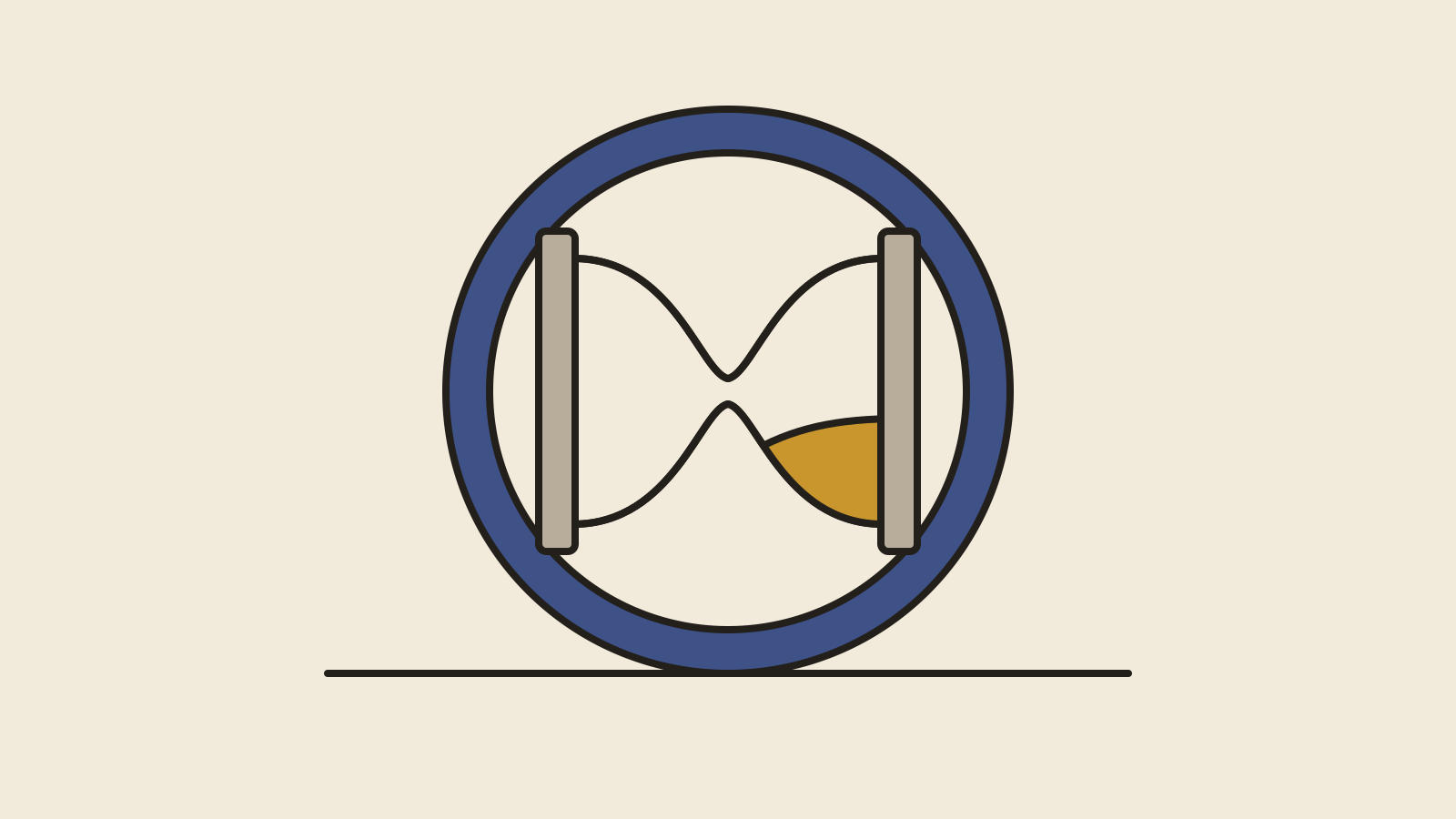
Eternal recurrence is the thought that everything in your life will happen again, in the same order and in every detail, an endless number of times. Nietzsche first presents it as a question. Suppose a demon came to you in your loneliest hour and told you that you must live this life again and again, with every pain, joy and small thing unchanged. Would you curse the demon, or would you call the news divine?
Friedrich Nietzsche
A German philosopher who declared the death of God, traced the hidden history of moral values and asked what could replace them.
The test is easy to try on last year alone, with the job you kept too long, the quarrel at a family dinner and the afternoons wasted on your phone. Most people asked whether they'd repeat their life do some quiet editing first, and the demon allows none. To say yes you must want the bad days too, since they helped make you. Nietzsche thought a person who could honestly say yes would have overcome every temptation to wish life other than it is.
Diagram
Eternal recurrence reads as a test of a life or a theory of the cosmos
Read as text
Two columns divided by how the idea is read. As a test of a life it is the demon's question of whether you would say yes to living your life again, published in The Gay Science in 1882. As a theory of the cosmos it argues that finite forces in endless time must repeat, an argument Nietzsche left in his notebooks.
Key features
- What recurs is the identical life, with no memory carried over and no chance to do better next time.
- In the published books it works as a test of attitude, and its force does not depend on the universe really repeating.
- It leaves no room for consolation from an afterlife, progress or a final purpose, since nothing lies beyond the circle.
- Its companion is amor fati, love of one's fate, which means wanting nothing in one's life to be different.
- In notebooks Nietzsche also sketched a proof from physics, arguing that finite forces in endless time must repeat their arrangements.
Not to be confused with
| Look-alike | The difference | Differs on |
|---|---|---|
| Determinism | Determinism says every event is fixed by earlier events and the laws of nature. That is compatible with a history that runs once and never repeats. Recurrence adds the circle, and as a test it needs no view on causes. | Differs onClaim |
| The absurd | Camus pictures Sisyphus pushing his rock up the hill for ever and asks us to imagine him happy in defiance of a pointless task. Nietzsche asks for more than defiance. The recurring life is to be loved. | Differs onClaim |
| Karma | In the Indian traditions of karma and rebirth a person is reborn into a different life shaped by past actions, and release from the cycle is the goal. Recurrence returns the same life unchanged, and there is nothing to escape to. | Differs onClaim |
- Differs onClaim
Determinism says every event is fixed by earlier events and the laws of nature. That is compatible with a history that runs once and never repeats. Recurrence adds the circle, and as a test it needs no view on causes.
- Differs onClaim
Camus pictures Sisyphus pushing his rock up the hill for ever and asks us to imagine him happy in defiance of a pointless task. Nietzsche asks for more than defiance. The recurring life is to be loved.
- Differs onClaim
In the Indian traditions of karma and rebirth a person is reborn into a different life shaped by past actions, and release from the cycle is the goal. Recurrence returns the same life unchanged, and there is nothing to escape to.
Origins and development
Nietzsche said the thought struck him in August 1881, beside a tall rock on the shore of Lake Silvaplana in the Swiss Alps. It appears in section 341 of The Gay Science (1882) and drives the plot of Thus Spoke Zarathustra (1883–1885), whose hero is sickened by it before he can accept it. Cyclical time was an old idea, held by the Stoics and others. Nietzsche turned it from a theory about the cosmos into a measure of a life. His sketches of a physical proof stayed unpublished.
Stoicism
An ancient school teaching that good character is the only true good, and that distress comes from our judgements about events, which we can change.
Why it matters
The demon's question survives outside philosophy because it needs no belief to work. Therapists and writers use versions of it to ask whether a life is being lived or merely got through. Milan Kundera opens The Unbearable Lightness of Being with it, and the film Groundhog Day is often compared with it, though its hero remembers each loop and can change. The thought also shows what Nietzsche meant by affirming life against pessimism.
Philosophical pessimism
The reasoned view that suffering outweighs the good in life, so that existence is on balance not worth having.
Critiques and limits
Georg Simmel showed in 1907 that the physical proof fails: a finite system can run for ever without returning to an earlier state. Ivan Soll argued in 1973 that an exact repetition with no memory linking the cycles should leave us indifferent, since the later self would feel nothing added. Alexander Nehamas replies that the thought concerns identity, because to want one thing different is to want to be someone else. As cosmology the doctrine has no scientific support. As a test it is a thought experiment.
Georg Simmel
The Berlin thinker who studied the recurring forms of social life, such as the pair, the stranger and the crowd of the big city.
Connections
Originated by
He first published it in The Gay Science in 1882 and made it the central teaching of Thus Spoke Zarathustra.
Influenced by
The Stoics taught that the cosmos ends in fire and begins again identically, a precedent Nietzsche acknowledged in Ecce Homo.
Nietzsche said the doctrine could already have been taught by Heraclitus, the thinker of endless becoming he most admired.
Critiques
It was devised as the opposite ideal to Schopenhauer's denial of life, a yes so complete that it wants everything again.
Contrasts with
Differs on claim. Determinism says each event is fixed by what came before, and it says nothing about the same events coming round again.
Differs on claim. Camus's Sisyphus repeats a pointless task and answers with defiance, where Nietzsche asks for love of a life that repeats.
Differs on claim. In rebirth each life differs according to past deeds and release is possible, where recurrence repeats one life unchanged with no exit.
Influenced
He read the eternal return as a selection in which only difference comes back, a theme at the centre of Difference and Repetition.
Critiqued by
Georg SimmelSociology
In Schopenhauer and Nietzsche of 1907 he showed that a finite system can run for ever without returning to an earlier state.
Further reading
- Nehamas, A. (1985). Nietzsche: Life as literature. Harvard University Press.
- Nietzsche, F. (1974). The gay science. Vintage Books. (Original work published 1882)
- Nietzsche, F. (2006). Thus spoke Zarathustra: A book for all and none. Cambridge University Press. https://doi.org/10.1017/CBO9780511812095 (Original work published 1883)
- Reginster, B. (2006). The affirmation of life: Nietzsche on overcoming nihilism. Harvard University Press. https://doi.org/10.4159/9780674042643
Cite this entry
Scholia. (2026). Eternal recurrence. In Scholia: Notes in the margin of the human sciences. Retrieved November 28, 2026, from https://scholia.zennia.sg/ideas/eternal-recurrence