IdeaEconomicsAlso in Political theory & science, Philosophy, Sociology
Free-rider problem
When people can enjoy a benefit whether or not they pay for it, many will not pay and the benefit may never be supplied.
The idea
A free rider enjoys something without paying towards it. The problem arises with benefits that reach everyone once they exist, payers and non-payers alike. If you will get the benefit anyway, and your own payment makes almost no difference to whether it arrives, the self-interested move is to keep your money. When enough people reason this way, too little is provided or nothing at all.
Picture a private lane shared by thirty houses, full of potholes. The residents are asked to chip in for resurfacing. Every car will use the new surface. A household that declines to pay drives on it exactly as its neighbours do, and is a little richer. If too many decline, the potholes stay.
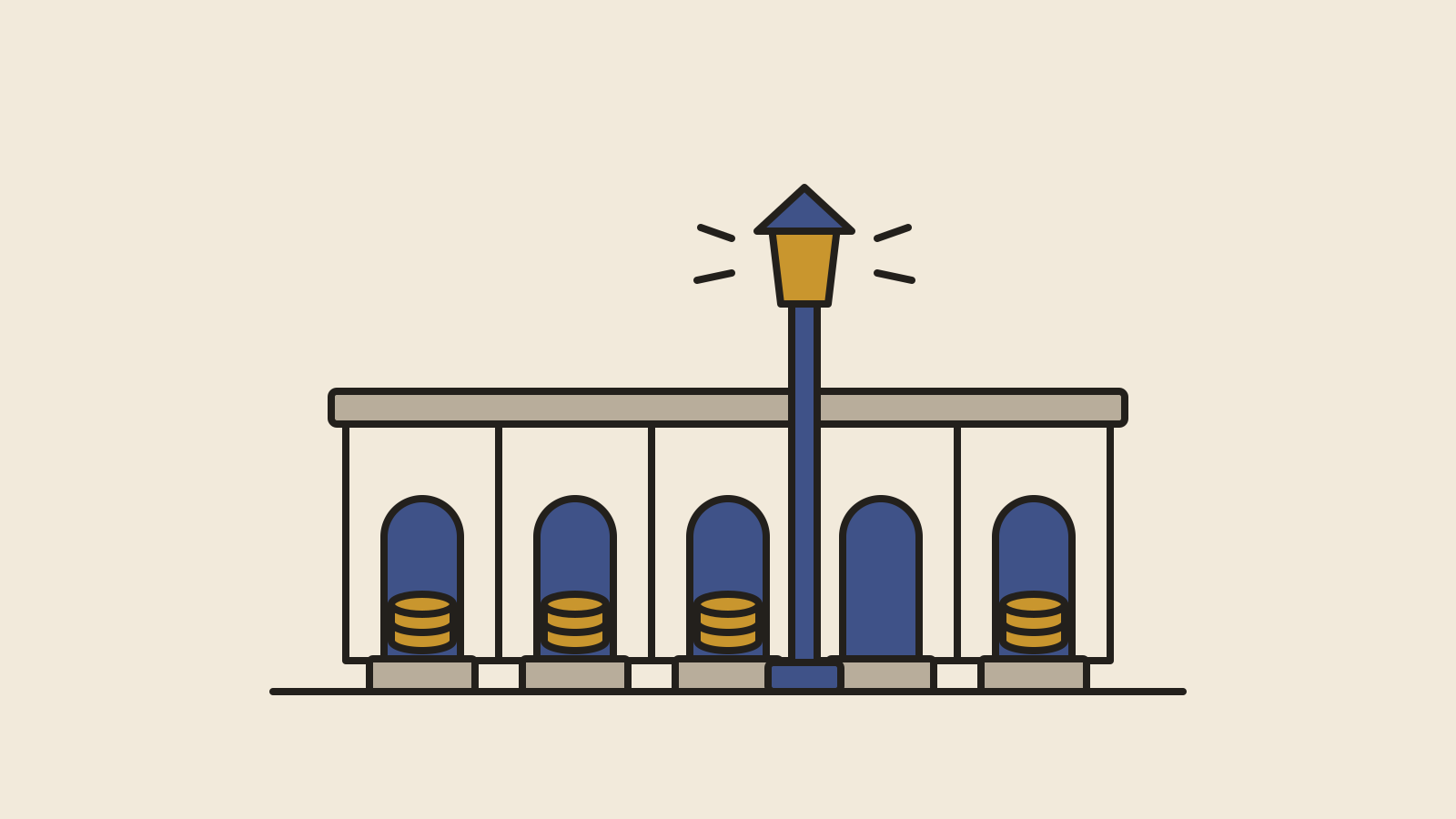
Economists use the problem to explain why markets under-supply things such as street lighting, clean air and basic research, and why governments pay for them out of taxes that nobody can opt out of.
Diagram
Whatever the others do, you come out ahead by not paying
Read as text
A two-by-two table of payoffs. The rows are your choices, pay or free ride. The columns are what everyone else does, pay or free ride. If all pay, you and each of the others get 3, the benefit of 5 less the cost of 2. If the others pay and you free ride, you get 5 and they still get 3. If you pay and the others free ride, the good is not supplied and you lose 2 while they get 0. If nobody pays, everyone gets 0. Free riding gives you more in both columns, so everyone free rides and all end at 0, though all would have preferred the cell where everyone pays.
Key features
- The benefit is non-excludable, meaning there is no practical way to withhold it from people who have not paid.
- Each person's contribution is small beside the total, so holding it back seems to cost the group nothing.
- Free riding can be reasonable for each person even though everyone would prefer the outcome where all pay.
- The usual remedies are compulsion such as taxes, private rewards kept for contributors and social pressure in groups small enough for shirkers to be noticed.
- In experiments people free ride less than the theory predicts, but more as a game is repeated.
Not to be confused with
| Look-alike | The difference | Differs on |
|---|---|---|
| Collective action problem | Free riding is the individual's temptation to take a benefit without paying. The collective action problem is the group's wider predicament, which also covers people who would contribute if they were sure others would. | Differs onScope |
| Prisoner's dilemma | The dilemma is a formal game, usually with two players who each visibly affect the other. Free riding concerns large groups, where one person's choice is barely felt. | Differs onScope |
| Tragedy of the commons | The free rider gives too little towards a shared benefit. In the tragedy users take too much from a shared stock that can run out. | Differs onMechanism |
| Moral hazard | Moral hazard is the carelessness that follows when someone else bears your risk and can't watch you. Free riding needs a shared benefit, and nothing has to be hidden. | Differs onMechanism |
- Differs onScope
Free riding is the individual's temptation to take a benefit without paying. The collective action problem is the group's wider predicament, which also covers people who would contribute if they were sure others would.
- Differs onScope
The dilemma is a formal game, usually with two players who each visibly affect the other. Free riding concerns large groups, where one person's choice is barely felt.
- Differs onMechanism
The free rider gives too little towards a shared benefit. In the tragedy users take too much from a shared stock that can run out.
- Differs onMechanism
Moral hazard is the carelessness that follows when someone else bears your risk and can't watch you. Free riding needs a shared benefit, and nothing has to be hidden.
Origins and development
David Hume observed in 1740 that two neighbours can agree to drain a meadow they share while a thousand cannot, because each looks for a way to leave the work to others. Paul Samuelson's 1954 theory of public goods showed why people would understate what such goods are worth to them. Mancur Olson's The Logic of Collective Action (1965) made the argument general. The phrase was already current in American labour disputes, where unions complained of workers who took negotiated pay rises without paying dues.
David Hume
A Scottish philosopher who argued that our beliefs about causes, the self and morality rest on habit and feeling more than on reason.
Paul Samuelson
The American economist who recast economics in mathematics and taught it to the world through the best-selling economics textbook of his century.
Why it matters
The problem is the standard argument for taxation: defence, flood barriers and public health are paid for compulsorily because voluntary payment would fall short. It explains union closed shops, the service charges in apartment blocks and the difficulty of climate agreements, where every country gains from the cuts others make. Wikipedia, open-source software and public radio show the other side, since all of them run on contributions that the theory says should dry up.
Critiques and limits
Gerald Marwell and Ruth Ames found in 1981 that people in one-off experiments gave roughly half of what they could to a shared fund, where theory predicted nothing. Ernst Fehr and Simon Gächter later showed contributions decaying with repetition unless players could punish shirkers. Richard Tuck argues in Free Riding (2008) that the reasoning is a twentieth-century invention. Earlier thinkers, he holds, saw nothing rational in refusing to help a cause you wanted to succeed. The tendency is well supported. Strict free riding is rarer than the theory implies.
Connections
Belongs to
It is the branch's standard explanation of why markets under-supply public goods and why taxes fund them.
Public choice and policyPolitical theory & science
Public choice uses free riding to explain why voters stay uninformed and why broad interests go unorganised.
Influenced by
David HumePhilosophy
Hume noted in 1740 that a thousand neighbours will not drain a shared meadow, each hoping to leave the work to others.
His 1954 theory of public goods showed why people would understate what a shared good is worth to them.
Contrasts with
Bystander effectPsychology
Differs on mechanism. A free rider knows what is needed and leaves the cost to others, while a bystander is often unsure anything is wrong.
Collective action problemPolitical theory & science
Differs on scope. Free riding is the individual temptation, the collective action problem the group's wider predicament, which also includes failures of assurance.
Differs on scope. Free riding concerns large groups sharing a good, while the dilemma has two players whose choices plainly affect each other.
Differs on mechanism. Free riders give too little towards a shared benefit, while users of a commons take too much from a shared stock.
Differs on mechanism. A free rider enjoys a shared good without paying, while moral hazard needs only a risk shifted to someone else.
Applied in
Social movementsSociology
Movement scholars ask how protests recruit when each sympathiser could stay home and still share in any victory.
International relationsPolitical theory & science
Small allies are said to free ride on the defence spending of the largest member of an alliance.
Cross with
Two distant entries to read beside this one, each with the question the pairing opens.
Langue and paroleCognitive science & linguistics
A shared language is a benefit nobody pays for and anyone may use, so why is it never undersupplied? Set them side by side
Anthropology of religion and ritualAnthropology
Do costly rituals solve free riding by making membership too expensive for those who would take without giving? Set them side by side
Further reading
- Cullity, G. (2025). The free rider problem. Stanford Encyclopedia of Philosophy. https://plato.stanford.edu/entries/free-rider/
- Marwell, G., & Ames, R. E. (1981). Economists free ride, does anyone else? Experiments on the provision of public goods, IV. Journal of Public Economics, 15(3), 295–310. https://doi.org/10.1016/0047-2727(81)90013-X
- Olson, M. (1965). The logic of collective action: Public goods and the theory of groups. Harvard University Press. https://doi.org/10.4159/9780674041660
- Tuck, R. (2008). Free riding. Harvard University Press. https://doi.org/10.4159/9780674033894
Cite this entry
Scholia. (2026). Free-rider problem. In Scholia: Notes in the margin of the human sciences. Retrieved November 28, 2026, from https://scholia.zennia.sg/ideas/free-rider-problem