IdeaEconomicsAlso in Political theory & science, Anthropology, Sociology
Tragedy of the commons
When a resource is open to all, each user gains by taking more, and together they can ruin it for everyone.
The idea
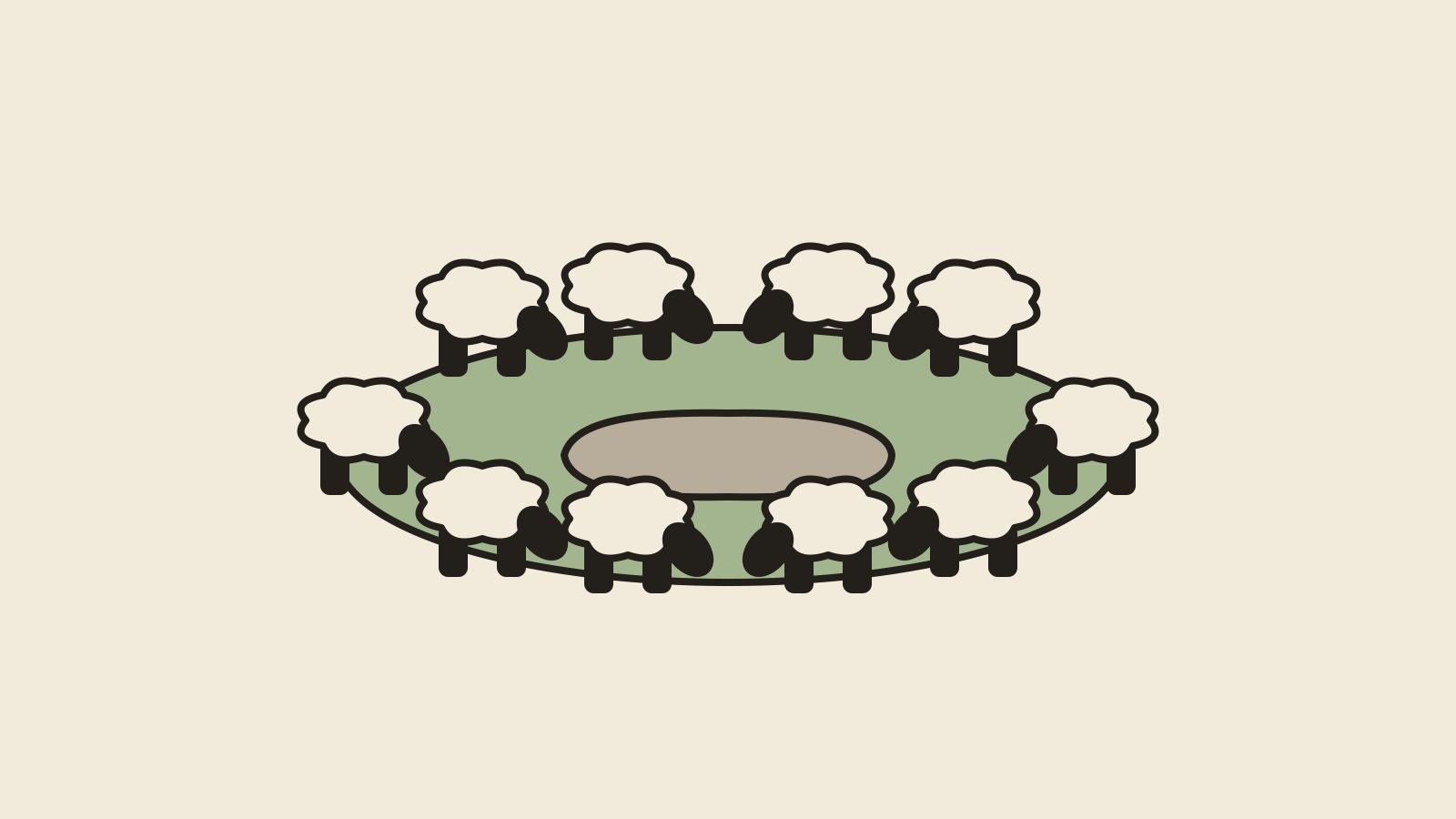
A shared resource that anyone may use can be destroyed by people who are each acting sensibly. Garrett Hardin's picture was a pasture open to every herder in a village. A herder who adds one more animal keeps the whole gain from selling it. The cost, a little less grass, is spread across all the herders. So each adds another animal, and then another, until the pasture is grazed bare.
The same logic turns up in a shared office fridge. Milk bought for everyone runs out by Wednesday, because each person who pours a generous cup gets all of the benefit and bears a sliver of the cost.
Hardin concluded that such problems have no technical fix. He argued that appeals to conscience would fail and that only private ownership or rules backed by force could save a commons. That conclusion, more than the pasture story, is what later research disputes.
Diagram
Each herder gains by adding animals, and together they exhaust the pasture
Read as text
Five steps in a chain. First, a pasture is open to every herder with no limit on use. Second, a herder adds one more animal. Third, that herder keeps the whole gain from the animal while the cost of the lost grass is shared among all herders. Fourth, every other herder reasons the same way and adds animals too. Fifth, the pasture is grazed bare. The chain holds only where no rules limit who may graze or how much.
Key features
- The gain from using more goes to one user, while the cost of overuse is divided among all.
- The resource is subtractable: what one user takes is no longer there for the others.
- Nobody need be foolish or malicious, since each user's choice is reasonable given what the others are doing.
- Hardin's story assumes open access, with no limit on who may use the resource or how much.
- His remedies were private property or what he called "mutual coercion, mutually agreed upon".
Not to be confused with
| Look-alike | The difference | Differs on |
|---|---|---|
| Free-rider problem | A free rider gives too little towards a benefit that everyone shares. In the tragedy each user takes too much of something that can be used up. One is under-supply, the other overuse. | Differs onMechanism |
| Prisoner's dilemma | The dilemma is an abstract game, usually for two players. The tragedy is a claim about real shared resources with many users, and it is often modelled as a dilemma played by a crowd. | Differs onScope |
| Common-pool resource | A common-pool resource is a type of good, defined by its properties. The tragedy is a prediction about what happens to such goods. The term carries no forecast of ruin. | Differs onClaim |
| Collective action problem | Olson's problem is getting the members of a group to contribute to a shared benefit. Hardin's is stopping users from drawing down a shared stock. | Differs onMechanism |
- Differs onMechanism
A free rider gives too little towards a benefit that everyone shares. In the tragedy each user takes too much of something that can be used up. One is under-supply, the other overuse.
- Differs onScope
The dilemma is an abstract game, usually for two players. The tragedy is a claim about real shared resources with many users, and it is often modelled as a dilemma played by a crowd.
- Differs onClaim
A common-pool resource is a type of good, defined by its properties. The tragedy is a prediction about what happens to such goods. The term carries no forecast of ruin.
- Differs onMechanism
Olson's problem is getting the members of a group to contribute to a shared benefit. Hardin's is stopping users from drawing down a shared stock.
Origins and development
The Oxford economist William Forster Lloyd described the overstocked pasture in lectures published in 1833. H. Scott Gordon gave the argument its economic form in 1954 in a study of fisheries. Hardin, an American ecologist, named it in a 1968 essay in Science whose real subject was population growth. From the 1980s Elinor Ostrom and others collected cases of commons that had lasted for centuries. By the 1990s Hardin himself was writing of the tragedy of the unmanaged commons.
Elinor Ostrom
The American political scientist who showed that communities can manage shared resources themselves, and won the Nobel prize in economics for it.
Why it matters
Overfishing on the high seas, falling water tables, crowded roads and carbon in the atmosphere are all described this way. The idea shapes policy: fishing quotas, congestion charges and emissions permits all try to make users face the cost they impose on others. It is also invoked in arguments for privatising shared land, which is one reason the debate over it stays heated.
Critiques and limits
Ostrom's Governing the Commons (1990) documented Swiss pastures, Japanese village forests and Spanish irrigation systems that users had managed for centuries by their own rules. Susan Cox argued from the historical record that the English commons Hardin pictured were regulated, with limits on each villager's animals. David Feeny and colleagues found that Hardin had run together common property and open access. William Murdoch and Allan Oaten (1975) rejected his case against food aid. The evidence is mixed: open-access resources often decline as he predicted, and managed commons often do not.
Connections
Belongs to
Overfishing, falling water tables and carbon emissions are the branch's standard cases of the argument.
Influenced by
Hardin's essay was about population, and it revived the Malthusian fear that numbers outrun a finite world.
Critiques
Hardin offered the pasture as a case where individuals pursuing their own gain damage the public interest.
Contrasts with
Collective action problemPolitical theory & science
Differs on mechanism. In the commons each user takes too much of an exhaustible resource, in Olson's case each gives too little.
Differs on mechanism. Free riders give too little towards a shared benefit, while users of a commons take too much from a shared stock.
Differs on scope. The dilemma is an abstract two-player game, while the tragedy is a claim about shared resources with many users.
Differs on claim. The term classifies a kind of good, while the tragedy predicts that such goods will be overused to ruin.
Applied in
International relationsPolitical theory & science
Fishing treaties and climate talks are analysed as attempts by states to limit their use of an unowned resource.
Economic anthropologyAnthropology
Anthropologists tested the prediction against real pastures, fisheries and forests and found many that were governed by local rules.
Influenced
Hardin's 1968 essay made the overgrazed pasture the branch's stock picture of a resource nobody owns.
Critiqued by
Her cases of commons that lasted for centuries showed that ruin depends on the rules in force.
Cross with
Two distant entries to read beside this one, each with the question the pairing opens.
Social identity theoryPsychology
Do users who identify with the group sharing a pasture take less from it, and how far can identity replace enforcement? Set them side by side
World EnglishesCognitive science & linguistics
English is open to all and owned by no country, yet use does not ruin it, so what separates it from an overgrazed pasture? Set them side by side
Further reading
- Feeny, D., Berkes, F., McCay, B. J., & Acheson, J. M. (1990). The tragedy of the commons: Twenty-two years later. Human Ecology, 18(1), 1–19. https://doi.org/10.1007/BF00889070
- Hardin, G. (1968). The tragedy of the commons. Science, 162(3859), 1243–1248. https://doi.org/10.1126/science.162.3859.1243
- Ostrom, E. (1990). Governing the commons: The evolution of institutions for collective action. Cambridge University Press. https://doi.org/10.1017/cbo9780511807763
Cite this entry
Scholia. (2026). Tragedy of the commons. In Scholia: Notes in the margin of the human sciences. Retrieved November 28, 2026, from https://scholia.zennia.sg/ideas/tragedy-of-the-commons
This topic is contested. The entry sets out the main positions rather than settling them.