IdeaPhilosophy
Gettier problem
Short cases in which someone holds a justified true belief by luck, which seem to show that such belief falls short of knowledge.
The idea
The Gettier problem is a challenge to the old definition of knowledge as justified true belief. Edmund Gettier described cases in which a person has good reasons for a belief, the belief is true and yet the truth has nothing to do with the reasons. The person is right by luck. Most people who hear such a case judge that the person does not know. If so, justification, truth and belief together are not enough.
Justified true belief
The traditional definition of knowledge: you know something when you believe it, it is true and you have good reason for believing it.
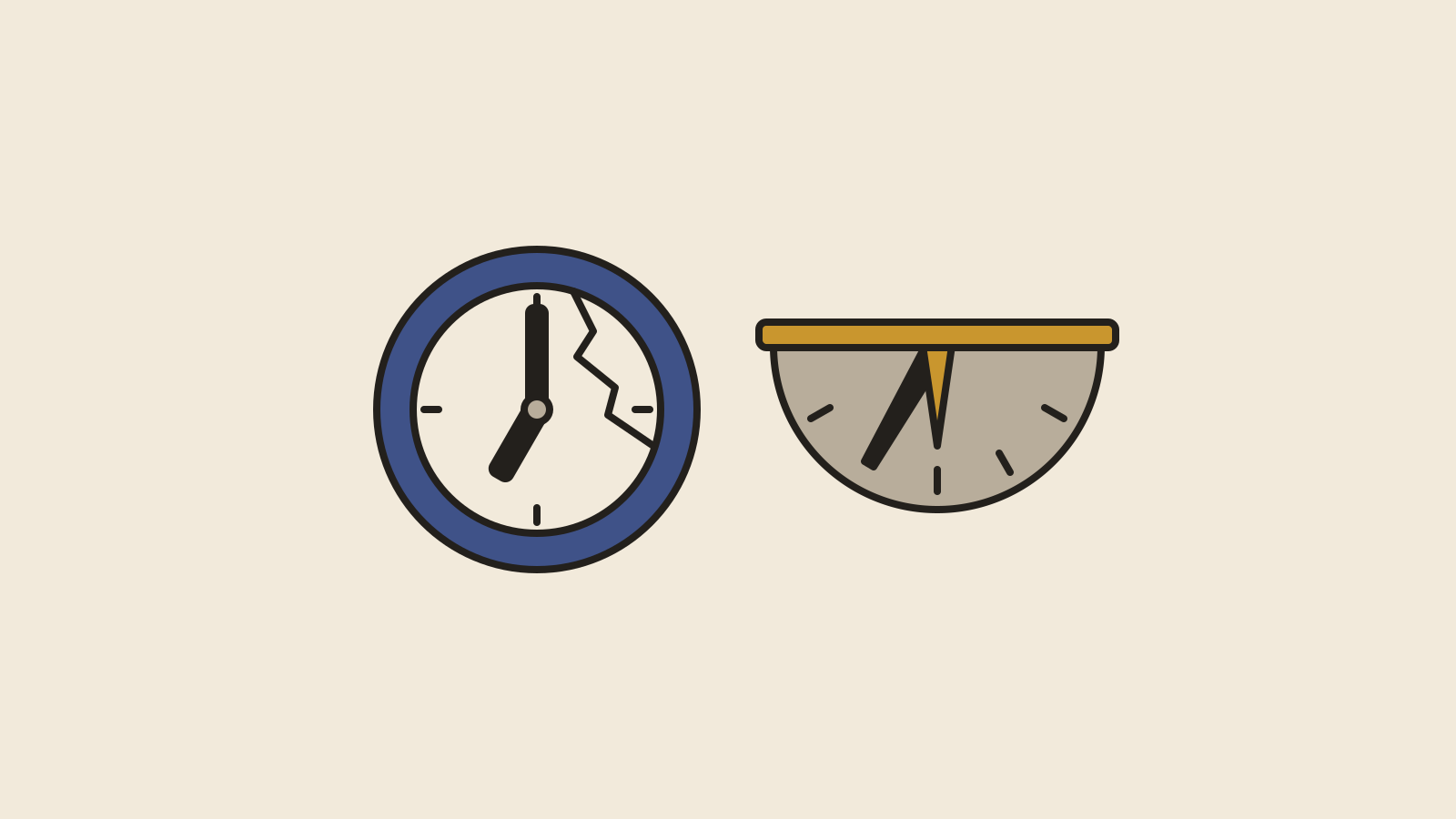
A stopped clock gives the pattern. You glance at the station clock, which reads 8.15, and you believe it is 8.15. The clock has always been reliable, so your belief is justified. It is in fact 8.15. But the clock stopped exactly twelve hours ago, and had you looked a minute later you would have been wrong. The example comes from Bertrand Russell, who used it before Gettier wrote.
Bertrand Russell
The British logician who made the analysis of language philosophy's main method and became one of his century's best-known public intellectuals.
Diagram
A Gettier case reaches a true belief through good reasons and luck
Read as text
A flow of four steps. A person has good evidence for a belief that happens to be false. The person validly infers a further belief from it. The further belief turns out to be true, but only by coincidence and for reasons the person knows nothing about. The result, emphasised, is a belief that is justified and true yet does not seem to be knowledge.
Key features
- The believer does everything right: the evidence is good and the reasoning valid.
- The belief is true, but through a route the believer knows nothing about.
- Luck enters twice, first to cut the evidence off from the truth and then to restore the truth by coincidence.
- The verdict rests on intuition about the case, which most people in the cultures tested appear to share.
- The recipe is general, so new cases can be built against almost any proposed repair.
Not to be confused with
| Look-alike | The difference | Differs on |
|---|---|---|
| Justified true belief | That is the definition under attack: knowledge is belief that is true and justified. The Gettier problem is the claim that those three conditions can all be met without knowledge. | Differs onClaim |
| Philosophical scepticism | The sceptic argues that we know little or nothing. Gettier assumed that we know plenty and that ordinary justification is often good enough. His target was a definition of knowledge, and he left our possession of it alone. | Differs onClaim |
| A lucky guess | A guesser has no good reason and gets it right by chance. In a Gettier case the reasons are good, and the luck lies in the gap between those reasons and what makes the belief true. | Differs onMechanism |
- Differs onClaim
That is the definition under attack: knowledge is belief that is true and justified. The Gettier problem is the claim that those three conditions can all be met without knowledge.
- Differs onClaim
The sceptic argues that we know little or nothing. Gettier assumed that we know plenty and that ordinary justification is often good enough. His target was a definition of knowledge, and he left our possession of it alone.
- Differs onMechanism
A lucky guess
A guesser has no good reason and gets it right by chance. In a Gettier case the reasons are good, and the luck lies in the gap between those reasons and what makes the belief true.
Origins and development
Gettier published "Is Justified True Belief Knowledge?" in the journal Analysis in 1963, while teaching at Wayne State University. It ran to three pages and gave two cases, one about a job candidate with ten coins in his pocket. He published almost nothing afterwards. Similar cases had been noticed long before, by the Indian Buddhist philosopher Dharmottara around 770 and by Peter of Mantua in fourteenth-century Italy. Replies came at once: ban reasoning through a false step, require a causal link to the fact, require a reliable method. Each met a fresh counterexample.
Why it matters
The problem set the agenda of epistemology for half a century and produced its main theories of knowledge, among them reliabilism and accounts built on safety from error. It also sharpened a distinction with practical bite: holding a true belief for good reasons differs from holding it because of what makes it true. A doctor whose correct diagnosis rested on a mislabelled scan, or an analyst whose sound model was rescued by an unrelated event, got the answer without knowing it.
Epistemology
The branch of philosophy that asks what knowledge is, where it comes from and how much of it we can have.
Critiques and limits
Some philosophers reject the verdict. Stephen Hetherington holds that Gettier's subjects do know, only luckily. Brian Weatherson argued that a simple theory may deserve to outweigh an intuition about odd cases. Jonathan Weinberg, Shaun Nichols and Stephen Stich reported in 2001 that the intuition varied by culture, but a larger study led by Edouard Machery in 2017 found it shared across four countries. Timothy Williamson treats the long run of failed repairs as evidence that knowledge has no analysis. The argument is conceptual and is widely accepted.
Connections
Belongs to
The search for a definition of knowledge that survives Gettier cases shaped the field for half a century.
Critiques
Gettier's cases meet all three conditions without yielding knowledge, so the conditions cannot be sufficient.
Contrasts with
Differs on claim. The analysis says three conditions suffice for knowledge, and Gettier's cases meet all three without it.
Differs on claim. Gettier assumes we know many things and attacks a definition, while the sceptic denies that we know them.
Parallels
Indian theorists of the means of knowledge discussed true beliefs reached by accident centuries before Gettier.
Cross with
Two distant entries to read beside this one, each with the question the pairing opens.
HeuristicPsychology
A heuristic uses part of the information and is often right: when a shortcut yields a true belief, is that knowledge or a lucky hit? Set them side by side
Validity (measurement)Psychology
A test score can be right about a person for the wrong reasons: is validity the measurer's name for what Gettier cases lack? Set them side by side
Further reading
- Gettier, E. L. (1963). Is justified true belief knowledge?. Analysis, 23(6), 121–123. https://doi.org/10.1093/analys/23.6.121
- Machery, E., Stich, S., Rose, D., Chatterjee, A., Karasawa, K., Struchiner, N., Sirker, S., Usui, N., & Hashimoto, T. (2017). Gettier across cultures. Noûs, 51(3), 645–664. https://doi.org/10.1111/nous.12110
- Nagel, J. (2014). Knowledge: A very short introduction. Oxford University Press. https://doi.org/10.1093/actrade/9780199661268.001.0001
- Zagzebski, L. (1994). The inescapability of Gettier problems. The Philosophical Quarterly, 44(174), 65–73. https://doi.org/10.2307/2220147
Cite this entry
Scholia. (2026). Gettier problem. In Scholia: Notes in the margin of the human sciences. Retrieved November 28, 2026, from https://scholia.zennia.sg/ideas/gettier-problem