IdeaPhilosophy
Justified true belief
The traditional definition of knowledge: you know something when you believe it, it is true and you have good reason for believing it.
The idea
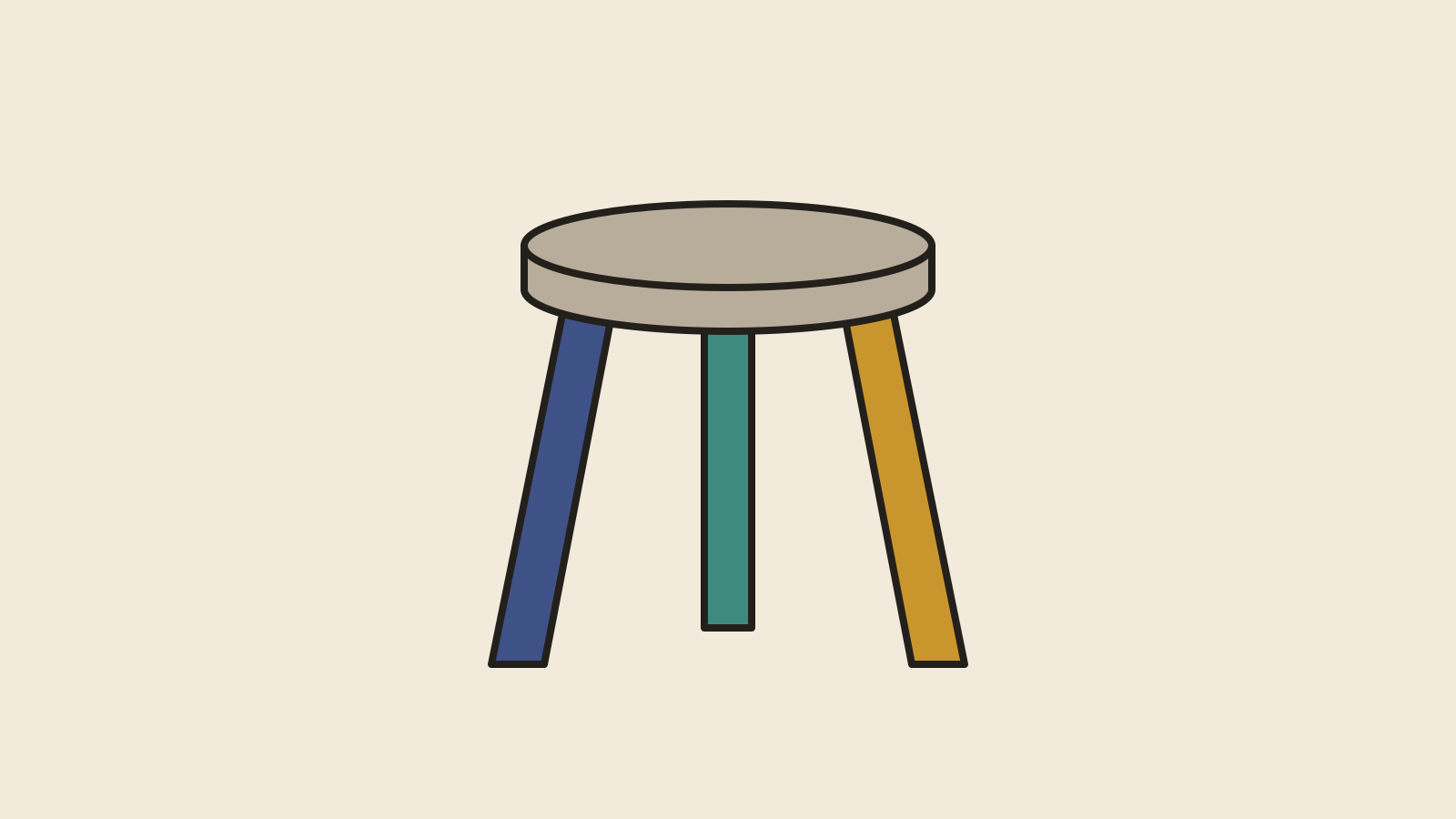
Justified true belief is the classic answer to the question of what knowledge is. On this account you know something when three conditions are met. You believe it. It is true. And your belief is justified, meaning you hold it for good reasons and not by luck or wishful thinking. Each condition is necessary and the three together are meant to be sufficient, a textbook case of defining a concept by necessary and sufficient conditions.
Necessary and sufficient conditions
A necessary condition is one a thing cannot do without, and a sufficient condition is one that is enough to guarantee it.
Take the claim that the last bus leaves at 11.40. If you never formed a view, you don't know it. If the bus in fact leaves at 11.10, you don't know it either, however sure you feel. And if you guessed 11.40 and happened to be right, that was luck. You know it when you checked the timetable and the timetable was correct.
Diagram
The traditional analysis places knowledge where truth, belief and justification meet
Read as text
Three overlapping circles labelled truth, belief and justification. Truth alone holds facts nobody believes. Belief alone holds false beliefs held for no good reason. Justification alone holds good but misleading evidence for a false claim that nobody has taken up. The region where all three overlap is labelled knowledge and is emphasised. The caption notes that Gettier cases sit in that central region and still seem not to be knowledge.
Key features
- Truth is required because nobody can know what is false, though people can be certain of it.
- Belief is required because a truth you have never accepted is not something you know.
- Justification separates knowledge from the lucky guess, and it can come from evidence, reasoning, memory or reliable testimony.
- Justification comes in degrees and does not demand certainty, so a justified belief can still turn out false.
- The analysis covers knowing that something is so, and leaves aside knowing how to ride a bicycle or knowing a person.
Not to be confused with
| Look-alike | The difference | Differs on |
|---|---|---|
| Gettier problem | The analysis says the three conditions are enough for knowledge. Gettier's cases describe beliefs that meet all three by coincidence and still seem not to be knowledge. One is the definition and the other its best-known refutation. | Differs onClaim |
| Pramana | The Western analysis tests a standing belief against conditions. Classical Indian theory asks which process, such as perception or inference, produced a true episode of awareness, and does not require the knower to have reasons to hand. | Differs onUnit of analysis |
| Sociology of knowledge | Sociologists use "knowledge" for whatever a group accepts as known and study how it came to be accepted. The analysis is normative: it says what a belief must achieve to deserve the name. | Differs onDescriptive or normative |
| Certainty | Feeling sure is neither needed nor enough. The analysis asks for truth and good reasons, and most versions accept reasons that fall short of proof. | Differs onStandard of judgement |
- Differs onClaim
The analysis says the three conditions are enough for knowledge. Gettier's cases describe beliefs that meet all three by coincidence and still seem not to be knowledge. One is the definition and the other its best-known refutation.
- Differs onUnit of analysis
The Western analysis tests a standing belief against conditions. Classical Indian theory asks which process, such as perception or inference, produced a true episode of awareness, and does not require the knower to have reasons to hand.
- Differs onDescriptive or normative
Sociologists use "knowledge" for whatever a group accepts as known and study how it came to be accepted. The analysis is normative: it says what a belief must achieve to deserve the name.
- Differs onStandard of judgement
Certainty
Feeling sure is neither needed nor enough. The analysis asks for truth and good reasons, and most versions accept reasons that fall short of proof.
Origins and development
The idea is usually traced to Plato. In the Meno Socrates says that true opinions become knowledge when they are tied down by reasoning. In the Theaetetus, written about 369 BCE, he tests the definition of knowledge as true belief with an account, and the dialogue ends without accepting it. The three-part formula in its modern wording dates from the twentieth century, in A. J. Ayer and Roderick Chisholm. Some historians doubt that it was ever a settled orthodoxy before 1963, when Edmund Gettier attacked it and made it famous.
Plato
The pupil of Socrates and founder of the Academy, whose dialogues set most of the questions Western philosophy has argued over since.
Why it matters
The three conditions are a working checklist wherever people must separate knowing from believing. A court asks whether a witness had grounds for what she asserts as well as whether it is so. A newsroom asks how a reporter knows. The analysis also names the difference between being right and knowing, which matters whenever a forecaster or an investor is credited for a correct call that owed everything to chance.
Critiques and limits
Edmund Gettier showed in 1963 that a belief can be justified and true by accident, and most philosophers accept that this defeats the simple analysis. Decades of repairs followed, each adding a fourth condition and each meeting new counterexamples. Linda Zagzebski argued that any analysis of this shape will meet them. Timothy Williamson concluded that knowledge cannot be broken into parts and should be taken as basic. As a conceptual analysis it is assessed by argument and cases, and few now defend it unamended.
Connections
Belongs to
It is the definition of knowledge that modern epistemology begins by teaching and then testing.
Originated by
Plato has Socrates examine knowledge as true belief with an account, though the Theaetetus ends by rejecting it.
Influenced by
The hunt for a definition that survives every counterexample follows the method Socrates uses in Plato's dialogues.
Contrasts with
Differs on claim. The analysis says three conditions suffice for knowledge, and Gettier's cases meet all three without it.
Differs on unit of analysis. The Western analysis tests a standing belief against conditions, while pramana theory asks which process produced an episode of awareness.
Sociology of knowledge and scienceSociology
Differs on descriptive or normative. Sociologists describe what a group accepts as knowledge, while the analysis says what a belief must achieve to count.
Necessary and sufficient conditions
Differs on scope. The term names a general tool of definition, and justified true belief is one disputed use of it.
Critiqued by
Gettier's cases meet all three conditions without yielding knowledge, so the conditions cannot be sufficient.
Cross with
Two distant entries to read beside this one, each with the question the pairing opens.
Statistical significancePsychology
A significant result gives reason to believe in an effect that may still be absent: which of knowledge's three conditions does it supply? Set them side by side
Market for lemonsEconomics
A used-car buyer may believe truly that a car is sound yet be unable to tell: what would count as justification in such a market? Set them side by side
Further reading
- Gettier, E. L. (1963). Is justified true belief knowledge?. Analysis, 23(6), 121–123. https://doi.org/10.1093/analys/23.6.121
- Nagel, J. (2014). Knowledge: A very short introduction. Oxford University Press. https://doi.org/10.1093/actrade/9780199661268.001.0001
- Plato. (1990). The Theaetetus of Plato. Hackett. (Original work published -369)
- Williamson, T. (2000). Knowledge and its limits. Oxford University Press.
Cite this entry
Scholia. (2026). Justified true belief. In Scholia: Notes in the margin of the human sciences. Retrieved November 28, 2026, from https://scholia.zennia.sg/ideas/justified-true-belief