IdeaEconomicsAlso in Philosophy, Sociology, Political theory & science
Homo economicus
The simplified person of economic models: self-interested, consistent and a tireless calculator of the best way to get what he wants.
The idea
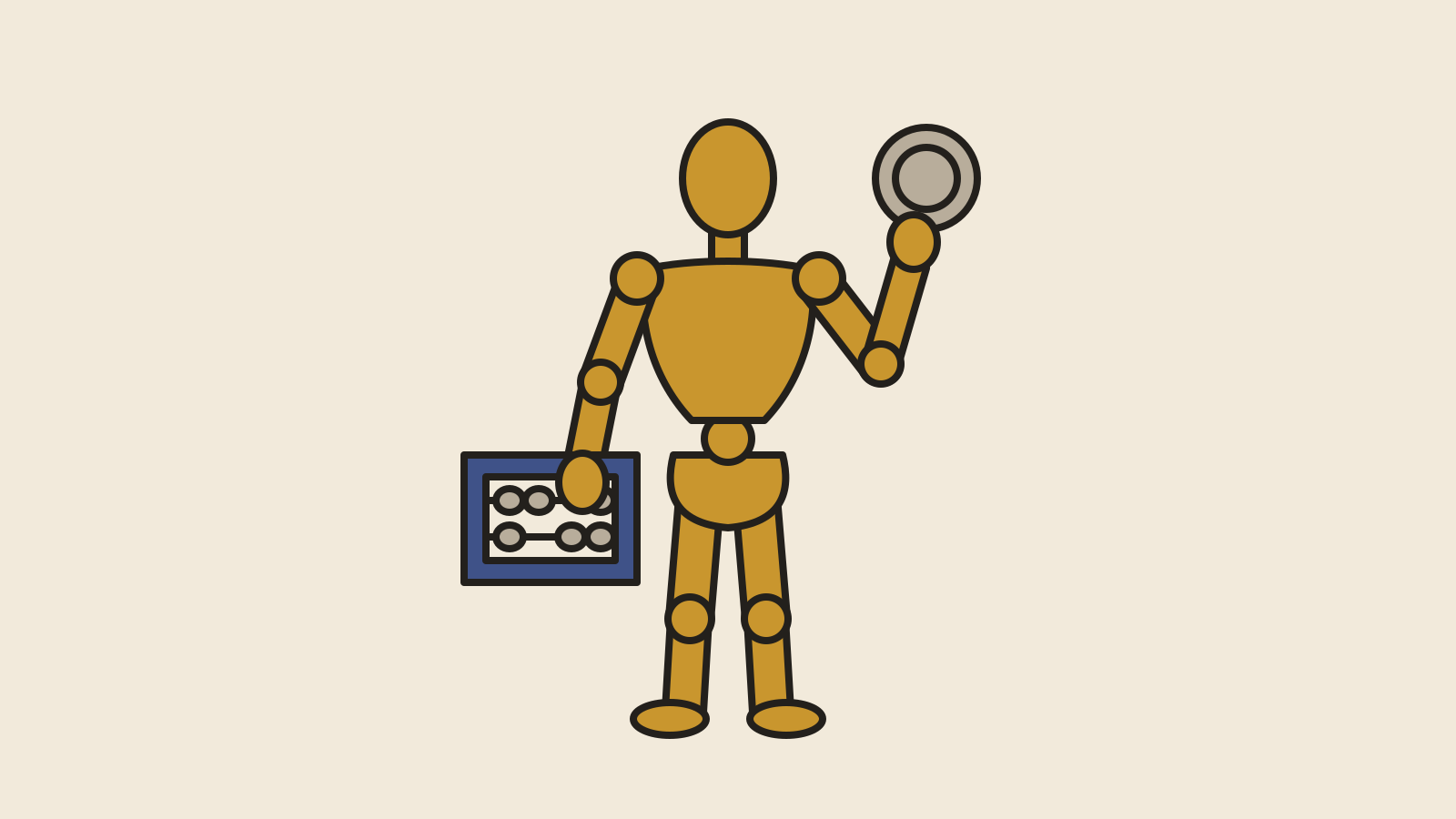
Homo economicus, or economic man, is the simplified person who lives in economic models. He knows what he wants and ranks his options without contradiction. He cares only about his own gain and works out the best way to get it. Nothing distracts him and nothing tempts him off course.
Nobody claims to have met him. The claim is that people in markets behave enough like him for his choices to predict theirs. Think of a commuter choosing between two petrol stations. Economic man compares price, distance and the fuel burnt on the detour, then drives to the cheaper one. He feels no loyalty to the station whose cashier knows his name, and no grudge against the one that raised prices during last month's shortage. Real drivers often do. The debate is over how much those feelings change what markets do.
Diagram
Economic man shares one trait with real people and differs on several
Read as text
Two overlapping sets. Homo economicus alone is purely self-interested, fully informed and a tireless calculator. People observed in experiments care about fairness, have limited attention and have weak self-control. The overlap holds what both share: they respond to incentives.
Key features
- He is self-interested: other people's gains and losses count only when they affect his own.
- His preferences are complete and consistent, so he can always say which of two options he prefers.
- He optimises, choosing the best available option given prices, income and what he knows.
- In the strong textbook version he also has full information and unlimited powers of calculation.
- He is an abstraction built for a purpose, which is to isolate the pull of gain from every other human motive.
Not to be confused with
| Look-alike | The difference | Differs on |
|---|---|---|
| Rational choice theory | Rational choice theory needs only consistent preferences, which may be generous or spiteful. Homo economicus adds a particular content: self-interest, usually material. A saint can be a rational chooser but cannot be economic man. | Differs onScope |
| Invisible hand | Homo economicus is an assumption about one person's motives. The invisible hand is a claim about what whole markets produce. Adam Smith, often named as economic man's author, also wrote a book on sympathy. | Differs onLevel |
| Selfishness | A selfish person can be impulsive, envious or muddled. Economic man is calm and calculating, and he feels no envy, since another person's gain doesn't enter his sums. | Differs onScope |
| Formalist–substantivist debate | Homo economicus is a model of one chooser. The anthropologists' debate of the 1960s was about whole economies, and whether a science built on that chooser can describe those without markets. | Differs onUnit of analysis |
- Differs onScope
Rational choice theory needs only consistent preferences, which may be generous or spiteful. Homo economicus adds a particular content: self-interest, usually material. A saint can be a rational chooser but cannot be economic man.
- Differs onLevel
Homo economicus is an assumption about one person's motives. The invisible hand is a claim about what whole markets produce. Adam Smith, often named as economic man's author, also wrote a book on sympathy.
- Differs onScope
Selfishness
A selfish person can be impulsive, envious or muddled. Economic man is calm and calculating, and he feels no envy, since another person's gain doesn't enter his sums.
- Differs onUnit of analysis
Formalist–substantivist debate
Homo economicus is a model of one chooser. The anthropologists' debate of the 1960s was about whole economies, and whether a science built on that chooser can describe those without markets.
Origins and development
John Stuart Mill drew the figure in an 1836 essay. Political economy, he wrote, treats man only as a being who desires wealth, and he added at once that no economist supposed real people were like that. Mill never used the name. Critics supplied it: John Kells Ingram wrote scornfully of "economic man" in 1888, and the Latin form was in print by then. In the twentieth century the figure was restated mathematically as a maximiser of utility.
John Stuart Mill
The Victorian philosopher who gave utilitarianism its classic form and made the leading liberal case for free speech, individual liberty and women's equality.
Utility
Economists' measure of how much a person gains from something, now usually just a number that ranks options by preference.
Why it matters
Arguments about bonuses, fines, taxes and welfare rules usually carry a hidden answer to one question: do people respond mainly to their own material gain? Policies designed for economic man rely on prices and penalties. Where the model fits, they work cheaply. Where it doesn't, they can backfire. In a well-known study of Israeli nurseries, a fine for late pick-up was read by parents as a fee, and lateness rose.
Critiques and limits
Defenders, following Milton Friedman, say a model should be judged by its predictions, and that markets discipline those who stray from it. Amartya Sen called the purely self-interested chooser a "rational fool", unable to tell his interests from his commitments. In the ultimatum game one player proposes how to split a sum and the other can veto it. People in many societies reject low offers at their own cost. As a literal description the figure has failed such tests. As a working approximation of market behaviour its standing is disputed.
Connections
Belongs to
Neoclassical economics restated the figure mathematically as a consumer who maximises utility within a budget.
Originated by
John Stuart MillPhilosophy
Mill defined the abstraction in an 1836 essay, as a being who desires wealth, without ever using the name.
Influenced by
UtilitarianismPhilosophy
Bentham's picture of people weighing pleasures against pains supplied the calculating psychology the figure inherited.
Contrasts with
Formalist–substantivist debateAnthropology
Differs on unit of analysis. Homo economicus models one chooser, while the debate concerned whole economies and which science should describe them.
Differs on scope. Rational choice theory needs only consistent preferences, while homo economicus adds that those preferences are self-interested.
Differs on level. Homo economicus is an assumption about one person's motives, the invisible hand a claim about what whole markets produce.
Applied in
Public choice and policyPolitical theory & science
Public choice carries the self-interested chooser from the market into the polling booth and the ministry.
Critiqued by
His essay Rational Fools held that a chooser moved only by self-interest cannot account for commitment.
Bronisław MalinowskiAnthropology
Argonauts attacks the picture of an economic man moved only by self-interest, and shows islanders working for prestige and duty.
Daniel KahnemanPsychology
His experiments showed real choices shifting with wording and reference points, which a fully rational chooser would ignore.
He held that no real chooser has the knowledge and computing power the model assumes.
Marcel MaussAnthropology
The Gift argues that the calculating, self-interested trader is a recent invention and a poor guide to exchange.
Mark GranovetterSociology
He called the isolated, self-interested chooser of economics undersocialised, blind to the relationships that shape real dealings.
Mary DouglasAnthropology
The World of Goods argues that people buy things to mark relationships and occasions, which a model of private wants misses.
He argued that models built for flawless calculators mispredict the saving, spending and investing of ordinary people.
Its experiments show regular departures from the consistent, self-interested calculator of the textbook model.
Economic anthropologyAnthropology
Fieldwork repeatedly found people exchanging for rank, kinship and honour, which the self-interested maximiser cannot describe.
Rejects the chooser who seeks ever more goods, holding that wants should be limited and economics judged by ethics.
Both strands reject the all-knowing calculator, the older for a creature of habit and the newer for a bounded chooser.
Replaces the all-knowing chooser with one who works within limits of knowledge, time and computation.
Denies that wants are private and fixed, since what one person buys depends on what others can see and afford.
EmbeddednessSociology
It rejects the picture of traders as strangers who consult only prices and their own advantage.
Gift exchangeAnthropology
Mauss argued that people exchange to make and keep relationships, which a model of private gain leaves out.
Heuristics and biasesPsychology
Shows that intuitive judgements of probability break the statistical rules a fully rational chooser is assumed to follow.
Original affluent societyAnthropology
Denies that unlimited wants are human nature, since foragers were said to stop work once modest needs were met.
Cross with
Two distant entries to read beside this one, each with the question the pairing opens.
KapwaPsychology
What would economic models predict differently if the chooser's self included the other person, as kapwa holds? Set them side by side
No-self (anatta)Philosophy
If a person is a changing stream of events with no lasting self, whose interest does self-interested economic man pursue? Set them side by side
Further reading
- Henrich, J., Boyd, R., Bowles, S., Camerer, C., Fehr, E., Gintis, H., & McElreath, R. (2001). In search of homo economicus: Behavioral experiments in 15 small-scale societies. American Economic Review, 91(2), 73–78. https://doi.org/10.1257/aer.91.2.73
- Mill, J. S. (1844). Essays on some unsettled questions of political economy. John W. Parker.
- Persky, J. (1995). Retrospectives: The ethology of homo economicus. Journal of Economic Perspectives, 9(2), 221–231. https://doi.org/10.1257/jep.9.2.221
- Sen, A. K. (1977). Rational fools: A critique of the behavioral foundations of economic theory. Philosophy & Public Affairs, 6(4), 317–344.
Cite this entry
Scholia. (2026). Homo economicus. In Scholia: Notes in the margin of the human sciences. Retrieved November 28, 2026, from https://scholia.zennia.sg/ideas/homo-economicus