IdeaPhilosophy
Idealism (metaphysics)
The view that reality is at bottom mental, so that physical things depend on minds or ideas for their existence.
The idea
Idealism in metaphysics is the claim that mind comes first. What exists at the most basic level is minds and their contents, and tables, mountains and stars depend on them. This is the opposite of physicalism, which says that everything is physical and that minds are a late arrival. It has nothing to do with the everyday sense of having high ideals.
Physicalism
The view that everything that exists is physical, or depends entirely on the physical, minds included.
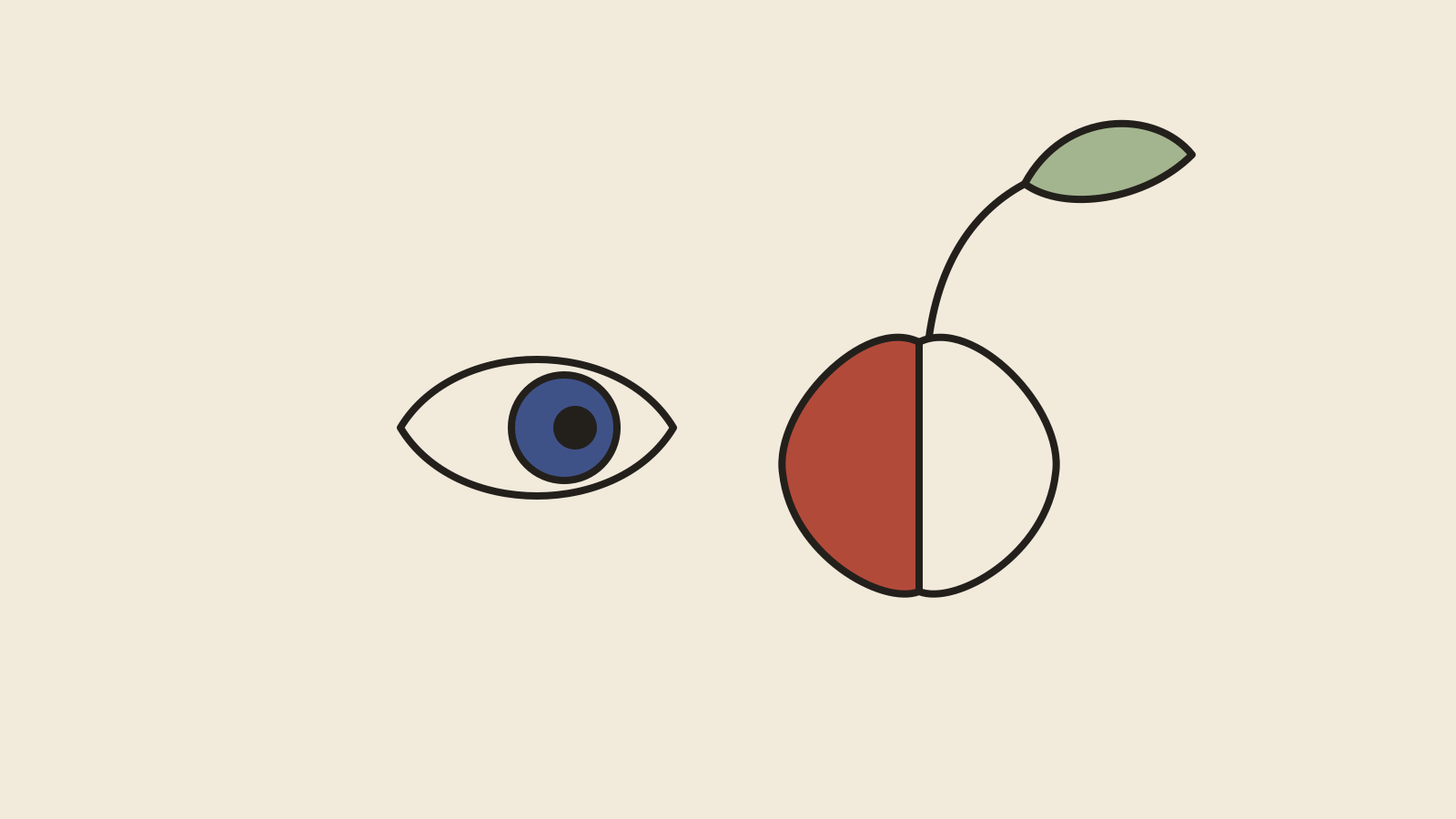
George Berkeley gave the classic argument in 1710. Take a cherry, an example he used three years later. You see its redness, feel its smoothness and taste its sweetness. Remove every such quality and ask what is left. Berkeley's answer was nothing. A cherry is a bundle of sensations, and sensations exist only in minds. A material something lying behind them is a posit we have no access to and no need for. The cherry in an empty room persists, he held, because God perceives it.
Diagram
Idealism sits at the opposite pole from physicalism
Read as text
A line runs from the claim that only matter exists on the left to the claim that only minds and their ideas exist on the right. Physicalism sits at the left end. Dualism, which holds that mind and matter are both basic, sits in the middle. Idealism sits at the right end.
Key features
- Physical objects exist only as experienced, or as the contents of some mind, and never wholly on their own.
- Idealists do not say the world is a dream, since perceptions are orderly, shared and independent of any one person's will.
- Berkeley's version is usually summed up in the Latin formula esse est percipi, to be is to be perceived.
- Later versions differ, and absolute idealists such as Hegel and F. H. Bradley held that reality is a single rational or spiritual whole.
- The view competes with materialism and with dualism, and its defenders claim it is simpler than either.
Not to be confused with
| Look-alike | The difference | Differs on |
|---|---|---|
| Transcendental idealism | Kant held that we know only appearances shaped by the mind, and he insisted that things in themselves exist independently. Berkeley denied any such mind-independent reality. | Differs onClaim |
| Theory of Forms | Plato's Forms are sometimes called ideas, and his view idealism. The Forms are in nobody's mind. They exist on their own, which makes Plato a realist about them. | Differs onClaim |
| Advaita Vedanta | Advaita also treats the everyday world as less than fully real. Its ground is brahman, pure awareness that belongs to no individual mind and has no contents such as ideas. | Differs onClaim |
| Social constructionism | Constructionists say that categories such as money or race exist through human agreement. That is a claim about social facts, and it leaves rocks and atoms independent of mind. | Differs onScope |
- Differs onClaim
Kant held that we know only appearances shaped by the mind, and he insisted that things in themselves exist independently. Berkeley denied any such mind-independent reality.
- Differs onClaim
Plato's Forms are sometimes called ideas, and his view idealism. The Forms are in nobody's mind. They exist on their own, which makes Plato a realist about them.
- Differs onClaim
Advaita also treats the everyday world as less than fully real. Its ground is brahman, pure awareness that belongs to no individual mind and has no contents such as ideas.
- Differs onScope
Constructionists say that categories such as money or race exist through human agreement. That is a claim about social facts, and it leaves rocks and atoms independent of mind.
Origins and development
Berkeley published the Principles of Human Knowledge in 1710, when he was twenty-five, and the Three Dialogues in 1713. He was pushing the empiricism of John Locke to its limit: if all we ever meet are ideas, matter is an idle hypothesis. Related positions are older, among them the Yogācāra school of Indian Buddhism. In the nineteenth century idealism dominated German and then British universities, until G. E. Moore and Bertrand Russell turned against it around 1900. It has lately returned in debates about consciousness.
John Locke
An English philosopher who argued that all our ideas come from experience and that governments rule only by the consent of the governed.
Why it matters
Idealism is the standing alternative whenever physical science seems unable to say what experience is. A reader meets it in arguments about the hard problem of consciousness, in readings of quantum mechanics that give the observer a role and in the simulation hypothesis, which resembles Berkeley's picture with a computer in place of God. It also forces a useful question: what evidence could anyone have for something beyond all experience?
Hard problem of consciousness
The puzzle of why brain activity is accompanied by felt experience at all, when it seems the same activity could go on with nothing felt.
Critiques and limits
Samuel Johnson kicked a stone and declared Berkeley refuted, which misses the target, since Berkeley never denied that stones feel solid. G. E. Moore argued in 1903 that idealists confuse the act of sensing with the thing sensed: a sensation of blue is mental, and the blue need not be. Russell added that a thought of a tree must be in the mind, and the tree need not be. Most philosophers today reject idealism. Idealism is a metaphysical thesis that no observation can settle, and a minority still defends it.
Connections
Belongs to
Idealism is one of the main answers to the metaphysical question of what kinds of thing exist.
Influenced by
Berkeley reached idealism by taking the empiricist rule that all knowledge comes from ideas of sense to its limit.
Hegel turned idealism from Berkeley's ideas in individual minds into absolute idealism, where reality is one self-developing rational whole.
Critiques
Idealism reverses physicalism, treating the mental as basic and the physical as dependent on it.
Berkeley argued that Locke's material substance behind our ideas is unknowable on Locke's own account and does no work.
Contrasts with
Differs on claim. Idealism makes reality depend on minds and their ideas, where brahman is no one's mind and has no contents.
Differs on scope. Idealism is a general thesis held in many periods, where German idealism is one movement of about fifty years.
Differs on claim. Berkeley denied matter apart from perception, where Kant affirmed things in themselves and the reality of objects in space.
Differs on claim. Plato's Forms exist on their own outside any mind, where the idealist's ideas exist only in minds.
Social constructionismSociology
Differs on scope. Constructionism says social categories depend on human agreement, where idealism says everything physical depends on mind.
Differs on claim. Idealism keeps one kind of thing, the mental, where dualism keeps mind and matter as two.
Critiqued by
With G. E. Moore he rejected the British idealists' doctrine that reality is one mind-dependent whole.
The tradition began around 1900 as a rejection of the British idealists' claim that reality is one mental whole.
Cross with
Two distant entries to read beside this one, each with the question the pairing opens.
Mental representationCognitive science & linguistics
Cognitive science says we think with inner representations of things: what stops the idealist's further step that the representations are all there is? Set them side by side
Self-fulfilling prophecySociology
A rumour of collapse can ruin a sound bank: how far can beliefs make facts before we should call those facts mind-dependent? Set them side by side
Further reading
- Berkeley, G. (1998). A treatise concerning the principles of human knowledge. Oxford University Press. (Original work published 1710)
- Guyer, P., & Horstmann, R.-P. (2026). Idealism. The Stanford Encyclopedia of Philosophy. https://plato.stanford.edu/entries/idealism/
- Moore, G. E. (1903). The refutation of idealism. Mind, 12(48), 433–453. https://doi.org/10.1093/mind/XII.4.433
Cite this entry
Scholia. (2026). Idealism (metaphysics). In Scholia: Notes in the margin of the human sciences. Retrieved November 28, 2026, from https://scholia.zennia.sg/ideas/idealism-metaphysics