School or branchPhilosophy
German idealism
The movement from Kant to Hegel that treated reality as the work of reason and tried to explain knowledge, morality and history in one system.
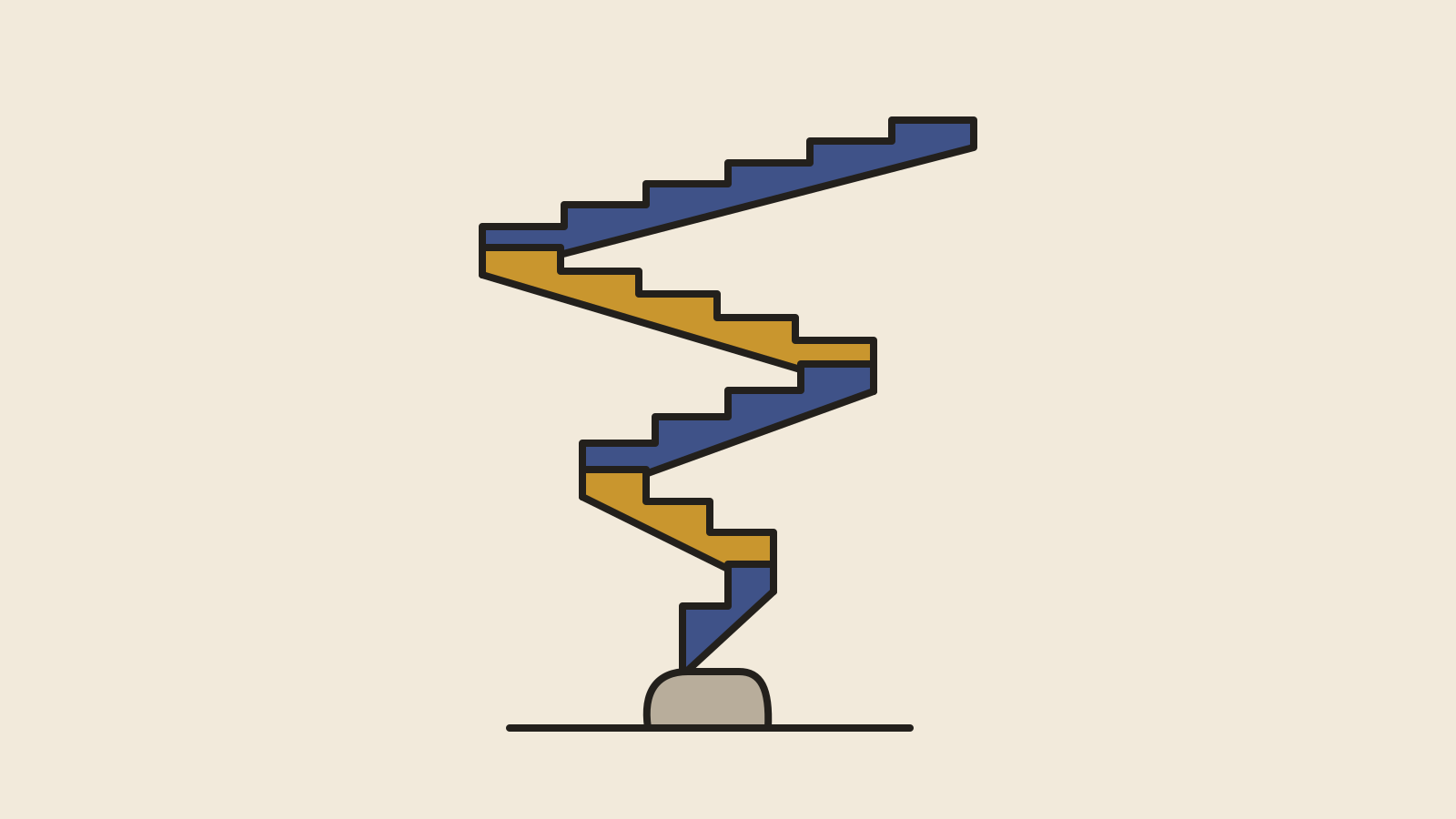
Overview
German idealism is the run of philosophy that began with Immanuel Kant's Critique of Pure Reason in 1781 and ended, by most reckonings, with Hegel's death in 1831. Its chief figures after Kant were Johann Gottlieb Fichte, Friedrich Schelling and G. W. F. Hegel. They shared a starting point. Kant had argued that the mind gives experience its form and does far more than receive impressions. His successors asked how far that thought could be taken.
Immanuel Kant
A Prussian philosopher who argued that the mind shapes the world we experience and that morality is a law reason gives itself.
G. W. F. Hegel
A German philosopher who argued that reason, freedom and society develop through history by working out their own contradictions.
A football match shows the kind of fact they cared about. Physics can describe twenty-two bodies and a ball. A goal, an offside and a win exist only because people share rules and recognise them in one another. The idealists held that much of reality is like this. Law, morality, science and history are the work of reason, and freedom means living under rules we can recognise as our own.
Diagram
German idealism ran for fifty years from Kant's Critique to Hegel's death
Read as text
A timeline from 1781 to 1831. Kant publishes the Critique of Pure Reason in 1781. Fichte publishes his science of knowledge in 1794, Schelling his System of Transcendental Idealism in 1800 and Hegel the Phenomenology of Spirit in 1807. Hegel dies in 1831, the usual end date of the movement, which is now historical.
Core commitments
- Reason is active: the mind helps to constitute the world it knows and is no mirror of a ready-made one.
- Philosophy must be a system in which knowledge, morality, art and religion follow from one principle and nothing is left as a brute given.
- Freedom is the central idea, understood as self-determination, which means being bound only by laws that reason gives itself.
- After Kant, the unknowable thing in itself has to go, since a reality wholly beyond thought could explain nothing.
- Reason has a history, and for Hegel above all ideas and institutions develop through conflict over time.
Not to be confused with
| Look-alike | The difference | Differs on |
|---|---|---|
| Idealism (metaphysics) | Idealism is the general thesis that reality is at bottom mental, held in many times and places. German idealism is one movement of about fifty years, and its members rejected Berkeley's version, in which things exist only as perceptions. | Differs onScope |
| Transcendental idealism | Kant's own position keeps a reality in itself that we can never know. Fichte, Schelling and Hegel dropped that limit and claimed that reason can know reality without remainder. | Differs onClaim |
| Romanticism | The Jena Romantics were friends and neighbours of the idealists and shared their themes. They trusted art, feeling and the fragment, where the idealists wanted a complete system reached by argument. | Differs onMethod |
| Idealism in the everyday sense | Calling someone an idealist usually means they hold high ideals or are impractical. The philosophical word comes from "idea" and concerns what reality is. | Differs onClaim |
- Differs onScope
Idealism is the general thesis that reality is at bottom mental, held in many times and places. German idealism is one movement of about fifty years, and its members rejected Berkeley's version, in which things exist only as perceptions.
- Differs onClaim
Kant's own position keeps a reality in itself that we can never know. Fichte, Schelling and Hegel dropped that limit and claimed that reason can know reality without remainder.
- Differs onMethod
Romanticism
The Jena Romantics were friends and neighbours of the idealists and shared their themes. They trusted art, feeling and the fragment, where the idealists wanted a complete system reached by argument.
- Differs onClaim
Idealism in the everyday sense
Calling someone an idealist usually means they hold high ideals or are impractical. The philosophical word comes from "idea" and concerns what reality is.
Origins and development
Kant's philosophy left a puzzle. He said that things in themselves cause our sensations, yet his own theory restricted the concept of cause to experience. Friedrich Jacobi pressed the objection in 1787. Fichte answered in 1794 by deriving everything from the activity of the self. Schelling added a philosophy of nature in the late 1790s, and Hegel's Phenomenology of Spirit (1807) presented the whole of human experience as one developing story. After Hegel died his followers split, and Marx and Kierkegaard each defined themselves against the system.
Why it matters
The movement set the agenda for much of what came after. Marx's theory of history reworks Hegel, and existentialism begins as a revolt against him. The beliefs that persons are owed recognition, that a people has a spirit and that history has a direction all passed from these writers into politics and everyday speech. The modern research university, founded in Berlin in 1810 with Fichte as an early rector, grew from the same circle.
Karl Marx
The German thinker who argued that the way a society produces its living shapes its classes, its conflicts and its ideas.
Existentialism
A movement in philosophy and literature holding that people have no given purpose and must make themselves through free choices they answer for.
Critiques and limits
Arthur Schopenhauer, who lectured in Berlin beside Hegel, dismissed the systems of Fichte, Schelling and Hegel as empty verbiage that betrayed Kant's limits on knowledge. Kierkegaard objected that a system of pure thought has no place for the existing individual. Bertrand Russell and G. E. Moore opened analytic philosophy around 1900 by rejecting the idealism that Hegel's British followers taught. Karl Popper later accused Hegel of preparing the ground for totalitarian thinking, a charge most Hegel scholars reject.
Søren Kierkegaard
A Danish thinker who made the single individual's choices, anxiety and faith the centre of philosophy and is often called the father of existentialism.
Key figures
- Immanuel Kant1724–1804
- Johann Gottlieb Fichte
- Friedrich Schelling
- G. W. F. Hegel1770–1831
- Karl Leonhard Reinhold
- Friedrich Heinrich Jacobi


Connections
Originated by
His Critique of Pure Reason of 1781 set the problems and the vocabulary that Fichte, Schelling and Hegel worked from.
Extends
The post-Kantians kept Kant's active mind and removed his unknowable thing in itself.
Influenced by
The pantheism controversy of the 1780s made Spinoza's single all-embracing substance a model for Schelling's and Hegel's absolute.
Jean-Jacques RousseauPolitical theory & science
Rousseau's thought that freedom is obedience to a law one gives oneself became the idealists' account of autonomy.
Critiques
The idealists denied that knowledge is assembled from passively received sense impressions, holding that the mind shapes what it receives.
Contrasts with
Differs on scope. Idealism is a general thesis held in many periods, where German idealism is one movement of about fifty years.
Differs on claim. Kant kept a reality in itself beyond knowledge, which Fichte, Schelling and Hegel rejected.
Contains
His system is the movement's final and most ambitious form, in which reality is the self-development of reason.
His claim that the mind structures experience is the starting point that Fichte, Schelling and Hegel tried to complete.
It is the method by which Hegel's idealism shows reason developing from its simplest concept to the whole.
Influenced
Nishida and Tanabe worked out their positions in argument with Kant and Hegel, borrowing the dialectic and reshaping it.
NationalismPolitical theory & science
Fichte's addresses of 1808 turned idealist philosophy into a call for German national education and unity.
Jacobi brought the word into philosophical debate in 1799, charging that Fichte's idealism dissolved reality into nothing.
Critiqued by
Popper's The Open Society and Its Enemies charged Hegel's worship of the state and of history with preparing the ground for totalitarianism.
Cross with
Two distant entries to read beside this one, each with the question the pairing opens.
Modernisation theorySociology
Hegel read history as reason's stages, modernisation theory as the West's stages repeated: what does each do with societies that do not fit? Set them side by side
Stages of cognitive developmentPsychology
Piaget's child comes to reason in new ways stage by stage: is that the idealists' active mind given a developmental history? Set them side by side
Further reading
- Beiser, F. C. (2002). German idealism: The struggle against subjectivism, 1781–1801. Harvard University Press. https://doi.org/10.4159/9780674020702
- Hegel, G. W. F. (1977). Phenomenology of spirit. Oxford University Press. (Original work published 1807)
- Kant, I. (1998). Critique of pure reason. Cambridge University Press. https://doi.org/10.1017/CBO9780511804649 (Original work published 1781)
- Pinkard, T. (2002). German philosophy 1760–1860: The legacy of idealism. Cambridge University Press. https://doi.org/10.1017/CBO9780511801846
Cite this entry
Scholia. (2026). German idealism. In Scholia: Notes in the margin of the human sciences. Retrieved November 28, 2026, from https://scholia.zennia.sg/schools/german-idealism