IdeaPolitical theory & science
Security dilemma
Steps a state takes to make itself safer can frighten its neighbours into arming too, and everyone ends up less secure than before.
The idea
The security dilemma describes how states that want only to be safe can end up as enemies. Where no higher authority protects anyone, a state strengthens its defences. Its neighbours cannot see into its leaders' minds, and most weapons that defend can also attack. So they assume the worst and arm in turn. The first state reads their response as proof that it was right to worry. Each step is reasonable. The sum is an arms race, or a war nobody set out to have.
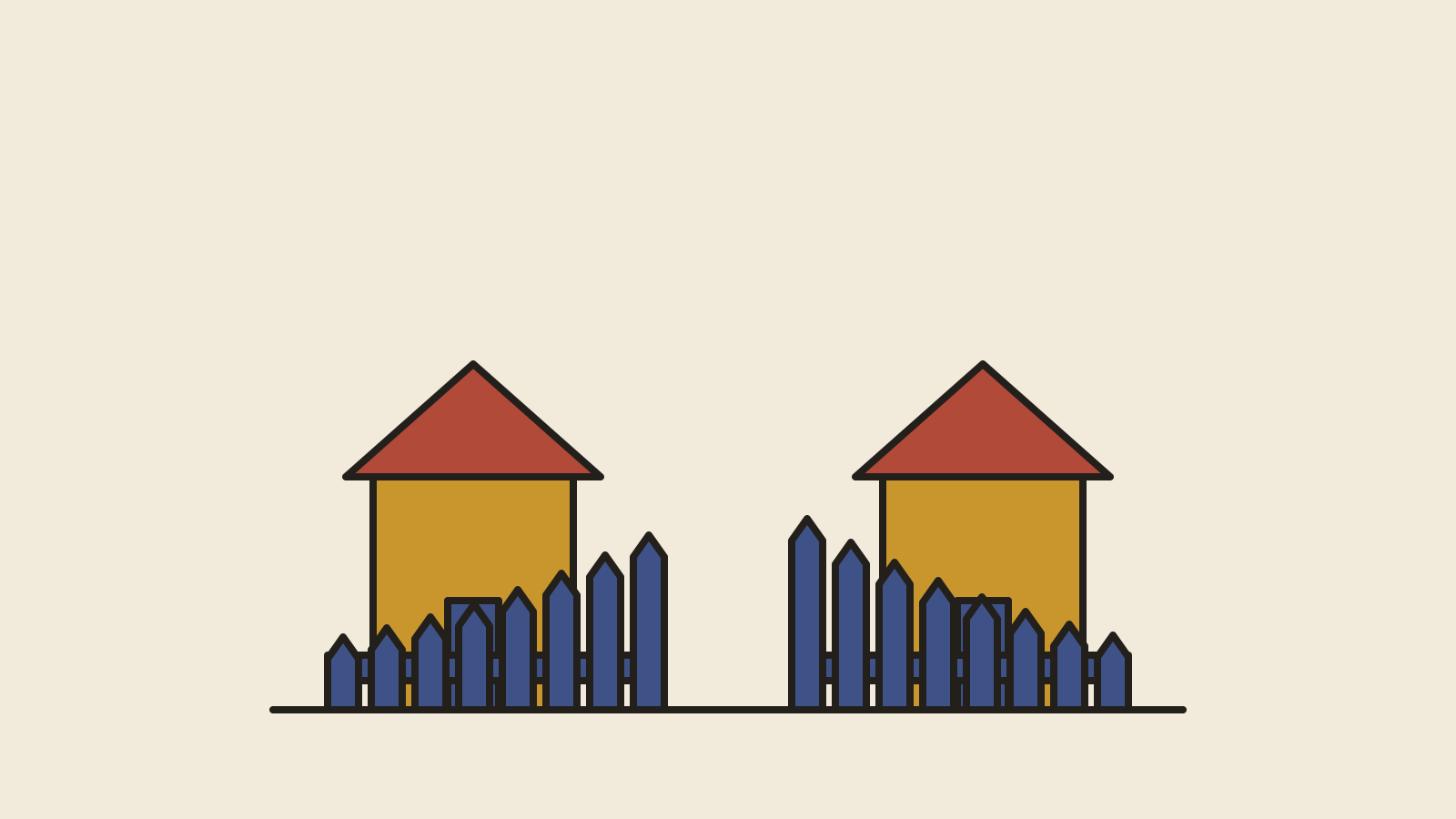
Two neighbours can fall into the same trap. One installs floodlights and a tall fence after a burglary nearby. The other wonders what he is planning and buys a large dog. Soon both households are more anxious than when they began.
It is called a dilemma because the alternative is no better. A state that declines to arm, hoping to reassure, risks being defenceless if its neighbour does turn out to be hostile.
Diagram
Each side's defensive step becomes the other side's reason to arm
Read as text
A loop of four nodes in which every link reinforces the next. State A arms for its own defence. This makes State B feel threatened, because it cannot be sure A's weapons are only defensive. State B arms in response. This makes State A feel threatened, which seems to confirm its original fear, so it arms further. The loop feeds itself, and both states end up less secure although neither wanted a conflict.
Key features
- It arises from uncertainty about intentions and requires no aggressive state at all.
- Reactions feed on each other in a spiral, since each side sees its own moves as defensive and the other's as hostile.
- Robert Jervis argued that it is milder when defence is cheaper than attack and when defensive weapons can be told apart from offensive ones.
- Leaders rarely grasp that others fear them, because they know their own intentions are peaceful.
- The remedies it suggests are reassurance, transparency and arms control.
Not to be confused with
| Look-alike | The difference | Differs on |
|---|---|---|
| Prisoner's dilemma | In the prisoner's dilemma each player does better by defecting whatever the other does, so trust cannot help in a single round. The security dilemma is driven by fear and uncertainty, and can ease if states manage to show that they mean no harm. | Differs onMechanism |
| Balance of power | Balance of power theory treats arming and allying against a strong state as the way domination is prevented. The security dilemma warns that the same moves can make everyone less safe. | Differs onClaim |
| Anarchy | Anarchy is the standing condition of having no authority above states. The security dilemma is one process that can arise within it, and anarchy does not always produce it. | Differs onScope |
| Deterrence | Deterrence theory says firmness and visible strength keep an aggressor in check. The security dilemma says they may provoke a state that was only afraid. Which applies depends on what the other side wants. | Differs onClaim |
- Differs onMechanism
In the prisoner's dilemma each player does better by defecting whatever the other does, so trust cannot help in a single round. The security dilemma is driven by fear and uncertainty, and can ease if states manage to show that they mean no harm.
- Differs onClaim
Balance of power theory treats arming and allying against a strong state as the way domination is prevented. The security dilemma warns that the same moves can make everyone less safe.
- Differs onScope
Anarchy is the standing condition of having no authority above states. The security dilemma is one process that can arise within it, and anarchy does not always produce it.
- Differs onClaim
Deterrence
Deterrence theory says firmness and visible strength keep an aggressor in check. The security dilemma says they may provoke a state that was only afraid. Which applies depends on what the other side wants.
Origins and development
John Herz named the dilemma in 1950. The historian Herbert Butterfield described the same predicament a year later, as a fear that neither side can see it inspires in the other. Robert Jervis developed it in the 1970s. He set a spiral model of conflict against a deterrence model and showed in 1978 how technology and geography make the dilemma sharper or milder, work that fed into arms control. Later writers, among them Charles Glaser, Ken Booth and Nicholas Wheeler, examined how states can escape it through signals of restraint.
Why it matters
Analysts reach for it whenever two governments each insist that their own build-up is defensive: the naval race between Britain and Germany before 1914, the Cold War, India and Pakistan, missile defence, the western Pacific today. It explains why hotlines, notified military exercises and inspections exist. It is also a useful discipline in ordinary argument, because it asks how one's own precautions look from the other side.
Critiques and limits
Randall Schweller argued in 1996 that if every state wanted only security, none would have reason to fear the others, so real conflict must come from states that want more. On that view the true problem is aggressors. John Mearsheimer accepts the dilemma but holds that nothing can soften it, since intentions can never be known. Keir Lieber disputes that offensive and defensive weapons can be told apart. The logic is well supported by historical cases. How often it, and not plain ambition, explains wars is still argued over.
Connections
Belongs to
Realism (international relations)
Realists treat it as the reason even peaceful states are drawn into competition for power.
Influenced by
Game theoryEconomics
Jervis used the stag hunt and the prisoner's dilemma to show when mutual restraint is possible and when it breaks down.
Contrasts with
Differs on claim. One says arming against a strong state prevents domination, the other that arming for defence can leave everyone less safe.
Prisoner's dilemmaEconomics
Differs on mechanism. In the game defecting always pays, while the security dilemma runs on fear and can ease when intentions become clear.
Anarchy (international relations)
Differs on scope. Anarchy is the standing condition of having no authority above states, and the security dilemma is one process that arises in it.
Parallels
Self-fulfilling prophecySociology
A state that treats its neighbour as a threat provokes the hostile response that proves the fear right.
Cross with
Two distant entries to read beside this one, each with the question the pairing opens.
Attribution theoryPsychology
States explain their own arming by circumstance. Do they explain a rival's arming by its character, as attribution research finds people do? Set them side by side
Market for lemonsEconomics
Buyers who cannot tell good cars from bad distrust every seller. What signal could a peaceful state send that an aggressor could not copy? Set them side by side
Further reading
- Booth, K., & Wheeler, N. J. (2008). The security dilemma: Fear, cooperation and trust in world politics. Palgrave Macmillan. https://doi.org/10.5040/9781350394193
- Herz, J. H. (1950). Idealist internationalism and the security dilemma. World Politics, 2(2), 157–180. https://doi.org/10.2307/2009187
- Jervis, R. (1978). Cooperation under the security dilemma. World Politics, 30(2), 167–214. https://doi.org/10.2307/2009958
Cite this entry
Scholia. (2026). Security dilemma. In Scholia: Notes in the margin of the human sciences. Retrieved November 28, 2026, from https://scholia.zennia.sg/ideas/security-dilemma