IdeaPhilosophyAlso in Cognitive science & linguistics
Knowledge argument
A scientist who knows every physical fact about colour seems to learn something new on first seeing red, so not every fact is physical.
The idea
You can read every description of durian without ever eating one and still be surprised by the first bite. The knowledge argument turns that small surprise into a case against physicalism, the view that everything is physical.
Physicalism
The view that everything that exists is physical, or depends entirely on the physical, minds included.
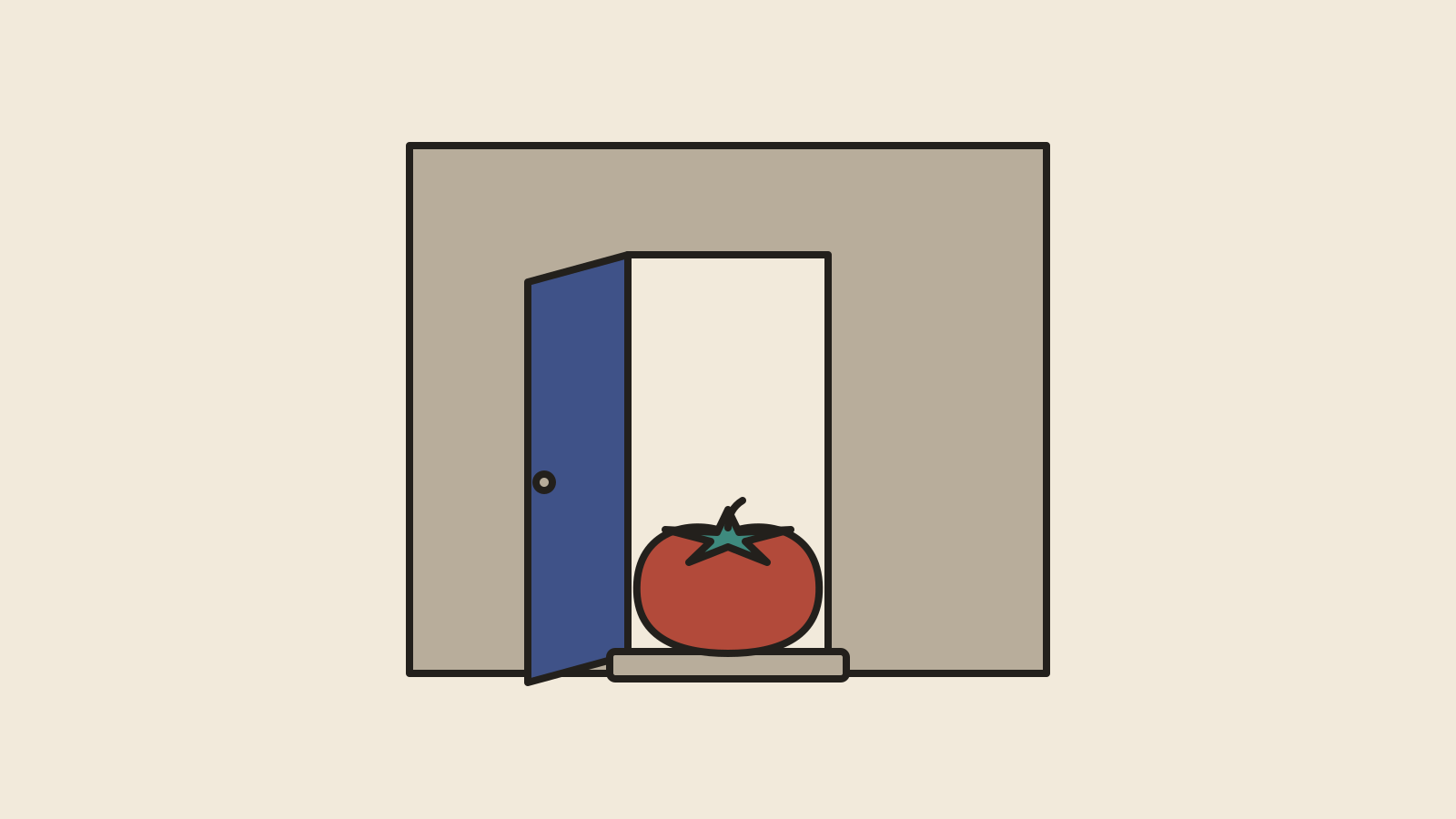
Its heroine is Mary, a brilliant scientist raised in a black-and-white room. Through books and a black-and-white screen she learns every physical fact about colour vision: the wavelengths, the cells in the eye, the brain's responses and the words people use. Then she walks out and sees a ripe tomato. Does she learn something new? Frank Jackson said she obviously does. She learns what it is like to see red. If she already had all the physical facts and still learned something, then there are facts that are not physical, and physicalism is false.
Diagram
If complete physical knowledge leaves something to learn, physicalism is false
Read as text
Four steps in a row. Mary, raised in a black-and-white room, knows every physical fact about colour vision. She leaves the room and sees red. She learns something new: what seeing red is like. So some facts are not physical, and physicalism is false. The third step is emphasised because most replies deny that what she gains is a new fact.
Key features
- Mary has complete physical knowledge of colour vision before she ever sees a colour.
- On release she seems to learn something: what seeing red is like for the one who sees it.
- If that is a new fact, then complete physical knowledge is not complete knowledge, and physicalism leaves something out.
- The argument works through what a person can know, where the zombie argument works through what can be imagined.
Not to be confused with
| Look-alike | The difference | Differs on |
|---|---|---|
| Qualia | Qualia are the felt qualities themselves, such as the redness Mary meets. The knowledge argument is one argument that facts about them escape physical description. | Differs onScope |
| Philosophical zombies | Both conclude that physicalism leaves something out. The zombie argument reasons from what can be conceived to what is possible. The knowledge argument reasons from what Mary could learn. | Differs onMethod |
| Hard problem of consciousness | The hard problem asks why brain activity is felt at all. Mary's room is a narrower case: that physical knowledge, however complete, leaves out what experience is like. | Differs onScope |
| Nagel's bat | Thomas Nagel argued in 1974 that we cannot know what a bat's sonar is like, and concluded that we lack the right concepts. Jackson went further and concluded that physicalism is false. | Differs onClaim |
- Differs onScope
Qualia are the felt qualities themselves, such as the redness Mary meets. The knowledge argument is one argument that facts about them escape physical description.
- Differs onMethod
Both conclude that physicalism leaves something out. The zombie argument reasons from what can be conceived to what is possible. The knowledge argument reasons from what Mary could learn.
- Differs onScope
The hard problem asks why brain activity is felt at all. Mary's room is a narrower case: that physical knowledge, however complete, leaves out what experience is like.
- Differs onClaim
Nagel's bat
Thomas Nagel argued in 1974 that we cannot know what a bat's sonar is like, and concluded that we lack the right concepts. Jackson went further and concluded that physicalism is false.
Origins and development
Frank Jackson, an Australian philosopher, published the argument in "Epiphenomenal qualia" (1982) and defended it in "What Mary didn't know" (1986). He concluded that qualia are epiphenomenal: real, but with no physical effects. C. D. Broad had made a similar point in 1925 with an archangel who knows all of chemistry yet cannot know the smell of ammonia. In the mid-1990s Jackson changed his mind. He became a physicalist and argued that the knowledge argument must go wrong somewhere, though it remains one of the best-known cases against physicalism.
Why it matters
The question behind it returns whenever people ask what science can capture. Can a textbook teach you what pain is like? Could a computer trained on every description of colour know what red looks like? The argument also shapes how philosophers talk about the gap between knowing about an experience and having it.
Critiques and limits
David Lewis and Laurence Nemirow replied that Mary gains new abilities, to recognise, imagine and remember red, rather than new facts. Brian Loar argued that she gains a new concept of a fact she already knew. Daniel Dennett held that a Mary who truly knew everything physical would not be surprised at all. Even its author now rejects it. Whether Mary learns a new fact remains contested.
Daniel Dennett
An American philosopher who argued that consciousness, free will and meaning can be explained by evolution and brain science with nothing left over.
Connections
Belongs to
Mary's room is one of the field's best-known arguments that physicalism cannot account for experience.
Influenced by
Nagel's bat essay argued that knowing the physical facts would not tell us what experience is like for its subject.
Critiques
If Mary knew all the physical facts and still learned something, some facts are not physical.
Contrasts with
Differs on scope. Qualia are the felt qualities Mary meets on release, and the argument claims that facts about them escape physical description.
Differs on method. Both target physicalism, the knowledge argument from what a person could learn and the zombie argument from what is conceivable.
Differs on scope. The hard problem asks why brain activity is felt at all, and Mary's room is one argument that physical knowledge leaves the feel out.
Further reading
- Jackson, F. (1982). Epiphenomenal qualia. The Philosophical Quarterly, 32(127), 127–136. https://doi.org/10.2307/2960077
- Jackson, F. (1986). What Mary didn't know. The Journal of Philosophy, 83(5), 291–295. https://doi.org/10.2307/2026143
- Nida-Rümelin, M., & O Conaill, D. (2024). Qualia: The knowledge argument. Stanford Encyclopedia of Philosophy. https://plato.stanford.edu/entries/qualia-knowledge/
Cite this entry
Scholia. (2026). Knowledge argument. In Scholia: Notes in the margin of the human sciences. Retrieved November 28, 2026, from https://scholia.zennia.sg/ideas/knowledge-argument