School or branchPhilosophyAlso in Psychology, Cognitive science & linguistics
Philosophy of mind
The branch of philosophy that asks what minds are, how they relate to bodies and brains and who or what can have one.
Overview
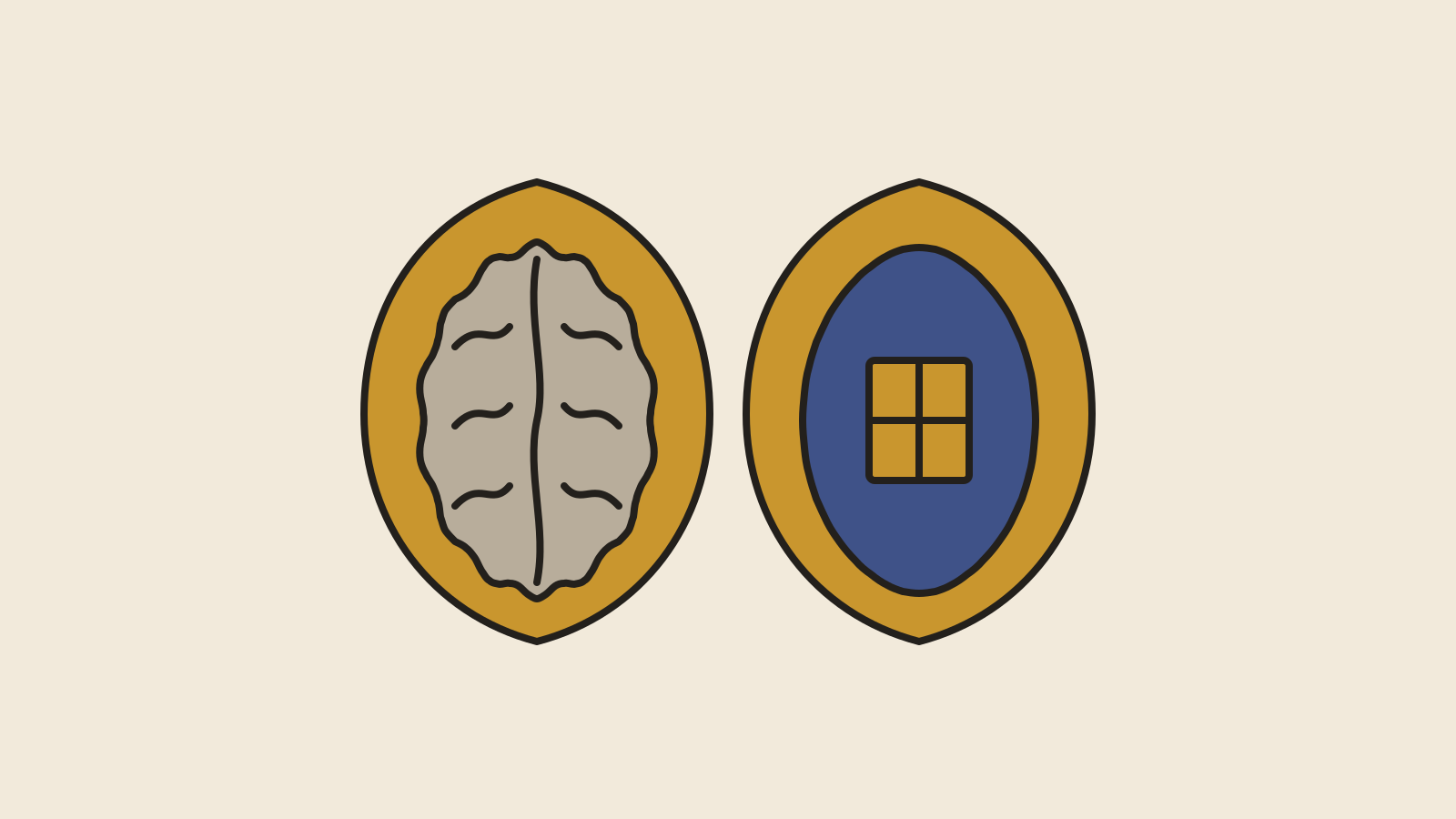
Philosophy of mind asks what a mind is and how it fits into a physical world. A brain is about 1.4 kilograms of cells passing chemical and electrical signals. A mind has thoughts about next week, a toothache and a memory of a grandmother's kitchen. The branch asks how these two descriptions can be of one thing, or whether they are.
Take a headache. A scan can show activity in parts of the brain, and a tablet changes the chemistry. Yet the ache is also something felt, known to its owner in a way no scan shows anyone else. Is the pain the brain activity, something the activity causes or a different kind of thing altogether? The same puzzle arises for beliefs, which are about things and can be true or false, as no single nerve cell obviously is. Newer questions follow from the old one: whether animals, infants or machines have minds, and how anyone could tell.
Diagram
The main positions divide over whether mind is physical, separate or a role
Read as text
A tree of positions on how mind relates to body. The first branch is dualism, which holds that the mental is not physical. It divides into substance dualism, on which the mind is a separate thing, and property dualism, on which one physical thing has non-physical properties. The second branch is physicalism, which holds that everything is physical. It divides into identity theory, on which mental states are brain states, and eliminativism, on which everyday mental categories will be replaced by brain science. The third branch is functionalism, which defines a mental state by the role it plays and leaves open what it is made of. Most functionalists are also physicalists.
Core commitments
- The mind-body problem sits at the centre: any account must say how mental states relate to states of the brain and body.
- Consciousness needs explaining, above all why brain activity comes with felt experience, the hard problem.
Hard problem of consciousness
The puzzle of why brain activity is accompanied by felt experience at all, when it seems the same activity could go on with nothing felt.
- Thoughts are about things, a feature called intentionality, and a theory of mind must say how that is possible.
Intentionality
The feature of beliefs, hopes, fears and other mental states by which they are about something, whether or not that thing exists.
- Arguments and thought experiments do much of the work, checked against what psychology and brain science find.
- The answers are meant to cover any possible mind, so animals and machines are test cases.
Not to be confused with
| Look-alike | The difference | Differs on |
|---|---|---|
| Cognitive psychology | Cognitive psychologists run experiments on memory, attention and reasoning to find how mental processes work. Philosophers of mind ask, mostly by argument, what a mental process is in the first place and what the experiments can and cannot show. | Differs onMethod |
| Computation and mind | That branch develops and tests one answer, that thinking is a kind of computation. Philosophy of mind is the wider field in which that answer competes with others, and it also covers consciousness and feeling. | Differs onScope |
| Metaphysics | Metaphysics studies what exists and what it is like in general: causes, time, objects and properties. Philosophy of mind applies those questions to one case and adds its own about knowledge and meaning. | Differs onScope |
- Differs onMethod
Cognitive psychologists run experiments on memory, attention and reasoning to find how mental processes work. Philosophers of mind ask, mostly by argument, what a mental process is in the first place and what the experiments can and cannot show.
- Differs onScope
That branch develops and tests one answer, that thinking is a kind of computation. Philosophy of mind is the wider field in which that answer competes with others, and it also covers consciousness and feeling.
- Differs onScope
Metaphysics studies what exists and what it is like in general: causes, time, objects and properties. Philosophy of mind applies those questions to one case and adds its own about knowledge and meaning.
Origins and development
The questions are ancient, and Indian and Greek thinkers argued over the soul long before the field had a name. Its modern form dates from René Descartes, who argued in 1641 that mind and body are distinct substances. Gilbert Ryle's The Concept of Mind (1949) mocked that picture as a "ghost in the machine" and opened the field as it is now taught. In the 1950s identity theorists held that mental states are brain states. Functionalism followed in the 1960s, and since the 1970s consciousness has moved to the centre.
René Descartes
A French philosopher and mathematician who doubted everything he could, then rebuilt knowledge on the one certainty that he was thinking.
Mind–body dualism
The view that mind and body are two different kinds of thing, one that thinks and one that takes up space.
Why it matters
Its questions have left the seminar room. Whether a chatbot understands what it writes, whether a patient who cannot respond is still aware and whether an octopus feels pain are all questions about minds that scans and tests alone do not settle. Law depends on the field too, since ideas of intention and responsibility assume some account of what a mind is. Readers meet it whenever a headline asks if artificial intelligence could be conscious.
Critiques and limits
Patricia Churchland argued in Neurophilosophy (1986) that the field leans too much on armchair intuition, and that everyday categories such as belief may not survive brain science. From the other side Peter Hacker, following Wittgenstein, holds that many of its puzzles come from misusing words, as when a brain is said to think or decide. Colin McGinn has suggested that the mind-body problem may lie beyond human understanding. After centuries the dispute between physicalism and its rivals is still open.
Ludwig Wittgenstein
The Austrian philosopher who wrote two opposed accounts of language, first as a picture of facts and later as a set of shared practices.
Physicalism
The view that everything that exists is physical, or depends entirely on the physical, minds included.
Key figures
- René Descartes1596–1650
- Gilbert Ryle
- Hilary Putnam
- Jerry Fodor1935–2017
- Thomas Nagel
- Daniel Dennett1942–2024
- Patricia Churchland
- David Chalmers


Connections
Influenced by
His division between a thinking mind and an extended body set the mind-body problem the branch still works on.
Behaviourism (psychology)Psychology
Mid-century philosophers shared its suspicion of hidden inner states and recast talk of mind as talk of dispositions to behave.
Husserl's tradition supplied the careful first-person descriptions of experience that later debates on consciousness draw on.
Contrasts with
Computation and mindCognitive science & linguistics
Differs on scope. Philosophy of mind asks what minds are in general, while this branch develops and tests the single answer that they compute.
Differs on scope. Metaphysics asks what exists in general, and philosophy of mind applies that question to minds and adds its own about meaning.
Cognitive psychologyPsychology
Differs on method. Cognitive psychology finds out how mental processes work by experiment, while philosophy of mind asks by argument what a mental process is.
Contains
The floating man is an early argument that self-awareness does not depend on awareness of the body.
His main work treats consciousness, belief and free will as problems that the sciences can help to solve.
Jerry FodorCognitive science & linguistics
His defence of beliefs and desires as real inner causes set the terms of the field's debate about mental content.
His remarks on sensation, rule-following and inner states reset debates about how mental words get their meaning.
A standard argument in the field's debate over whether running the right program is enough for having a mind.
Computational theory of mindCognitive science & linguistics
The computational theory is one of philosophy of mind's main answers to how a physical brain can reason about meaningful contents.
Functionalism (philosophy of mind)
Since the 1970s functionalism has been the most widely held account of what mental states are.
Since the 1990s it has been the central dispute about consciousness in the philosophy of mind.
Dualism set the mind–body problem that the philosophy of mind has worked on ever since.
A standing answer to the field's question of what, if anything, the word "I" refers to.
The mind is its hardest test, so most arguments for and against it are made in the philosophy of mind.
It bears on how words for pains and other sensations connect with the experiences they are about.
Any theory of what minds are also has to say how a mind other than your own can be known.
Explaining how a state of a brain can be about anything is one of the branch's standing problems.
Mental representationCognitive science & linguistics
Philosophers ask what makes an inner state stand for one thing and not another, the problem of content.
Qualia are the philosophy of mind's standard word for the felt side of experience in arguments about consciousness.
Applications
AutopoiesisCognitive science & linguistics
Philosophers use it to argue that mind is continuous with life, so that only self-producing systems can have one.
Belief reports, where swapping two names for one thing can change truth, test every theory of mental content.
Turing testCognitive science & linguistics
Philosophers use it as the test case for whether behaviour could ever be sufficient evidence of a mind.
MetacognitionPsychology
Philosophers use it in debates over self-knowledge and over whether consciousness requires thoughts about one's own mental states.
Cross with
Two distant entries to read beside this one, each with the question the pairing opens.
AnimismAnthropology
Animists hold that animals, plants and places can be persons: what criteria for having a mind would include or exclude a river? Set them side by side
Collective consciousnessSociology
Durkheim gave shared beliefs a life of their own beyond individuals: can a group have a mind by the standards philosophers apply to brains? Set them side by side
Further reading
- Kim, J. (2011). Philosophy of mind (3rd ed.). Westview Press.
- Nagel, T. (1974). What is it like to be a bat?. The Philosophical Review, 83(4), 435–450. https://doi.org/10.2307/2183914
- Ryle, G. (1949). The concept of mind. Hutchinson.
Cite this entry
Scholia. (2026). Philosophy of mind. In Scholia: Notes in the margin of the human sciences. Retrieved November 28, 2026, from https://scholia.zennia.sg/schools/philosophy-of-mind