IdeaPsychology
Learned helplessness
After repeated bad events they cannot control, animals and people may stop trying, even when escape later becomes possible.
The idea
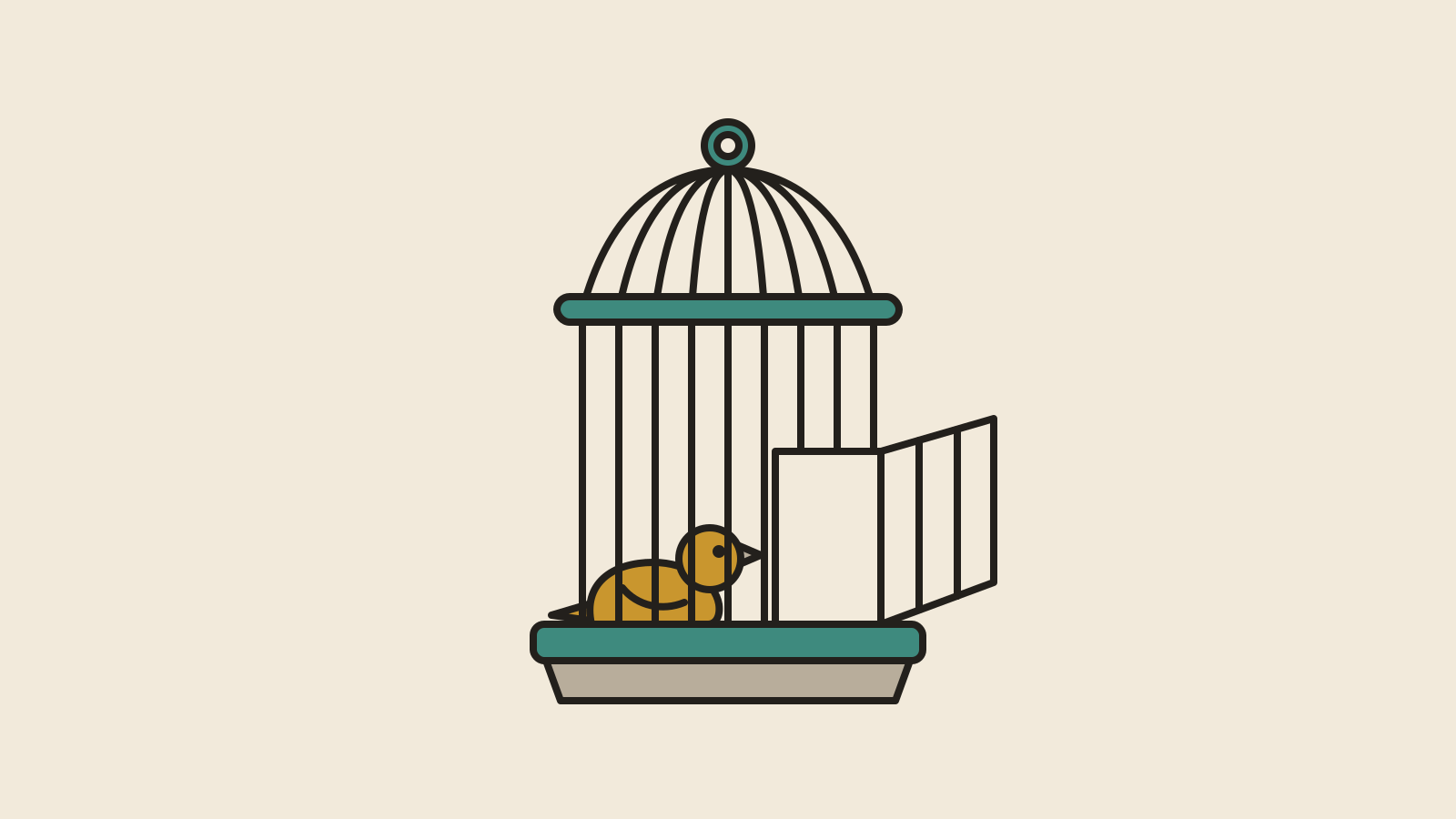
Learned helplessness is the claim that living through bad events you cannot control can teach you that nothing you do matters, and that this lesson carries over to situations where action would work. The result is passivity, slower learning and low mood.
Picture a pupil who fails one maths test after another despite revising. By the fourth test she has stopped revising. When a new teacher sets problems well within her reach, she leaves them blank. Her earlier failures taught her something about maths and about herself: effort and results are unconnected.
The theory's central term is control. What does the damage is the missing link between what you do and what happens to you, however unpleasant the events are in themselves. Two people can suffer the same setbacks, and only the one who could do nothing about them is expected to give up.
Diagram
Uncontrollable events teach an expectation that outlasts them
Read as text
A flow of four steps. Bad events that cannot be controlled lead to an expectation that acting will fail. That expectation leads to passivity and low mood. Because the individual no longer tries, chances to discover control are missed, which feeds back into the expectation that acting fails.
Key features
- The cause is uncontrollability: outcomes arrive whatever the individual does.
- The effect transfers, so helplessness learned in one setting appears in a different one.
- Three deficits follow: less effort to act, difficulty learning that actions now work and a flattened or anxious mood.
- In people the explanation given for a bad event matters, and blaming a cause that is personal, lasting and wide-ranging predicts deeper helplessness.
- Earlier experience of control protects, an effect researchers call immunisation.
Not to be confused with
| Look-alike | The difference | Differs on |
|---|---|---|
| Ego depletion | A helpless person stops trying because experience has taught them that effort changes nothing. A depleted person is said to stop because a resource of self-control has run out, whatever they believe. | Differs onMechanism |
| Locus of control | Julian Rotter's term names a standing belief, carried from one situation to the next, about whether outcomes come from oneself or from outside forces. Learned helplessness is the passivity that follows particular uncontrollable events, and it can lift. | Differs onUnit of analysis |
| Cognitive model of depression | Aaron Beck traced depression to negative beliefs about the self, the world and the future. The helplessness account traces it to one expectation: that outcomes can't be controlled. | Differs onClaim |
| Self-efficacy | Self-efficacy is the belief that you can carry out an action. Helplessness is the belief that outcomes ignore your actions, however well you perform them. | Differs onClaim |
- Differs onMechanism
A helpless person stops trying because experience has taught them that effort changes nothing. A depleted person is said to stop because a resource of self-control has run out, whatever they believe.
- Differs onUnit of analysis
Julian Rotter's term names a standing belief, carried from one situation to the next, about whether outcomes come from oneself or from outside forces. Learned helplessness is the passivity that follows particular uncontrollable events, and it can lift.
- Differs onClaim
Aaron Beck traced depression to negative beliefs about the self, the world and the future. The helplessness account traces it to one expectation: that outcomes can't be controlled.
- Differs onClaim
Self-efficacy is the belief that you can carry out an action. Helplessness is the belief that outcomes ignore your actions, however well you perform them.
Origins and development
In 1967 at the University of Pennsylvania, Martin Seligman and Steven Maier, following a first study by Seligman and Bruce Overmier, gave dogs electric shocks that some could switch off and others could not. Later, in a box where jumping a low barrier ended the shock, most dogs from the second group lay down and endured it. Donald Hiroto found a similar effect in 1974 in students exposed to noise they could not stop. In 1978 Lyn Abramson, Seligman and John Teasdale added the role of explanations to account for human depression.
Why it matters
The idea shaped how clinicians think about depression, and Seligman's later work on optimism grew from asking why some of his animals never became helpless. It is invoked, sometimes loosely, to explain why long unemployment saps the search for work and why pupils who expect to fail stop attempting tasks. Animal versions of the procedure are still used to screen antidepressant drugs.
Critiques and limits
Charles Costello argued in 1978 that the human laboratory studies resembled depression only loosely. Jay Weiss proposed that the animals' passivity came from chemical depletion in the brain under stress and involved no learning. The sharpest correction came from the authors themselves. Maier and Seligman concluded in 2016 that passivity is the brain's default response to prolonged stress, and that what animals learn is control. The behavioural effect is well supported. Its mechanism, and how far it explains human depression, remain open.
In education and policy
Carol Dweck took the idea into classrooms in the 1970s. She found that children who gave up after failure tended to blame a fixed lack of ability, and that teaching them to put failure down to effort improved persistence more than a run of easy successes did. That work led towards her later theory of growth mindset. For teachers the practical point is that pupils need tasks where effort visibly changes the result.
Growth mindset
The belief that ability can be developed, which Carol Dweck's theory says leads people to persist and learn more after setbacks.
Connections
Belongs to
Behavioural psychology (learning and behaviour analysis)
It came out of animal learning experiments on escape and avoidance.
Clinicians took it up as a laboratory model of depression and of the passivity seen after trauma.
Critiques
The dogs seemed to have learned an expectation, something the stimulus-response theories of the time had no place for.
Contrasts with
Differs on claim. The helplessness account traces depression to an expectation of no control, Beck to negative beliefs about self, world and future.
Differs on mechanism. Helpless people stop trying because they believe effort is useless, while depleted people are said to stop because a resource is spent.
Differs on unit of analysis. Locus of control is a standing belief a person carries between situations, while helplessness is passivity produced by particular uncontrollable events.
Differs on claim. Self-efficacy concerns whether you can perform an action, helplessness whether any action would change the outcome.
Applied in
Seligman's work on optimism began with the animals and people who did not become helpless.
Brain studies traced the passivity to the dorsal raphe nucleus and the detection of control to the prefrontal cortex.
Extended by
Seligman's work on optimism began with the animals and people in his experiments who never became helpless.
Influenced
Her first studies asked why some children become helpless after failure while equally able classmates keep trying.
Cross with
Two distant entries to read beside this one, each with the question the pairing opens.
SatyagrahaPolitical theory & science
Satyagraha asks people long subject to injustice to act: what in Gandhi's method overcomes the passivity that uncontrollable harm produces? Set them side by side
Class consciousnessSociology
Does an exploited class fail to act because it lacks awareness of shared interests, or because it has learned that acting changes nothing? Set them side by side
Further reading
- Abramson, L. Y., Seligman, M. E. P., & Teasdale, J. D. (1978). Learned helplessness in humans: Critique and reformulation. Journal of Abnormal Psychology, 87(1), 49–74. https://doi.org/10.1037/0021-843X.87.1.49
- Maier, S. F., & Seligman, M. E. P. (2016). Learned helplessness at fifty: Insights from neuroscience. Psychological Review, 123(4), 349–367. https://doi.org/10.1037/rev0000033
- Seligman, M. E. P., & Maier, S. F. (1967). Failure to escape traumatic shock. Journal of Experimental Psychology, 74(1), 1–9. https://doi.org/10.1037/h0024514
Cite this entry
Scholia. (2026). Learned helplessness. In Scholia: Notes in the margin of the human sciences. Retrieved November 28, 2026, from https://scholia.zennia.sg/ideas/learned-helplessness