School or branchPsychologyAlso in Cognitive science & linguistics
Biological psychology
The branch of psychology that explains behaviour and experience through the brain, nervous system, hormones and genes.
Overview
Biological psychology studies how the body produces behaviour and experience. Its questions are about mechanism. Which brain structures, nerve cells, chemical messengers, hormones and genes are at work when someone sees, sleeps, learns, fears or falls ill? It also goes by the names biopsychology, physiological psychology and behavioural neuroscience.
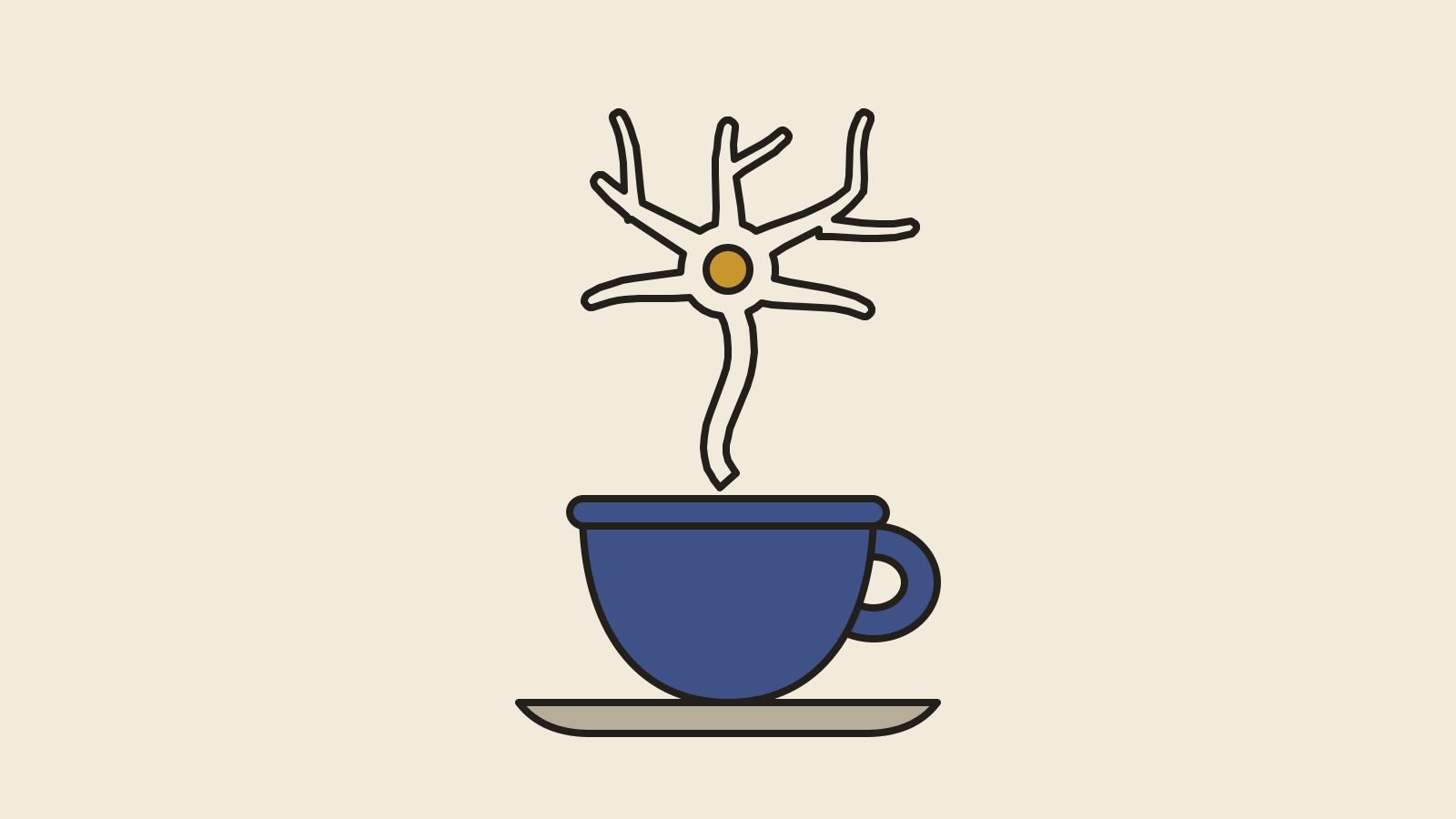
A cup of coffee is a small case study. Through the day a chemical called adenosine builds up in the brain and attaches to receptors on nerve cells, which makes you drowsy. Caffeine is shaped closely enough to adenosine to occupy the same receptors without activating them. The drowsiness signal is blocked, and you feel alert until the caffeine clears. A biological psychologist explains the change in mood and attention by that chain of events.
The branch is defined by this kind of explanation. Any topic in psychology can be approached in this way, including memory, emotion, personality and mental disorder.
Diagram
Biological psychology explains behaviour at several levels, each inside the next
Read as text
Six nested circles. At the centre are genes and molecules. Around them are nerve cells and synapses, then circuits of cells, then brain regions, then the whole body with its hormones, and outermost the behaving person. Each level sits inside the next, and biological psychology explains behaviour by tracing mechanisms across them.
Core commitments
- Every mental process is carried out by the body, chiefly the brain, so psychology and biology describe one system.
- Behaviour is explained by tracing mechanisms at several levels, among them genes, cells, circuits and whole brain regions.
- The strongest evidence comes from intervening: lesions, stimulation and drugs show what a structure or chemical does, where a scan shows only what accompanies what.
- Humans share most brain mechanisms with other animals, so animal research can inform human psychology.
- The brain is shaped by experience as well as by genes, and it changes throughout life.
Not to be confused with
| Look-alike | The difference | Differs on |
|---|---|---|
| Neuroscience | Neuroscience studies the nervous system for its own sake, down to the chemistry of a single cell. Biological psychology uses that knowledge to explain behaviour and experience. | Differs onScope |
| Cognitive neuroscience | Cognitive neuroscience links mental processes such as attention and memory to brain activity, mostly in humans and mostly with imaging. Biological psychology is wider: it also covers hormones, drugs, sleep, hunger and animal experiments. | Differs onScope |
| Evolutionary psychology | Biological psychology asks how a mechanism works in a living body now. Evolutionary psychology asks why natural selection would have built it. | Differs onLevel |
| Cognitive psychology | Cognitive psychology describes mental processes as the handling of information and can do so without mentioning the brain. Biological psychology describes the tissue that does the handling. | Differs onLevel |
- Differs onScope
Neuroscience
Neuroscience studies the nervous system for its own sake, down to the chemistry of a single cell. Biological psychology uses that knowledge to explain behaviour and experience.
- Differs onScope
Cognitive neuroscience
Cognitive neuroscience links mental processes such as attention and memory to brain activity, mostly in humans and mostly with imaging. Biological psychology is wider: it also covers hormones, drugs, sleep, hunger and animal experiments.
- Differs onLevel
Biological psychology asks how a mechanism works in a living body now. Evolutionary psychology asks why natural selection would have built it.
- Differs onLevel
Cognitive psychology describes mental processes as the handling of information and can do so without mentioning the brain. Biological psychology describes the tissue that does the handling.
Origins and development
Wilhelm Wundt's Principles of Physiological Psychology (1874) gave the field an early name, though he meant chiefly the use of physiology's laboratory methods. Paul Broca had already tied speech to a region of the left frontal lobe in 1861. In the twentieth century Karl Lashley searched the rat brain for the trace of a memory, and Donald Hebb proposed in 1949 that learning strengthens the connections between cells that are active together. Drugs for mental disorders arrived in the 1950s, and scanners that show the working brain spread through the 1980s and 1990s.
Wilhelm Wundt
The German physiologist and philosopher who founded the first psychology research laboratory in 1879 and trained the first generation of experimental psychologists.
Why it matters
Its findings stand behind drug treatments for depression, anxiety and schizophrenia, advice on sleep and shift work, rehabilitation after stroke and the understanding of addiction as a change in the brain's reward circuits. Headlines announcing that a brain area lights up during love or gambling are reports, usually simplified, from this branch.
Critiques and limits
The psychologist William Uttal called the hunt for a brain area behind each mental function a new phrenology. Complex functions, he argued, are not located in single places. Katherine Button and colleagues showed in 2013 that the typical neuroscience study was too small to detect its effect reliably, which helps explain results that fail to repeat. The neurobiologist Steven Rose objects that explaining a person's distress by brain chemistry alone ignores the life they are living. George Engel proposed the biopsychosocial model as a corrective.
Phrenology
A refuted nineteenth-century doctrine that character can be read from the bumps of the skull, because each mental faculty has its own brain organ.
Biopsychosocial model
Engel's proposal that health and illness always depend on three things together: the body, the person's mind and their social circumstances.
Key figures
- Paul Broca
- Karl Lashley
- Donald Hebb
- Wilder Penfield
- Brenda Milner
- Roger Sperry
- Eric Kandel
Connections
Influenced by
His 1874 Principles of Physiological Psychology gave the field an early name, though he meant chiefly physiology's laboratory methods.
Findings that damage to particular brain areas impairs particular abilities gave the branch its first map of the brain.
His work on conditioned reflexes showed that learning could be measured as a change in a bodily response.
Critiques
Mind–body dualismPhilosophy
It treats mental life as the activity of the brain and body, leaving no separate mental substance any work to do.
Contrasts with
Differs on level. Biological psychology explains how a mechanism works in the body now, evolutionary psychology why natural selection built it.
Differs on level. Cognitive psychology describes mental processes as information handling, and biological psychology describes the tissue that does the handling.
Differs on level. Biological psychology explains hunger or fear through hormones and brain circuits, while this branch also works with goals and experience.
Contains
David MarrCognitive science & linguistics
His first papers modelled the cerebellum and hippocampus as learning machines, and they still guide experiments on brain circuits.
He was a physiologist who treated learning as a function of the cerebral cortex.
Critical period hypothesisCognitive science & linguistics
It ties a behavioural ability to a timetable of brain maturation, as critical periods in animal vision and birdsong do.
Its tests have been physiological, from Cannon's surgery on cats to modern studies of how the brain senses the body.
Mapping which brain regions serve which functions is one of the branch's founding projects.
It is the branch's account of how learning, practice and injury leave physical traces in the nervous system.
A discarded forerunner whose premise that the brain is the organ of mind became the branch's starting point.
Behaviour genetics, which produces the estimates from twin, adoption and DNA studies, sits within biological psychology.
Influenced
ConnectionismCognitive science & linguistics
Its units and adjustable links are simplified from nerve cells and synapses, following Donald Hebb's idea that use strengthens a connection.
Applications
Conditioned fear and eyeblink responses are standard tools for tracing how the brain stores a memory.
Hard problem of consciousnessPhilosophy
Neuroscientists who search for the neural correlates of consciousness frame their theories as answers to it or ways round it.
Brain studies traced the passivity to the dorsal raphe nucleus and the detection of control to the prefrontal cortex.
Marr's levels of analysisCognitive science & linguistics
Neuroscientists use the levels to ask what a brain region computes before asking how its cells do it.
PhysicalismPhilosophy
Biological psychology works on the assumption that every mental process is carried out by the brain and body.
ReductionismPhilosophy
Explaining memory or mood by neurons and neurotransmitters is reduction in practice, and its reach is debated within psychology.
Spaced training produces longer-lasting changes at synapses than massed training in sea slugs, flies and mice.
Free willPhilosophy
Libet's 1983 experiments on brain activity before conscious decisions brought the question into the laboratory.
Dopamine neurons signal when an outcome is better than expected, a brain basis for reinforcement.
Cross with
Two distant entries to read beside this one, each with the question the pairing opens.
HabitusSociology
If upbringing leaves lasting habits of posture, taste and expectation, where in the brain and body would habitus be found? Set them side by side
No-self (anatta)Philosophy
Does brain science find anything that stays the same through a life, or does it support the Buddhist stream of changing events? Set them side by side
Further reading
- Button, K. S., Ioannidis, J. P. A., Mokrysz, C., Nosek, B. A., Flint, J., Robinson, E. S. J., & Munafò, M. R. (2013). Power failure: Why small sample size undermines the reliability of neuroscience. Nature Reviews Neuroscience, 14(5), 365–376. https://doi.org/10.1038/nrn3475
- Hebb, D. O. (1949). The organization of behavior: A neuropsychological theory. Wiley.
- Kandel, E. R. (2006). In search of memory: The emergence of a new science of mind. W. W. Norton.
Cite this entry
Scholia. (2026). Biological psychology. In Scholia: Notes in the margin of the human sciences. Retrieved November 28, 2026, from https://scholia.zennia.sg/schools/biological-psychology